
More hot videos from NAMM featuring the OP-1, Minitaur, MiniBrute and Livid controllers
Teenage Engineering @ NAMM 2012 – OP-1 OS update
Cyril from MOOG shows off their new MINITAUR @ NAMM 2012
Arturia @ NAMM 2012 – MINIBRUTE
Livid @ NAMM 2012 – What’s New
Uploaded by DontEatWhatTheyFeed
Akai @ NAMM 2012 – MAX 49
No clue why this video is upside down, but at least you get some good views of AKA’s MAX 49
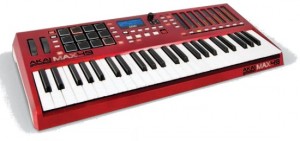
The new Akai MAX 49 Keyboard Controller may look like a typical controller keyboard (albeit well equipped), but it has a number of features that set it apart as one of the most versatile controllers available. Aside from the familiar trigger pads featured on the MPK range of controllers, and the same semi-weighted keyboard, the MAX 49 has features which make it capable of controlling just about synthesiser, past or present.
The Akai MAX 49 is similar in appearance to the MPK range of keyboards, though this model is finished in red. To the left of the unit, 12 velocity sensitive, and backlit trigger pads provide an intuitive way of programming percussion parts, or triggering live samples. These features the swing and note repeat feature made famous on the MPC range of samplers. To the right, 8 touch faders add additional control over the synthesiser or software package currently being used. In terms of controlling synthesisers, the Akai MAX 49 is better equipped than any other controller available. Aside from the more familiar connections, such as a USB socket for connection to a host computer, an a MIDI socket for connecting to other keyboards, sound modules or MIDI equipment, the MAX 49 has a CV & Gate Output, making it capable of controlling vintage (or modern) analogue synthesisers. With the recent increase in popularity of genuine analogue synthesisers, this feature may make it the first choice of controller for those looking to ‘go analogue’ in a live setting.
The Akai MAX 49 ‘s CV connectivity goes hand-in-hand with another of its features: an on-board step sequencer. This allows patterns to be created on the unit itself and sent to whichever synthesiser is being controlled. An arpeggiator also features. For those who are more rooted in the modern studio, the MAX 49 comes complete with a software package called AkaiConnect. This neat utility automatically maps the keyboards controls to VST plug-ins. To further increase compatibility with software packages, the device can operate in Mackie Control and HUI modes.
The Akai MAX 49 is a great controller in its own right, but the addition the step sequencer, arpeggiator and CV and gate outputs provide a means of adding additional features to an analogue synthesiser, as well as providing a central device for controlling both modern and vintage synthesisers. Is this the beginning of an analogue renaissance?
New 3 oscillator synth from StudioLogic – Sledge
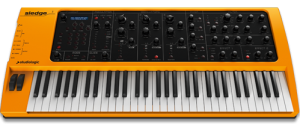
Studiologic, mainly known for their controller keyboards previously, have released their first synthesizer, the Sledge. The Sledge is a 3 oscillator virtual analog synth that includes not only the standard analog waveforms, but a full set of wavetables from the PPG Wave. Also includes a Waldorf-modelled multimode filter, selectable white and pink noise, hard sync, an arpeggiator, fast envelopes, and a basic selection of effects. For many synthesizer enthusiasts, it is the particular interaction of the sound engine and user interface that makes a great instrument. A quick look at Sledge shows you the generous set of controls available to interact directly with the sound engine. When you touch the knobs and switches of the front panel, you will instantly be aware of the meticulous attention to detail our engineers have refined, during many decades building the best electronic keyboards.
You will experience the logical set-up of the synthesizer modules, mirroring the signal flow of a classic analogue synthesizer. But what really distinguishes any synthesizer is its sound. Fortunately, our friends at Waldorf Music have happily shared their experience and know-how on this crucial part of the Sledge Synthesizer.
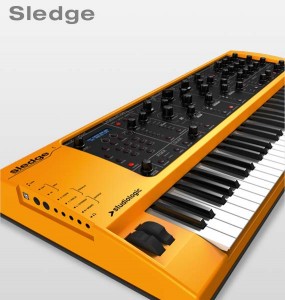
Specifications:
• 32 Pots
• 3 chicken head rotary switches (7 positions)
• 1 rotary encoder with push function
• 2 x 16 digits backlit LCD
• High Quality Pitch and Mod Wheel
• up to 256 Sounds
• fast and efficient sound selection via numeric keypad
• 2 fast LFOs per voice, each with adjustable Speed and Depth
• 1 extra modulation routing for Mod Wheel, with adjustable Speed and Depth
– Shape: Sawtooth, Rectangular, Triangle, Sine, Sample & Hold, Ramp
– Destination: Osc 1, Osc2, Ocs3, PWM / Wave / FM, Volume, Filter Cutoff
• Monophonic mode with single or multiple trigger
• 3 Oscillators per voice
– Range from 64′ to 1′ each
– Shapes: Sawtooth, Square, Triangle, Sine, Pulse (with Pulse Width Modulation)
– Oscillator 1 with 66 Original PPG Wavetables
• Frequency Modulation of sine and triangle
• Oscillator Hardsync (Osc 2 to Osc 3)
• Noise Generator with selectable white and pink noise
• Mixer with Volume and On/Off switch for each Oscillator and Noise
• 1 Multi Mode Filter per voice
– 24 / 12dB
– Lowpass
– Highpass
– Bandpass
– Resonance up to Self-Oscillation and beyond
– Adjustable Keytrack and Drive
• 2 fast Envelopes per voice (filter / amplifier)
• Powerful Arpeggiator
– Latch mode
– syncable to MIDI Clock
– Direction Up, Down, Alternate
– Range up to 10 Octaves
• 2 simultaneuous Effects
– Effect 1: Chorus / Phaser / Flanger
– Effect 2: Reverb / Delay
• sturdy, lightweight enclosure (less than 10 KG)
• high quality, 5 octaves Fatar TP 9 keyboard
• Master Volume Control • Power Switch
• Stereo line output
• Headphone output
• Expression pedal input
• MIDI in and out
• USB connector for MIDI in / out
– uses standard USB MIDI driver provided by host computer OS
– Windows ME minimum, Windows XP or newer recommended
– Mac OS X 10.2 minimum, Mac OS X 10.3 or newer recommended
• Built in power supply
10 Years and still rocking – Happy Birthday microKORG
In 2002, Korg launched the microKORG, Korg’s compact analog modeling synthesizer with an outrageous Vocoder built right in! After a decade as one of the best-selling synths on the planet, the microKORG is still going strong. Chances are you’ve seen it on stage or heard it on a favorite song. But it is not just Korg that is excited about this great milestone. Join some of our special Korg friends as they wish the microKORG a Happy Birthday!
KORG kaossilator 2 / mini kaoss pad 2 videos
Now say hello to the impressive kaossilator 2. Boasting a powered-up sound generator, kaossilator 2 delivers synth and drum sounds spanning a wide range of genres, plus dramatically expanded loop recording. kaossialtor 2 is packed with capabilities that can be enjoyed alone on or together with other people. Use two loops to create DJ-like mixes. Use the internal mic to record guitar, vocal, or other audio source — just as with a looper effect. The Organic Electroluminescent (OEL) display provides superb visibility. Add to that a touch slider for ease of use, microSD card data saving, plus a built-in speaker and mic. All of these features reflect the enhancements incorporated into the sleek and exciting kaossialtor 2.
Now, welcome the mini kaoss pad 2! In addition to inheriting powerful effect programs from the KAOSS PAD KP3 and the KAOSS PAD QUAD, it provides an MP3 player with adjustable pitch, making the mini kaoss pad 2 unit ideal for creating DJ-Style performances. Use it as a DJ playback device, or use it to process the entire output of your DJ rig with Korg’s famous KAOSS effects. Instrumentalists, guitarists, sound designers and even just music fans will enjoy using the mini kaoss pad 2. The Organic Electroluminescent (OEL) display provides superb visibility. Add to that a touch slider for ease of use, microSD card data saving, plus a built-in speaker and mic. All of these features reflect the enhancements incorporated into the sleek and exciting mini kaoss pad 2.
Teenage Engineering OpLab Preview
The Oplab Musical Experimental Board allows you to interconnect virtually any electronic musical instruments. And finally it’s just plug and play. No more hassle with one box for MIDI and another for CV or a third for USB. Oplab has it all in one place. Just connect your cables, set the appropriate scenario and experience a perfect sync. You could use a mouse to bend pitch, or use an old hard drive as a scratch pad. You can even turn your own body into a musical instrument (great if you are in the business of interpretive dance or you’re a stripogram) by wearing the TS-1 sneaker. A sensor attached to the show will trigger when you stomp your foot to the ground, and could trigger a kick drum or any other sample.
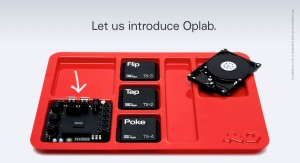
For all of these nifty little ideas, check out the OpLab page on Teenage Engineering’s website.
Smithson Martin Kontrol Surface KS-1974
Virtual DJ control in an analog synth’s body. In November Smithson Martin accounced the Kontrol Surface, it’s the same kind of deal as their Emulator, but in an analog synth style packaging. Essentially if you’re a DJ and you want to look like a complete renegade maverick mofo, then you should purchase this and pretend that you can play synth.
The design of the interface is flexible, meaning you can have custom interfaces for software such as Traktor, or Ableton.
Alan Smithson takes you through the product in the video above.
Via Sonic State
Official video: Casio XW-P1 Performance Synthesizer
“Introduction to the new XW-P1 Performance Synthesizer from Casio by Mike Martin.” Casio has unveiled two new professional Synthesizers: the XW-P1, a 61 key performance synthesizer equipped with Casio’s exclusive Hybrid Processing Sound Source (HPSS) that meets the needs of the most experienced performing musician, and the XW-G1 groove synthesizer, designed for the DJ and club performer, provides an interactive step sequencer and a sample looper for digitally capturing performance patterns and external instruments. Designed with today’s professional musician in mind, both the XW-P1 and XW-G1 synthesizers are the ideal tools for performing and recording artists alike. With the launch of two new products Casio has re-entered the professional synthesizer market, ultimately demonstrating its commitment to innovation in the marketplace.
XW-P1:
6 Oscillator Monophonic Solo Synthesizer
HexLayer – A single sound made up of 6 components for gig ready splits and layers
Drawbar Organ Mode with 9 sliders, adjustable rotary speaker, key click, vibrato and percussion
400 fully editable PCM based sounds like stereo pianos, vintage electric pianos, strings, guitars, drums and more
Performance mode providing 4 internal or external instrument zones with instant recall of effects, 13 Track Step Sequencer and 16 step programmable Arpeggiators and Phrases
4 real-time controller knobs
Pitch and Modulation Wheels
USB and MIDI ports and a 1/8” stereo line input to connect to an MP3 Player, laptop or tablet
The XW-P1 will be available March 2012 with an MSRP of $699.00
Quotes
Mike Martin, General Manager, Marketing, Electronic Musical Instruments Division
“The XW series are not just new keyboards, they represent a new direction for Casio in the musical instrument business.”
“Casio’s formula of value and quality that has been the foundation of award winning instruments like Privia has been applied to a new product category, and the XW-P1 and XW-G1 are just the beginning.”
“The solo synth has an incredibly deep and powerful design. Among countless others, the oscillators even have access to waveforms from Casio’s original CZ synthesizers. It can create a variety of classic analog sounds, but also has the power to deliver sounds with an aggressive edge.”
‘Everyone is going to be surprised by the expressiveness and range of sounds the solo synth can create, but that is just one aspect of these products.'”
Live from NAMM: Moog Minitaur Analog Bass Synth demo
Moog launch new Minitaur Analog Bass Synth at NAMM 2012.
Minitaur is a powerful, compact Analog Bass Synthesizer that features a classic one knob per function design. It is the first instrument in the Taurus family that does not have foot pedals. At only 8.5″ x 5.25″ and less than 3lbs, the Minitaur puts legendary analog Moog bass into a package designed to fit seamlessly into today’s performance and production environments. There are no confusing or convoluted menus to dig through. Plug in a MIDI controller or hook it up to your computer and start playing immediately.
NAMM: Modulation Orgy LFO From Synthetic Sound Labs
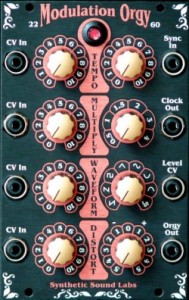
Synthetic Sound Labs has just released its first Euro rack format module, the Model 2260 Modulation Orgy, further expanding its line of 5U format synthesizer modules. This new 16 HP width module contains a unique Low Frequency Oscillator (LFO) that offers unmatched modulation flexibility.
Synthetic Sound Labs has been in the analog synthesizer business since 1973, but the 2260 is the first Euro rack module and the sixth in SSL’s continuing line of new analog synthesizer modules.
LFOs are typically used by analog music synthesists in conjunction with other analog sound producing devices for creating slow, undulating rhythms and sound patterns. The SSL 2260 Modulation Orgy features both manual and external voltage control over LFO Tempo (speed), tempo Multiplier, Waveform and Waveform Distortion. A total of eight Waveforms are produced, including Sawtooth, Ramp, Rectangle, Triangle, Sine, Sweep, Lumps and Random. All these (except Random) may be modified using the Wave Distort controls to vary waveform duty cycles. Independent output jacks provide both normal and inverted LFO phases.
2260 ‘Modulation Orgy’ Specifications at a glance:
- Model 2260 Tap Tempo LFO
- Function: Flexible Low Frequency Oscillator (LFO)
- Tempo Adjust: .05 Hz to >50 Hz (approx)
- Tempo Multipliers: Six (0.5, 1, 1.5, 2, 3, 4; overlapping) – Manual & voltage controlled
- Waveforms: Saw, Ramp, Square, Triangle, Sine, Sweep, Lump and
- Random – Manual and Voltage controlled
- Wave Distortion: 10% to 90% (approx, except Random) – Manual and
- Voltage controlled Inputs
- Tempo CV, Multiplier CV, Waveform CV, Distort CV, Sync, Level CV. 0 to +5V nominal.
- 1/8” Phone jacks. 100k impedance.
- Outputs: Clock (0 to +5 digital), LFO voltage (10V P-P; +/-5V). 1K impedance.
- 1/8” Phone jacks.
- Panel Indicators: LFO Rate – Red LEDs
- Panel: High quality 0.062” aluminum. Durable black Metalphoto finish with
- natural aluminum and copper graphics. Complimentary Brass colored knobs.
- Power: Euro rack standard 16 pin keyed header.
- +5VDC @ 14ma, +15vdc @ 16ma, -15vdc 18ma
- Size: 5.0” H x ~3.25” W x ~1.25” D (16 HP). Skiff ready.
Modulation Orgy Details
A unique feature allows the 2260 to synchronize to precise multiples of the musical beat permitting timed vibratos, tremolos, and clocking of external sequencers and sample & hold type devices. Synchronization is accomplished by manually operating a front panel button, or supplying external clock pulses via the external Sync input. Multiple 2260s may also be cascaded to provide complex polyrhythmic modulation patterns, which is aided by use of the Clock output jack.
The basic LFO Tempo (frequency) is adjustable from approximately 0.05Hz (a 20 second cycle) and 12.8Hz. However, in conjunction with the Multiplier, this range is extended from 0.025Hz (a 40-second cycle) to over 50Hz in six overlapping tempo multiplication factors, ranging from 0.5 (1/2 note) to 4.0 (sixteenth note).
The external Level CV input responds linearly and is normalled internally to +5V so that with no input, the 2260 outputs are at maximum. This convenient input can frequently save a separate VCA when doing voltage controlled modulation depth.
A panel LED displays the LFO output rate. Knobs are conveniently placed for ample room for manual adjustment. Top quality 1/8” jacks permit smooth, effortless patching.
Quality, solder masked, fiberglass-epoxy printed circuit boards and meticulous hand-crafted assembly assure years of trouble-free service.
Pricing is $250 US and is available today from Synthetic Sound Labs and from distributors worldwide, including Analogue Haven, in whose booth the Modulation Orgy is being demo’ed at NAMM.
DATAMASKIN

