
Lots of controls on this new vintage lead synthesizer and pattern sequencer
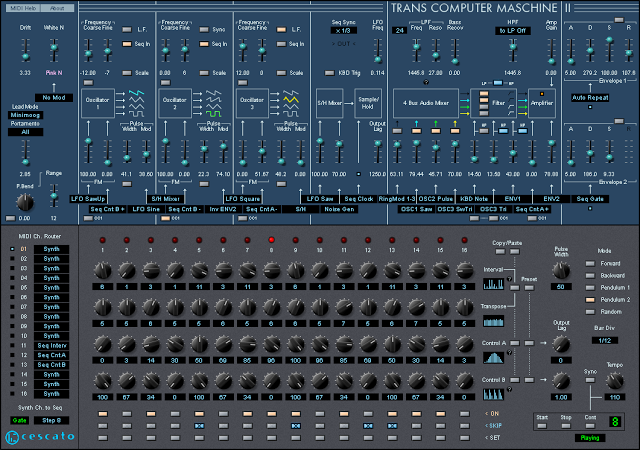
Trans Computer Maschine is a semi-modular Vintage Lead Synthesizer + Pattern Sequencer. Modeled after two legendary mono synths and a custom analog sequencer from Germany.
3 Multi-Oscillators with Sawtooth, Triangle, Sawtooth-Triangle and variable Pulse shapes.
Color adjustable Noise Generator.
3 mode Ring Modulator.
Advanced Sample/Hold.
Selectable 2/4-pole resonant LP Filter with auto-oscillation.
HP Filter with bus selection.
2 exponential Envelope Generators offering 3 operation modes.
Unique Sequencer features like ‘skip’ and ‘set’ can be played live from MIDI keyboard.
Inter-patch Sequencer pattern ‘Copy/Paste’ feature.
Fully MIDI controllable.
Fully VST automatable.
– Added ‘Drift’ control for subtle analogue detuning adjustment.
– Added ‘Noise Colour’ modulation from multiple sources.
– Added routing to use ‘S/H Mixer’ as OSC3 ‘Minimoog modulator’.
– Extended Envelopes ‘Attack’ range to 200µs.
– Fixed/added Oscillators self-modulation via ‘S/H Mixer’.
– Improved Amplifier featuring light distortion with clipping indicator.
– Remodelled Low Pass Filter feat. 3 modes with resonance ‘Bass Recover’.
– Remodelled Oscillators feat. accurate upper harmonics and isolated phase.
– Remodelled Ring Modulator featuring true Odyssey behaviour.
http://cescato.net/T-C-M-II.htm
First look at the Akai – MPC Element
The essential instrument for computer-based music production, MPC Element brings powerful music-making capability to your computer in a slimline design that’s made to produce. You get cutting-edge features, including MPC Note Repeat and Swing, along with the all-new MPC Essentials software. With the included 1GB sound library, MPC Essentials empowers you with the essential sounds of modern music production, and you can easily import your own sound samples. MPC Essentials can operate standalone and can also work seamlessly with your current DAW as a plugin. MPC Element comes with everything you need to make music right away, and, because it operates via standard MIDI, you can also use MPC Element to control MIDI music software you already have. An 1/8-inch MIDI input and an 1/8-inch MIDI output are both onboard and 1/8-inch to 5-pin MIDI cables are included.
MPC Element Hardware
- Fuses legendary MPC beat and song creation capability with the power of your computer
- 16 backlit, multicolor pads with pressure and velocity sensitivity
- MPC Note Repeat, Full Level, 16 Level, and Tap Tempo
- Includes MPC Essentials software (download), 1GB sound library, up to 8 pad banks
- Slim low-profile design with integrated cover to protect control surface
- USB-powered, no power adapter required, USB cable included
- Compact design just 14mm thin fits easily into a laptop bag
- Brushed aluminum control surface with bright backlit buttons
- Standard MIDI for use with most popular software
- 1/8-inch (3.5mm) MIDI input, 1/8-inch MIDI output, cables included
MPC Essentials Software
- 32- and 64-bit music production capability
- Works standalone, no DAW required, with MPC Element for seamless music creation
- Works with your current music software (DAW) as a VST, RTAS, or AU plugin
- Run virtually unlimited instances in your DAW simultaneously
- 1GB sound library with all the essential sounds of modern music production
- Import your WAV and AIFF sound samples and assign them to any pad
- Up to 8 pad banks (assign up to 128 pads), 4 samples and 4 insert effects per pad
- Hosts VST plugins and automatically maps controls
- Export to WAV and AIFF
NI Maschine + Microsoft Surface Pro Demo
Background video description:
It works. Using ASIO4ALL driver. VSTs that were active:
2 Massive vsts
5 reaktor
1 drum kit (stock 909 from Maschine, with 1 metaverb effect)
I had a lot of glitching and stopping because of some processes in
Windows. I advise that you reset your computer before using…
We just had to put this one in :-)
We know – totally out of scope for this mag, but still awesome stuff ahead of us
https://www.facebook.com/TheHobbitMovie
http://www.thehobbit.com
In theaters December 13th.
The second in a trilogy of films adapting the enduringly popular masterpiece The Hobbit, by J.R.R. Tolkien, “The Hobbit: The Desolation of Smaug” continues the adventure of the title character Bilbo Baggins (Martin Freeman) as he journeys with the Wizard Gandalf (Ian McKellen) and thirteen Dwarves, led by Thorin Oakenshield (Richard Armitage) on an epic quest to reclaim the lost Dwarf Kingdom of Erebor.
Follow us on Twitter: https://twitter.com/thehobbitmovie
Spicing up this Tuesday morning with new stuff from Pet Shop Boys – Thursday (ft. Example )
Brand new video from Pet Shop Boy featuring Example
From the Pet Shop Boys album “Electric”
Out now: http://PetShopBoys.co.uk
Digital: http://smarturl.it/psbelectricdigital
CD: http://smarturl.it/psbelectricphysical
Tour info: http://bzz.is/PSBTour
Time to test the Elektron Analog Four Lead patches
Quick demo of the patches in the “Lead” category posted at elektron.se, the authors own opinions of the patches below:
“None of these sound very useful for my uses but I thought someone may like to hear them. For most patches I play a few keys and then adjust the mod wheel and pitch bend to see what effect – if any – has been programmed.”
Have you seen FARTBARF 20130926 ?
FartBarf Live at Studio Hermosa Sept. 26th 2013 (3 songs) (the show was actually on the 25th but they didn’t come on till after midnight so you figure it out…)
Time again for some playtime on the Buchla Easel
Todd Barton plays the Buchla Easel
“using the keyboard’s arpeggiator to drive the on board Sequential Voltage Source — some fun little patterns and timbres. . .”
“just another “getting my ya-yas” out and havin’ fun. enjoy!”
About the Buchla Easel:
The Music Easel is a highly evolved electronic musical instrument. It maintains many of the design philosophies and functional characteristics of its predecessors, the 100 series Modular Electronic Music System and the 200 series Electric Music Box. The Music Easel introduces some substantial innovations in electronic instrument design – innovations that make it a truly expressive real-time instrument for composition and performance.
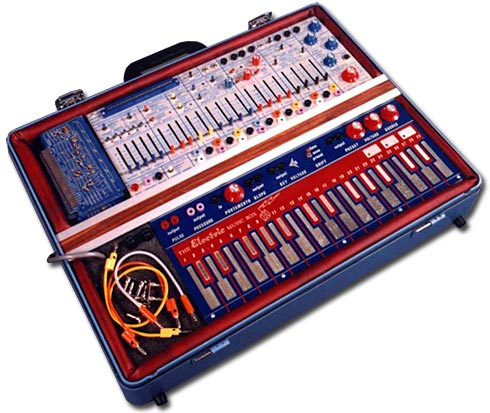
The Music Easel contains many of the elements commonly used to generate and process sound: a keyboard, sequencer, pulser, preamplifier, envelope detector and balanced modulator; oscillators, gates, envelope generators and filters; facilities for mixing, monitoring and reverberating. Many of these elements possess an unusual degree of sophistication. The keyboard is solid state, with touch sensitive, chromatically organized keys, accurate and reproducible pressure output, tactile feedback, octave shifting, and voltage controlled portamento. A complex oscillator, developed through computer aided simulation studies, is a rich source of complex audio spectra. featuring voltage control of pitch, timbre and waveform, this oscillator provides the Music Easel with a timbral range unapproached by other musical instruments.
The connectives are as important as the elements to be connected. Interconnection within the Music Easel is accomplished with a combination of switching and patching, a system which is flexible, expedient, and open ended. Logical, compact organization and color coded graphic feedback facilitate rapid and effective interaction. Multiple correlations between a performer’s actions and the Music Easel’s responses are readily implemented, enabling a degree of expressive articulation heretofore impossible with electronic instrumentation.
Further augmenting the Music Easel’s real time performability is the capability of permanently storing and immediately retrieving complete instrument definitions (patches) or portions thereof. (An “instrument definition” includes settings of parameters, degrees of articulation, switch positions and interconnections.) Storage entails the installment of resistors on program cards; retrieval is accomplished by plugging in a desired program card and activating a switch.
With its extended timbral resources, unusual expressive capability, and its facility for storage and recall of instrument definitions, the Music Easel opens new horizons to the composer and performer. To appreciate its potential as a new musical instrument the Music Easel must be seen, heard and played.
The new generation of FXpansion BFD3
BFD3 is the third generation of FXpansion’s flagship software acoustic drum studio: new levels of realism and ground-breaking features in an intuitive redesigned engine, here’s what they have to say about it:
With stunning new kits with mix-ready presets and modelling technology for tom resonance and cymbal swells, BFD3’s audio engine delivers uncompromising detail while using lossless compression for efficiency. The revamped interface has a new mixer and sound browser for the easiest BFD experience yet.
BFD3’s kits were recorded at two world-class studios with varied recording chains and room ambience making a huge amount of sounds possible. The library includes expressive articulations, a brushed kit and processed drum presets for fast custom kit-building. BFD3 also contains a powerful built-in environment for pattern creation and editing, complete with a range of performances by legendary drummers for effortless production of drum tracks indistinguishable from the real thing.
Availability & Pricing
BFD3 is available on a USB 2.0 flash drive or as a download product from the FXpansion web shop as well as through our international dealer partners.
Pricing is USD $349.00, EUR €269.00, GBP £229.00.
BFD3 Upgrade is available for all registered BFD2 owners for USD $199.00, EUR €155.00, GBP £129.00 for the USB flash drive version and USD $149, EUR €115, GBP £99 for the download version.
All prices are inclusive of VAT where applicable.
Can’t get enough Reason?
The Propellerhead crew got a Hot Hand USB MIDI controller sent to the office. It’s a wireless motion sensor you put on like a ring that can then control parameters via MIDI. Of course Mattias had to give it a try! Here he’s controlling filter frequency, noise level and phase on a Subtractor.
And AskAudio has a new tutorial out:
Reason 7: Creating REX Files
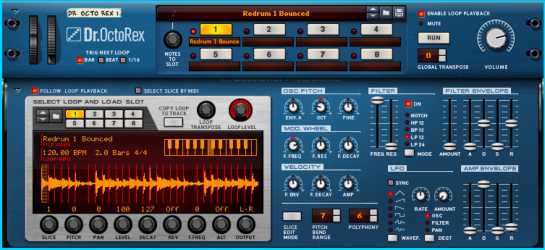
Oh, it’s hard to believe it. The reason to own Recycle, that *ahem* older once-miracle of modern sampling has now past. No longer do you need to encode audio files in another application, outside of Reason. Now, you can convert audio files within Reason, into Rex files. Which, of course, are the loop files that Dr. Octo Rex eats for breakfast.
So, why, with Reason’s amazing time stretching ability would this feature even be relevant? Well, if you’ve ever gone into the editor of Dr. Octo Rex, and have actually messed around with features like the Amp envelope, Filter envelope, or you’ve applied an LFO to a loop. Or, if you’ve ever modified the pan, pitch, or filter frequency of individual slices within a REX file… Well, you know you can take loops to a very different place.
In short, REX files are still amazing, relevant and because you can now easily create your own REX files life has gotten much better.
So, how do you do it?
DATAMASKIN

