
Roland announces TD-15 and TD-11 drum sound modules with SuperNATURAL
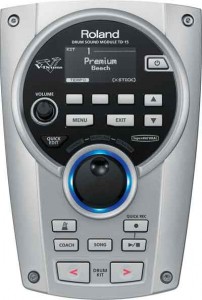
Roland has introduced the <>TD-15 and TD-11 Drum Sound Modules, two new sound engines for V-Drums electronic percussion products featuring all new SuperNATURAL sounds with Behavior Modeling Technology. The company says that these modules offer V-Drums players an unmatched level of playability and dynamic expression.
The flagship TD-30 Drum Sound Module, released in January 2012, was the first V-Drums sound engine equipped with SuperNATURAL sounds produced by Behavior Modeling Technology. Originally developed for their synthesizers and pianos, Roland says that these leading-edge technologies deliver a quantum leap in realism in both sound and expression for emulating drums, percussion, and other traditional instruments.
With the TD-15 and TD-11, SuperNATURAL sounds are now available in mid- and entry-level V-Drums models. In addition to the ultra-expressive sounds, these modules include an enhanced Ambience feature, plus Coach and Quick REC functions for building drumming skills and capturing drumming performances.
Roland tells us that each new module has a large LCD and the intuitive V-Drums interface for easy navigation and sound customization. Two different USB ports allow users to play audio files from convenient flash media and connect directly to computers for MIDI/Audio over USB.
- The TD-15, available standalone and as part of the new TD-15KV and TD-15K V-Tour Series V-Drums sets, features 500 instruments and 100 user-customizable drum kits. Ten multi-effects are provided for processing drum sounds, and the front panel offers dedicated buttons for tuning, muffling, and effects. There are 11 trigger inputs, plus a click output that can be assigned to the headphone or master outputs.
- The TD-11, available standalone and as part of the new TD-11KV and TD-11K V-Compact Series V-Drums sets, features 190 instruments, 50 user-customizable drum kits, and 10 trigger inputs.
Pricing and Availability:
The TD-15 and TD-11 Drum Sound Modules will be available in late spring.
More information:
Free Roland MC-202 Kick Drum Sample Pack By Robotik Audio
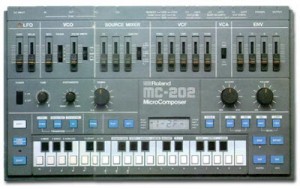
Robotik Audio has released a set of free kick drum samples recorded from the Roland MC-202 MicroComposer analog synthesizer.
The Roland MC-202 is capable – just like any other (monophonic) synth – of creating some very powerful kicks. Zeroing the oscillators using only a low freguency sine, resonance, envelope, ultra short attack, different decays and very little sustain and release. I’ve created my own little sample kit from it. The kit contains 26 dry WAV samples of the MC-202 with no normalizing or any eq’ing. Personally I really like the sound it produces so here you go.
The samples are available for free download via Robotik Audio.
This is an analog synthesizer/sequencer. It sounds very much like the TB-303 and SH-101 bass synths. Sometimes considered the “poor man’s 303”. It has a very evolved form of TB-303 like programming (more like the MC-4) and SH-101 like controls of the VCO, VCF, VCA, LFO, Envelope and Mixer sections. The LCD display is a great feature too.
The MC-202 was sort of a next-generation TB-303. So the idea was to program sequence/patterns into it internally which would give you those 303 basslines that we’ve come to love. But programming the MC-202 is a bit too intense and over done for the simple monophonic bass line. However you can control it externally by hooking up a MID-CV/Gate converter. Then you basically have yourself an SH-101!
The sequencer is actually a 2-channel CV/gate sequencer, with both channels being capable of driving a separate external synth. It’s a very useful unit, also, for its DINsync capabilities; it can receive on one port, and send over two, and also can ‘split’ DINsync to branch a sync signal out to multiple devices.
This machine is best for those who want to get 303-like patterns (it has accent just like the 303) and basslines with an SH-101 sound. If you can handle programming the notes into its sequencer you can have a lot of fun.
Time machine: Roland JV-1080 “Early 90s”
all synth sounds and drums:
Roland JV-1080 Digital Synthesizer (1994)
recording: multi-track
more info: http://www.retrosound.de
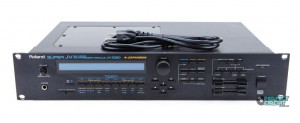
The Roland JV-1080 was one of the hottest and most popular digital synthesizers ever to come from Roland. Incredible sound quality capable of emulating any instrument imaginable plus totally fat analog synth type sounds and loads of percussion! It has 64 voices of polyphony and 16 part multitimbral, it’s no wonder this is part of almost every Film Score Composers set-up as well as many more artists and hobbyists!
It has 8MB of sounds and it also offers a lot of expandability with 4 expansion slots and 2 data card memory slots. You can get up to 42MB of sounds by adding any of the popular JV-80 expansion cards suited for Techno, World Instruments, Orchestral or Synthesizers. The 1080 has a large LCD screen, lots of effects and filters for creative flexibility, motion control and extensive MIDI implementation. Editing is intense but enhanced and simplified by external editors like MOTU’s Unisyn.
Spaceship – electronic music
BRUNO ENDER LEE – “Spaceship” – performed live, March 3. 2012
MacBeth M5N, Doepfer MAQ-sequencer, ARP Odyssey, Synthesizers.com Studio-88, MiniMoog Voyager OS, Moog Little Phatty, Analogue Solutions Vostok, Roland Juno-60, Korg Delta, Korg Polysix, Korg MS 2000
(through 5 different stereo-panning-delays, 4 Behringer DD600 & 1 Boss ME-50)
composed, arranged & produced by Bruno Ender Lee; 2012 Velvet Voyage Productions
Analog Universe (NightBirds Electronic Music / Live in studio) 2012
Recorded live & direct in the studio with 3 cameras.
Instruments used :
RSF Kobol & Blackbox, ARP Odyssey, KORG MS-20, ROLAND System 101 & 102 (x2), ROLAND Jupiter 6.
Race against time to get everything done in one take 
Video by NightBirds.
Publication & Copyright by NightBirds Electronic Music – 2012
http://fr-fr.facebook.com/people/NightBirds-Electronique/100000038001995
http://soundcloud.com/nightbirds-electronic
Roland Jupiter-6 Signature Sounds
The Jupiter 6 is an incredible analog synth. All of the Jupiters have a sound that was unlike any other synthesizer and the Jup 6 is no exception. This sound is due in part to classic analog Roland technology in its filters, modulation capabilities and a thick cluster of 12 analog oscillators at 2 per voice. Easy and intuitive programming via front panel sliders, knobs and buttons for all your tweaking needs.
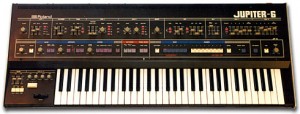
The Jup 6 is a scaled down version of the Jup 8 in terms of programming and polyphony. However the Jup 6 has some major improvements of its own such as newly added MIDI control and better tuning stability! While the Jup 6 does have MIDI, the implementation is very rudimentary and hard to control. The Jup 6 was one of the very first (along with the Sequential Prophet 600) synths to use the then new MIDI protocol, and the implementation on the Jup 6 is far from complete.
http://gstormelectronica.blogspot.com/
A quick demonstration of the Roland Jupiter-6 vintage analog synthesizer. Showing some of the signature sounds that are its claim to fame, and some sounds that may be not so familiar.
Not since 1983 has Roland produced anything quite like it. What sorts of things set the Jupiter-6 apart from its peers?
– Its wild multimode filter capable of Lowpass, Highpass, and Bandpass
– Like a handful of other synths, compound waveform selections are possible for each of the oscillators.
– A feature called Cross Mod: it’s like a third ‘virtual oscillator’ which is a frequency modulator for affecting OSC1. The beauty is that you still have OSC2 to do as you wish.
– Very stable oscillators, and the autotune routine takes about a second to execute! Memorymoog takes around 8 seconds.
– Envelopes: the attack transients are most unique. They aren’t extremely fast, nor syrupy, but I haven’t been able to get any other synth attack to sound the same.
What are these signature sounds the Jupiter-6 does well?
– Buzzy things
– Creamy Sawtooth, silky pad sounds
– Ambient Drones
– Gritty, Dirty, Raw, Nasty, Edgy sounds
– Blippy arpeggios
– Aggressive stabs/leads
– and very rude filter sweeps
Space Echo Spring Reverb
Just a short video with the spring reverb from the Roland Space Echo series.
This particular reverb comes from the RE-301, but as far as I know, the RE-201, 301 and 501 has the same reverb.
I removed the spring reverb when I had to fix one of my units. I’ve placed it in the box again, don’t worry.
The sequence was programmed on a Korg Mono/Poly
I love the text on the reverb tank. “Manufactured by beautiful girls in Milton, Wis. under controlled atmosphere conditions.”
More background information on the topic:
The Roland RE-201, commonly known as the Space Echo, is an audio analog delay effects unit produced by the Roland Corporation.
A tape echo device records incoming audio to a loop of magnetic tape, then replays the audio over a series of several playback heads before it is erased again by new incoming audio. The tape used in the RE-201 is the standard 1/4″ tape of the open-reel variety, but made as one, continuous loop. In the Roland ‘RE’ range there are no reels of any kind, the tape is transported via a capstan drive. The tape loop is contained in a loose, constantly moving jumble in the tape chamber (also known as the tape tank) under a plastic panel which protects the tape and keeps it from getting tangled. The replacement tapes were known as Roland RT-1L replacement tape loops and sold by Roland.
There are several control dials on the device that alter such aspects as tape speed, repeat pattern (an 11-position rotary switch), one instrument and two microphone inputs, a single analog backlit VU meter for all three inputs, wet/dry mix for both echo and reverb, and intensity (number of repeats, in a sense; it actually reduces how much the erase/record head erases the tape), that can be adjusted to a user’s liking; and bass/treble controls to EQ the sound of the repeats (not the dry signal), as well as dry and effected “Echo” output jacks with a switch for output setting (-10, -20, -35db levels.)
Used as a delay/echo, the Roland RE-201 is said to produce an unpredictable delay that is warm and gritty sounding. It is also capable of producing a large variety of its own sound effects, even without an input signal (by turning the intensity control to maximum and allowing the unit to self-regenerate, or self-oscillate, while manipulating the tape speed and other controls).
Despite its age, the Roland RE-201 is widely sought after, and still used by many bands to this day, notably in the experimental work of Radiohead, and the rockabilly stylings of Brian Setzer, the latter using one recently to get the slapback sound sought after for rockabilly and such styles of music. The Roland RE-201 is also extensively used in modern electronic music
Roland Alpha Juno-1 & Roland Juno-60
This is a ‘single patch’ comparison of the Juno-1 and Juno-60. This Juno-60 is visiting the studio for a few days to be repaired. This Juno-60 had a dead LFO-trig switch that now functions and a faulty volume pot that is also functioning normally now. Its a Happy Juno. Both the Juno-1 and Juno-60 are programmed to the exact same parameters and waveforms.
I wanted to record a short video to compare the two Junos while I had the opportunity as well.
This Juno-60 was a joy to have visit the studio and it is fully functioning and doing well now.
Recreating Marvin Gaye’s 1982 electronic Soul ballad Sexual Healing using Logic
Central to the groove is the Roland TR-808 drum machine – in fact, rumour has it that this was one of the first commercial hits to utilise the 808. Though the beat and groove sound simple, there’s a lot of syncopation so it’s essential to study the original beat. Try importing the track and slowing down the drum-only intro using Logic’s varispeed feature.
“Recreation” (NightBirds Electronic Music) 2012
Live with OBERHEIM Xpander & XK Keyboard with the ROLAND MC-202. Only
Composed quickly with the Oberheim Xpander in multimode. Each OSC are played with different height of notes and controlled by the arpeggiator of the XK keyboard. The rest are played with the Roland MC 202.
Time for a break from the completion of the studio and here is a small piece of musical recreation!
Quick Video by NightBirds.
Publication & Copyright by NightBirds Electronic Music – 2012
http://fr-fr.facebook.com/people/NightBirds-Electronique/100000038001995
http://soundcloud.com/nightbirds-electronic
DATAMASKIN

