
Interview with Nullsleep
Scion Installation LA presents an exclusive interview with Pixel Pushers artist: Nullsleep
Nullsleep is the alias of Jeremiah Johnson, an electronic musician whose style could best be described as post-cyberpunk. Nullsleep is the cofounder of 8bitpeoples, an artist collective interested in the audio-visual aesthetics of early home computers. nullsleep.com
Hard to find the right microphone?
Well then this might be of assitance:
Don’t know which mic to choose? If you need help determining which microphone is right for the task at hand, check out myMicSound, a free Web application by Ear Machine that simplifies the sometimes difficult chore of using your ears to decide which microphone to purchase.
The myMicSound application learns your preference by analyzing ratings of example microphones; it then returns a list that ranks microphones by the probability that you will like their sounds.
About the free Web application, Andrew Sabin, Ear Machine owner and psychoacoustics researcher, comments, “MyMicSound is the first step toward a fundamental change in how people decide to purchase audio equipment.” He continues, “Currently, people make these decisions by receiving recommendations from friends, or by conducting a clumsily-organized listening comparison. MyMicSound offers users a simple format to use their own ears to conduct a free, controlled, and comprehensive listening test.”
To get started, you can either submit your own recording, or use one from myMicSound’s collection. How does it work? MyMicSound removes the sound of the microphone used to make that recording, and then simulates the sound of new microphones. According to Ear Machine, myMicSound carefully considers factors influencing the sound of the microphone, such as the proximity to the sound source, the polar pattern, and whether filters are active or not.
MyMicSound is the first sound-based recommendation engine in the audio equipment market, Ear Machine says. Its software algorithm is said to rely on state-of-the-art knowledge in both auditory perception and computer science. Similar algorithms, such as the one used by Pandora, are widely used in music recommendation.
For more information or to try myMicSound for yourself, visit Ear Machine’s Web site at ear-machine.com.
Howard Jones remasters his back catalogue

Howard Jones recently reissued “Human’s Lib” (1984) and “Dream into Action” (1985) as remastered editions, both available separately and as a box holding a bonus live disc with early performances. Coming up now are the two remix albums “The 12″ Album” (1984) and “Action Replay” (1986). Both were remastered by Howard Jones and Robbie Bronneman.
The set is again available separately or in a box set. This box also includes a bonus disc with several rare mixes and versions that have never been released on CD before. You will find for instance the 1983 7″ version of “Conditioning”. The box will be available for pre-order via Jones’ Dtox webstore on February 21 and will be released on March 21.
The 20th Anniversary Concert: This DVD is a recording of Howard’s spectacular 20th anniversary concert at the Shepherds Bush Empire on September 20th 2003. The DVD was Howard’s concept and he has been involved with the project in every step of the production. The DVD is packaged in a beautiful deluxe 2 disc digi pack.
It features 29 songs, including guest appearances from Midge Ure, Nena and Jed Hoile.
The running time of the concert is 164 mins and we have also included 103 minutes of extras, packed full of behind the scenes footage as well as a 51 minute interview with Howard, interviews with the band and crew and interviews with members of the audience themselves. The DVD is directed by Sadia at Chimera Arts and mixed in 5.1 and stereo by Stephen W Tayler.
Commodore 64 LIVE DEMO
Live demo of one of my songs.
Bassline is played by an good old C64 equipped with Cynthcart.
Tune is called “we ain’t finished yet” and has been featured on DEAD PIXELS long play.
In 2009 I began experimenting with SID chiptune (built-in sound generator chip of Commodore 64), and Cynthcart to create a blend of original 8bit sound from the 80’s and Rock music.
Download FULL albums completely for FREE @
www.lukhash.com
Shared by lukhashdotcom
Featuring the Synthanola
This is my 555 Contest (www.555contest.com) entry. It is an analogue synthesiser based on 555 timers, with three channels and four octaves per channel. It is sequenced with either paper tape (as shown) or by any 8-bit interface with suitable flow control.
“This video demonstrates two paper tapes which play Inventions 8 and 13 by J.S. Bach.
Sorry about the jumpy video. My computer must have been doing something at the time. My hands can’t actually move that quickly.”
More information at .http://kaput.retroarchive.org/555/
Electric Independence
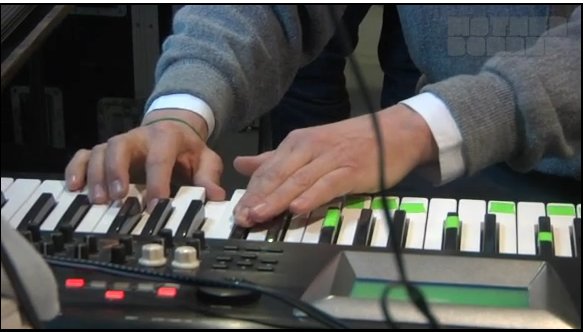
Here’s what they have to say about it:
If there’s a word for the sort of post-genre electronic music Matmos creates it might be “slippery.” Maybe it’s bending vintage ARP synth sounds into tumbling psychedelia, contact mic’ing a cow’s reproductive tract, or turning human skin into skittering IDM (don’t ask): the important thing is that there’s no way in hell you would have thought of it.
Matmos’ core duo/couple is made up of Martin (M.C.) Schmidt and Drew Daniel, who moved together a couple of years ago from San Francisco to Baltimore where they can generally be found at warehouse noise freakouts or, in Daniel’s case, teaching literature at Johns Hopkins University. You may have heard their work on Bjork’s vital records Vespertine and Medulla, for which Matmos did the production work and contributed virtuosic performances on household appliances and medical instruments.
For the debut of the second season of Electric Independence, Motherboard’s electronic music series, we visited the duo at their Baltimore studio to learn about their collaborative process and the new album they are working on, The Marriage of True Minds. At one point, Jordan ends up on the floor with ping pong balls on his eyes, listening to white noise, and feeling telepathic energy. On his feet, he gets a tour of their most important gear, then chats with the guys about rat cages, stress detectors, their love of Throbbing Gristle, and their love for each other. — Michael Byrne
Electric Woman
“Electric Woman part 2”
intro, strings and lead sounds: Oberheim OB-Xa
bassline: Moog Minimoog
drums: SCI Drumtraks
recording: multi-trak
(special thanks to susa for the assistance)
the audio file:
http://soundcloud.com/retrosound/elec…
Modular Drum Programming
Zoog is working on new Angelspit material. In this video Zoog explains in detail how he processed the drums (played by Chris Kling) his Doepfer Modular Synth and a Metasonix D-1000 Valve Drum Machine.
Zoog Uses: Doepfer A-190 MIDI-CV SYNC Interface, Doepfer A-160 Clock Divider, Doepfer A-154 Sequencer Controller, Doepfer A-155 Analogue Sequencer, Doepfer A-174 Joy STick Controller, Doepfer A-132-4 Quad VCA, METASONIX D1000 Valve Drum Machine, KORG Kaoss Pad 3
DOEPFER.DE
METASONIX.COM
ANGELSPIT.NET
Stereoklang in an exclusive talk with synth pioneer John Foxx

Anyone with the slightest interest in electronic music has come across the works of John Foxx. John more or less on his own reshaped the electronic landscape with albums like Metamatic and The Garden. Starting off in the 1970’s forming the band Tiger Lily, that later morphed into the legendary act Ultravox. However, John left the band in 1979 to pursue a solo career and over the years, since then, John has been extremely productive – to say the least. John did withdraw from the music scene for a while to pursue other areas, but reappeared in the 90’s via Nation12 and then later on actively started to pursue his music career often in collaboration with others like Louis Gordon, Harold Budd and most recently with Benge (ben Edwards). Currently we are all set for a real treat with the new album called Interplay, featuring John Foxx & the Maths. Without further a due, and introductions, we dive deep into the mind of Mr. John Foxx
The Metamatic album has lots of pop format songs with raw and distorted synths, a sound that still feels fresh. But no-one picked up on that combination until much later, e.g EBM and Futurepop movement in the 90s and even more so by the Skweee movement of the 00s. Not even yourself continued in that direction with those raw synth sounds until your more recent work. – Why didn’t you pursue that direction? Was it going against the time too much?
There were many other things to pursue. For instance, reclaiming some of my own ground from ‘Systems of Romance’ on ‘The Garden’ album. I also wanted to make ‘Cathedral Oceans’ and other kinds of quiet music.
Then there was the preoccupation with Psychedelia, and its link to German electronic music. This wasn’t at all recognized in England at the time. At one point, I was also afraid that perhaps Metamatic was too raw and minimal and cold. This seems odd, because it seems quite warm now – but it certainly didn’t compared to other records being made at the time. A few years later, when I had the perspective to be able to appraise things from a safe distance, I realized there might be something special about Metamatic after all.
You’ve once said that new instruments like the electric guitar, synthesizers and drum machines changes the shape of the music. That you write to accommodate to the machines – Do you perceive that the DAW/laptop studio made the same impact?
Oh yes, every technological introduction changes the music – there are musicians who would not exist in other environments – The form of many new musicians’ work is enabled by intelligent use of new technologies – Autechre for instance, require a portable digital ecology in order to exist in their present form. Theirs is an intelligent, visceral response to new digital environments.
XXX require flexible digital recording technology to review and refine their music. It is clearly not based on any purely acoustic hierarchy of sound.
Just as Frank Sinatra changed both singing and recording by using a microphone and an amplifier – enabling him to sing quietly in front of a big band, so DAWs and laptops have created methods of working and kinds of music that were not possible before.
Iliadis sets Organ instrument plug-ins free
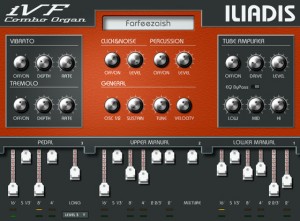
Iliadis plug-ins
- iVF Combo Organ, two manual transistor organ simulation.
- iBX Organ, tonewheel organ simulation.
- Euthymia Electronic Organ V2, Hammond clone simulation.
- VH-1 & VH-2, two great organ simulations.
- iSPINNER, simple rotary speaker simulation.
The Iliadis plug-ins are available to download as freeware for Windows (VST). Donations are appreciated.
More information: Iliadis
DATAMASKIN

