
Modeselektor & Thom Yorke – This
Modeselektor & Thom Yorke – ‘This’ (Official Video)
Created by FutureDeluxe / futuredeluxe.co.uk /
Twitter / twitter.com/futuredeluxe
Facebook / facebook.com/pages/Future-Deluxe/183007228394786
Produced by FutureDeluxe & Fractured Films
Directed by – Andrew Jones
Written by – Jason Drew & Andrew Jones
3d & animation – Jason Drew & Xander Marritt
Girl character rigging & animation – Xander Marritt
Edit & post production – Andrew Jones & Xander Marritt
Producer / Art Director – James Callahan
Titles – Ollie Aplin & Andrew Jones
Wardrobe – Skye Pennant
Actress – Sheryl Lee
Marionettist – Sarah Fitzpatrick
Fractured Films / fracturedfilms.com
Director of Photography – Dominic Jones
1st AD – Will Jewell
Producer – Daniel Nixon
1st Assistant Camera – Jason Oxley
Gaffer – Stefan Mitchell
Grip – Phil Richards
Make-up – Nathan McLaughlin
Runner – Lorena Wright
New version of a classic chorus echo device with tape-delay simulation
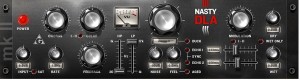
Variety Of Sound has released NastyDLA mkII, a new version of the classic chorus echo device with tape-delay simulation.
The mkII version of this plug-in is an overall technical redesign and features “stateful saturation” algorithms for an overall improved sound experience and changes several things under the hood. Basically, NastyDLA mkII remains feature-wise the very same but introduces the input stage modelled by this new technology and also redesigns the tape compression algorithm for an improved IM distortion performance. In general, the distortion generation appears to be more analog-like and the perception of width and depth has been improved significantly.
Improvements:
- The behaviour of the input stage has been changed. It acts output level compensated now and only is active if the SAT switch is engaged. It is modeled based upon a stateful saturation algorithm which sound wise turns in to a way better distortion performance as well as a more “3d” sound perception.
- The tape compressor has been improved for a better IM distortion performance and a less muddy sound.
- The level of noise which can be dialed in has been altered. The level itself is corrected and by moving the according knob to the left-most position the noise can be switched off.
The .dll name and the VST plug-in ID has been changed and so both, old and new version, can be used in parallel in any case. Nevertheless, the mkII version remains preset-compatible with version 1.x so one can transfer presets between them in both directions.
NastyDLA mkII is a Windows 32-bit freeware release for VST compatible applications and you can grab your copy via the download page.
Hohner Multimonica I – Vacuum tube synthesizer of the 1950s
The “Hohner Multimonica” is a combined double-manual keyboard instrument consisting of a monophonic synthesizer (sawtooth oscillator, vacuum tube technology) and a polyphonic harmonium with fan-driven reeds. This electro-acoustic musical instrument comes from the German postwar era. It was produced in two main variants (“Multimonica I” later “Multimonica II”). The “Multimonica I” even had a built-in AM radio for local station reception. But there was also a version available without radio.
The first appearance of the Multimonica is falsely dated to 1940. Some may even date it back to the prewar era. But its tube technology suggests that this musical instrument came into trade in the early 1950s. The short newsreel report from 1952 in this video supports this fact.
Hohner modeled its musical instrument after an electro-acoustic instrument by the German company “Siegfried Mager & Co.” and the harmonium manufacturer Johannes Straube (“Mager-Straube-Kleinorgel”). German engineer Harald Bode (*1909 †1987) was incorrectly assigned to the construction of this musical instrument.
Closer look at the Roland Juno 6 synth
Background info:
The Juno 6/60 is a popular synth that is the subject of a lot of discussion, and much of it is negative. I am a huge fan of the Juno 6/60 and think it gets and unfair amount of criticism, primarily behind the veil of the internet. This demo showcases its amazing sound and some of it’s capabilities.
Below is the link to the original uncompressed demo:
http://soundcloud.com/briancastro/roland-juno-6
Pekka Kauppila updates MauSynth beta
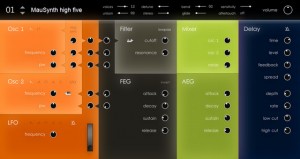
Pekka Kauppila has released a new beta version of MauSynth, a free polyphonic synthesizer plug-in for Windows.
MauSynth is a basic subtractive synthesizer with emphasis on high sound quality and friendly interface.
The plugin is written in c++. It is currently in beta stage, feedback is welcome. MauSynth will stay free even after beta.
Changes in the new beta version
- Improved oscillators.
- Improved filter.
- Improved GUI.
- Aftertouch support.
- Adjustable velocity sensitivity.
- Improved legato mode.
The MauSynth beta is available to download as a VST instrument plug-in for Windows.
New demo of the iOS app – Noisemusick
This is a demo of the iOS app Noisemusick. Since I haven’t seen any videos of it here and the developer hasn’t released one yet I figured I would give the market a little demo of what this app can do. Recorded via iSight through Photo Booth hence the shitty quality, but I hope at least the sound can do the app justice.
http://www.fluxama.com/
The Noisemusick app is a collection of THREE controllable synthesizers that generate interesting chaotic sounds. Have fun creating sonic bedlam, exploring weird soundscapes, or use it to GREAT EFFECT in your live performances and recordings. It’s squonky electric FUN for the whole family!
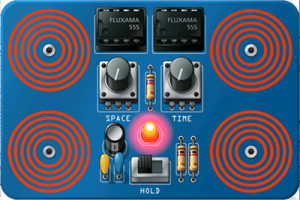
With Noisemusick you can:
- Choose a sound to match your mood: blue, green, or pink!
- Practice and probe to find interesting interactions of sound!
- Discover weird oscillations!
- Use it as a raw input to other filters and effects!
- Run on an iphone or iPad; it’s a Universal app
The original circuit boards were inspired by a workshop presented by Jessica Rylan in 2007. The original Noisemusick schematic includes two infrared sensors for additional chaos on the inputs. Since your mobile device doesn’t have an infrared input, the circuit has been modified accordingly.
Time machine: KORG POLYSIX Analog Synthesizer 1981
This video shows what someone can do with a Polysix who knows it very well. The audio signal was recorded straight from the Polysix’ output, without any additional effects or dynamics. The Korg Polysix is a classic analogue polyphonic synth. It was the best sold analog synthesizer. Roland answered one year later with the Juno-60.

The Korg Polysix has per voice:
1 VCO + suboscillator (PWM possible), 24 dB lowpass filter, 1 ADSR envelope, 1 LFO (sine waveform only). It also has an very useful FX section, which lets you forget that you have 1 VCO per voice. ENSEMBLE, CHORUS and PHASE effects are possible. The Polysix has the same useful ARPEGGIATOR like the Mono/Poly. It is synchronisable with drum machines, sequencers,…
The Polysix has 32 RAM memories for your patches. With the tape interface, the whole RAM memory can be stored on tape/cassette. Of course you can save the memory data as WAV files as well. The Korg Polysix was inspired by the Sequential Circuits Prophet-5 – in fact, the Polysix has SSM chips like the early Prophets. For this reason, it has a warm, “american” analog sound…
The Polysix can produce fat pads with the “ensemble” effect, which reminds me on old string machines. It also can produce great bass and lead sounds in unisono mode. Weird sounds are possible with the arpeggiator in combination with filter resonance.
The hardware is solid, well made – except the original internal battery, which tends to leak. Especially when the Polysix is not turned on for a long time.
THE SOUND PROGRAMS IN THIS MOVIE:
Do you have a Polysix and want to play with the powerful sounds heard in the video? You can buy the “ANALOGAUDIO1 PATCH BANK” with 64 patches (2 banks with 32 patches) for 12,99 Euros. After payment through PayPal you will get a WAV file with sound data for the tape interface of your Polysix via email. You will also get a patch list with names of the patches (PDF), to find the right sounds quickly. The details about the functionality of the tape interface are described in the manual of the Polysix, which you can download for free.
The bank contains all the sounds you are hearing in this video and some more. The included patch list (PDF) is very useful to find the needed sounds quickly. As an experienced synth player / programmer I programmed these special sounds carefully to get the most out of the Polysix – these sounds are not available anywhere else!
If you want to buy the “ANALOGAUDIO1 PATCHBANK” for your Polysix, please drop me a mail:
ceramic-man@gmx.de
The Analog Session – Trailer
The Analog Session – featuring Alexander Robotnick & Ludus Pinsky. This is the trailer of our new work. New videos and a new album are coming soon! Stay tuned.
On Alexander Robotnick’s channel: www.youtube.com/mauriziodami
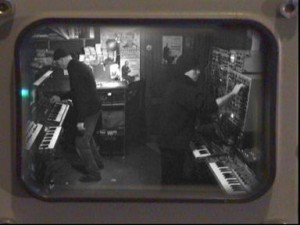
In February 2009, Alexander Robotnick and Ludus Pinsky put together their personal analog synths to organise and perform an Analog Session. The idea was to recreate the purely analog sound of the 70s and early 80s, which the two artists consider being the true “electronic sound”. The Session lasted 5 days , 3 of which to set up and connect pieces of equipment and to fix sync problems and VAM malfunctioning.
Soft Circuitry With Mini Synth
I guess the term soft synths can be used in many different meanings 
This soft interface is made from metallic wools, Velostat (a resistive material), conductive fabrics, sheep’s wool and acrylic craft felt.
It is connected to the circuit with snaps soldered to wires and alligator clips.
The circuit is comprised of 2 oscillators using the 4093 IC, piped through a distortion filter built using the 4049 and then out through the 4040, a 12 stage binary counter, it has 12 outputs, each dividing the source by 2.
Four of the twelve outputs from the counter IC are taken onto the soft interface using snaps to wire and mixed using a felted patch cord of sheep and metallic wool.
One oscillator is controlled by a force sensing resistor made from Velostat and conductive fabric.
Oscillator number two is controlled by a felted sculptural potentiometer, one side of the spike is a needle felted bronze trace, the opposite side is Velostat. You connect the two through your body by wearing stretchy conductive fabric over the tips and touching both sides at once.
Your body naturally has a high resistance, so you mainly get slow oscillation and hear low tones.
Each of the two oscillators have a control pin, they turn on and off based on if that pin is set to high or low. Each oscillator’s outputs are feeding into the other’s control pin, so you can turn one off and on, by touching the other.
Tutorial: How to Make Nasty Filtered Bass in Massive & Ableton
Ever wanted to find out how to create that effective glitch bass sound in Massive, then check this tutorial out:
BASS SOUND DESIGN COURSE: http://vespers.ca/shop/lessons-and-workshops/audio-weapons-ableton-live-inter… How to make a glitch hop style bass patch in Native Instruments Massive synth using a saw wave oscillator, unisono detuning and pan spreading, bandpass and daft filters, macros, pitchbends, and filter frequency automation. Using Ableton Live as a host. Tutorial by Vespers, Certified Ableton Trainer.
DATAMASKIN

