
Free Ableton Live Pack – Vinyl Crackler
Ableton Live Pack featuring vinyl crackle effect. This effect rack is designed to make your audio sound as if it were sampled from a vinyl record. It’s a modification of the vinyl distortion plug in, but will only introduce the crackles and pops when the audio is playing. Perfect for making drum samples sound like they were sampled from a record player.
Free Download: http://bit.ly/freesynth56

Ableton Live comes with a cool little plug in called vinyl distortion. It adds a layer of record player crackles and pops over any track it is inserted on. This can be a great effect for adding a retro quality to your tracks.
Recently, I was playing around with some live drum samples I set up in an instrument rack and I wanted to create the illusion that those samples came from an old record. I placed the vinyl distortion plug in on the track, but it wasn’t the effect I was looking for. The plug in constantly emits a vinyl crackle. It doesn’t matter whether the song is playing or not, the vinyl distortion plug in is always outputting vinyl crackles. If my samples were taken off of a vinyl record, you would only hear the crackling while the sample is playing. To solve this problem I create this week’s free Ableton Live Rack: Vinyl Crackler.
The Next SoundCloud is here – or at least in a BETA mode

SoundCloud, the online music-streaming platform and de facto music label for independent artists trying to share their tunes efficiently, announced a complete redesign of its service Wednesday, in what the Berlin-based company called an attempt to “unmute the web.”
The new version of SoundCloud, which the company called “The Next SoundCloud” and launched in private beta Wednesday, offers four new or improved features to the online music platform. Those include a sleeker player (improving on SoundCloud’s signature waveform design), the ability to play sounds continuously and navigate away from a particular track to continue searching the site without the audio stopping, improved search algorithms and tools, and the ability to repost audio in a way very similar to the “reblog” feature on Tumblr.
The improvements, SoundCloud co-founder and CEO Alexander Ljung said, were an attempt to make the web more audio-friendly.
“Sound is a key part of our overall experience of the world and on the other hand, more and more of our experience of the world is happening online,” Ljung said while giving a demonstration of the new SoundCloud at the company’s San Francisco office. “The problem today is that the web is very silent.”
Additional background info can be found in the original Wired article here >>
MacBeth Micromac – lead bass
Background data:
Here’s a short video where I am using both the 3U Eurorack version and the Desktop version of the up and coming MacBeth micromac! This is pretty standard stuff- but this morning I switched the gear on before work and came up with these rather vintage minimoog like sounds! The 3U Eurorack version is on the left side- the Desktop version on the right side!
Short info on the Micromac:
The long-awaited Micromac by MacBeth is a small and yet powerful, full analog standalone desktop synthesizer because unlike his competitors it has three voltage controlled oscillators and a classic Moog lowpass filter. Never before it was more affordable to purchases a true MacBeth synthesizer!
The desktop version of the Micromac has not only CV and gate inputs to play the synth but also a MIDI/CV interface from Kenton, who stand for very reliable and stable interfaces.
3VCOs: VCO1 and 2 have saw, pulse, triangle and sine waveforms and the pulse width can be voltage controlled by external CVs. A low frequency noise with level control is available as well. VCO 1 can hard sync VCO2. VCO3 can be used as a modulation oscillator and can be disconnected from the master CV. Modulation targets are filter cutoff frequency and/or pitch of VCOs1&2. All VCOs have individual outputs, coarse and fine frequency controls, separate CV inputs for controlling frequency and pre-filter level controls.
The filter is a Moog 24dB lowpass filter. It´s input is a mixture of all three VCOs and noise. The cutoff frequency can be controlled by the first envelope generator as well as by an external CV. The filtertracking is switchable between off / half / full (0%, 1V/oct and 1.5V/oct).
The envelopes are ADSRs with a switchable release parameter thats time is depending on the decay parameter, just like the Minimoog. The filter envelope can be also used to control VCO2´s pitch what sounds great when VCO2 is synchronised. Furthermore you can invert this envelope´s characteristic. The second envelope modulates the VCA. If an external CV is patched to the VCA the internal modulation is broken up. A momentary button allows for manual triggering of the envelopes
Modular Pedal Test – 18 Mooger Fooger modular synth
You can never have too many 😀
Session #3, Take #2 with the Shout Out Mooger Fooger modular table top synth.
http://www.shoutoutoutoutout.com
http://www.auxgang.tumblr.com
Combining all of the Shout Out Out Out Out collective mooger foogers to make one biggish, patchable tabletop synth.
Experimental – musical table
This project by Kouichi Okamoto is awesome! 504 musical box movements which each play only a single note:
The musical table installed 504 volumes on the top plate,
and there are 504 musical box movements which play only a single sound
in the point of the 5-m electric line extended from there.
The motor revolving speed of the musical boxes are adjusted by the volume of
the table, and the musical boxes play sound at random.
Enjoy
Made in Canada – Modcan & Intellijel
New teaser from the “I dream of wires” electronic music documentary that is in the makings:
Canada holds a significant place in the history of electronic instrument development: from the ground-breaking inventions of Hugh Le Caine in the 1940s to the innovations at the University of Toronto’s Electronic Music Lab in the 1960s. Recently, Canada has again come to play a significant role with the modern day resurgence of modular synthesizers; it is home to two highly respected manufacturers: Modcan, founded by Toronto’s Bruce Duncan, was the first company to reintroduce modular synthesizers to the post-MIDI marketplace, and Intellijel, founded by Vancouver’s Danjel Van Tijn, is one of the fastest growing and most respected lines of Eurorack synthesizer modules.
For more info on Modcan, visit: modcan.com
For more info on Intellijel, visit: intellijel.com
Music/sound: Jason Amm (Solvent), Bruce Duncan (Modcan), Danjel Van Tijn (Intellijel), John Elliot (Emeralds)
Catch I DREAM OF WIRES’ showcase at Mutek Montreal 2012: Saturday June 2 @ Satosphere, with live performances, all incorporating modular synthesizers, by Sealey/Greenspan/Lanza (Orphx/Junior Boys), Keith Fullerton Whitman (Kranky/Editions Mego), Solvent (Ghostly International/Suction Records), Clark (Warp Records), and Container (Spectrum Spools).
I DREAM OF WIRES is a forthcoming documentary film about the history and resurgence of modular synthesizers. The film is currently in production. This is the 5th in a series of extended interviews, which will be produced and released in various formats throughout the production, and following the release, of the film. I DREAM OF WIRES extended interview segments are sponsored by MATRIXSYNTH (m.matrixsynth.com).
For info on the film: facebook.com/idreamofwiresdocumentary
How to Make Music With iPad Apps – iMaschine / Korg MS-20 / Animoog / GarageBand / BeatShuffler
In this Ableton tutorial Danny J Lewis experiments with creating a drum and bass track idea entirely with iOS Apps recorded into Ableton Live. It is part of our series of Making Music With Apps tuorials.
Go to: http://www.pointblankonline.net/courses/ableton-live-courses.php to find out how you can learn more about using Ableton Live as a recording tool. Please get in touch with our course advisors at advice@pointblankonline.net if you want to find out more.
More info on Propellerhead´s upcoming Rack Extensions
The guys at Propellerhead has released some more info on their upcoming Reason 6.5 release (free for registered users) including the newly announced Rack Extensions, here’s what they have to say:
It’s not just third parties who are getting into the creation of Rack Extensions. On release day, Propellerhead will be releasing their own Rack Extension devices for Reason 6.5 and Reason Essentials 1.5. Below is some early information on what we’ll have on offer.
Radical Piano
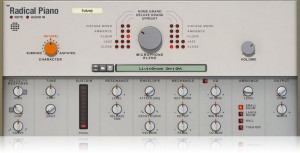
The premise is simple. The results are stunning. We’ll give you three basic pianos paired with the technology to make an infinite number of your own. Based on a custom blend between sampling technology and physical modeling algorithms, Radical Piano affords songwriters, producers, and sound designers an unprecedented level of control to craft a realistic piano that is 100% unique.
Pulsar
Pulsar LGM-1 is a dual channel modulation power house for the Reason rack. We call it a dual LFO but it’s also a powerful little synth in its own right. More info coming soon.
Polar
Polar is a classic harmonizer/pitch shifter with a host of modern tricks up its sleeve. Use it for old school harmonizing and stereo widening effects, or use it to go totally granular filtered pitch shift repeater on your music. More info coming soon.
When Reason 6.5 and Reason Essentials are released, we’ll also be launching the Propellerhead Shop. It will be the central location where users can try and buy Rack Extensions with single-click ease. While many companies have begun developing Rack Extensions for the Reason platform, we’ll leave their own product announcements up to them. Below is a small sample of companies that are currently planning to launch Rack Extensions in the Propellerhead Shop:
Uhe, Rob Papen, Softube, Peff, KORG…
JONO – new software musical instrument inspired by modular synthesizers
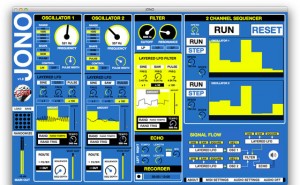
LOM has released JONO, a software musical instrument inspired by modular synthesizers.
By providing mixture of classical and experimental elements it can serve as an interesting addition to your setup or as a standalone tool.
JONO features
- Two oscillators, modulated by the layered LFO and the sequencer.
- Each oscillator has a couple of ranges and waveshapes, and LFO modulation, which allows you to mix three different LFOs into patterns and rhythms in a very simple yet powerful interface enhanced by the oscilloscope.
- State-variable filter, modulated by another layered LFO, offering three standard filter functions – lowpass, highpass and bandpass.
- Stereo echo and a recorder – for recording short bits of your work right away, without connecting additional software.
- Sequencer provides control over the amount of steps, variable loop length and the speed for each sequence (two sequencers for two oscillators).
- Includes a set of presets, but also allows you to save your own.
- ‘RANDOMIZE’ button, which randomizes the whole setup.
- MIDI support, both for classic pitch control from a MIDI keyboard as well as for control of the main parameters with knobs or sliders.
JONO is available to purchase as a standalone application for Windows and Mac (includes full source code in MaxMSP language), priced at 15 EUR.
Native Instruments Maschine Tutorial
Native Instruments Maschine has caused quite a bit of a storm since its release – to find out why, our good fiend Owen form 2twenty2 takes you through the features and applications in this three part tutorial.
The Maschine is an incredibly powerful sampler, sequencer and controller and in this first video we take a look at how to getting sounds onto the pads and what to do with them.
For full product specifications please visit:
http://www.dv247.com/drums-and-percussion/native-instruments-maschine–61792
DATAMASKIN

