
Oscillator – new and free audio-controlled synthesizer
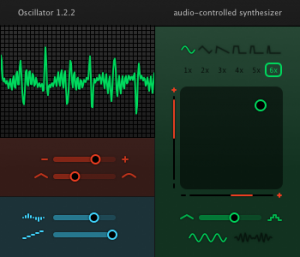
SineVibes has released Oscillator– an audio-controlled synthesizer for the Mac – as a free download.
Oscillator is an AudioUnit effect plugin that lets you turn any audio into sci-fi effects, glitches and noises. It is based on a multi-waveform oscillator with up to six voices and variable frequency stepping, whose parameters are modulated using the input signal’s dynamics.
The oscillator output can then be processed via effects which include ring modulator, sample rate degrader and bit crusher. This lets Oscillator turn any audio signal into a wide variety of sounds and effects.
Oscillator is a free download at the SineVibes site.
Quasar: new multitasking behavior for iOS Music Apps
“Trying a new Tweak for the jailbroken iPad called Quasar. It is great for playing more than one music app in the same screen at the same time and also for changing the behavior of some apps working together.”
Here’s one more demo:
Enjoy
Moog releases the Devine Expansion Pack
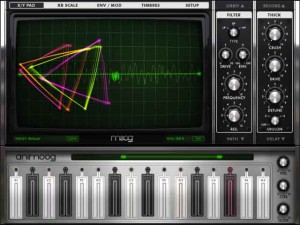
Moog has released an Expansion Pack for Animoog. They say that each Expansion Pack for Animoog contains powerful presets that inspire creativity as well as new timbres for creating sounds completely unique to you.
Created by Richard Devine, Moog tells us that the Devine Expansion Pack infuses an array of new and unique sounds into Animoog’s Anisotropic Synthesis Engine. They say that, from ethereal lead sounds to sci-fi insanity, the Devine expansion pack takes total advantage of Animoog’s uniquely expressive keyboard, modulation and timbre array.
The Devine Expansion Pack includes 32 original presets handcrafted by Richard Devine himself. Also included are 43 new Timbres nearly doubling Animoog’s sonic vocabulary.
Richard Devines speaks on his The Devine Expansion Pack,
“I have been a fan of Animoog since the day it was launched. Animoog’s ability to mix and match classic analogue waveforms and also digital waveforms is amazing! Being able to sweep, automate, and control them within the Anisotropic Synth Engine is what makes it such an expressive tool for creating new sounds. With the Devine Expansion Pack, I wanted to develop a sound set that took full advantage of all Animoog’s features. Something that was unique and could be played musically or controlled chaotically. The ultimate goal was to create a set of futuristic synth sounds that inspire new ideas and new music.”
Pricing and Availability:
$1.99
More information:
Solvent in the studio
Veteran Canadian producer and hardware lover, Solvent, gave StudioFeed an inside look at his Bloor-West home studio set-up, as well as discussed everything from why he makes music to the story behind his recent RDJ-CS5 EP. Jason touched on many topics involving music in this lengthy interview, including what it’s like to have a fifteen-year career and to still be considered a “relatively obscure” musician. In addition to making music, Solvent is also involved in a documentary on modular synthesizers called “I Dream of Wires” that is expected to be released later in 2012.
Dowload StudioFeed’s whole interview with Jason from our Soundcloud player (35 mins):
soundcloud.com/studiofeed/studiofeed-interview-solvent
for more info:
solventcity.com
solvent.bandcamp.com
Closer look at the Akai MAX49 keyboard controller
Here are three brand new videos featuring the new controller from Akai, more info below:
MAX49 from Akai Professional places revolutionary MIDI and CV control at your fingertips. With an intuitive layout and included AkaiConnect automatic-mapping software, MAX49 offers an instant, fully immersive experience with your favorite music software and virtually all VST plugins. From its 49 semi-weighted keys and 12 real MPC pads, to its groundbreaking LED touch faders and vintage CV & Gate outputs, MAX49 combines cutting-edge Akai Pro technology with classic capability to give you an unprecedented music-making experience.
CUTTING-EDGE
MAX49 is one of the most unique controllers ever engineered. Right away you’ll notice one of its most distinguishing features: four banks of eight backlit LED touch faders, allowing you to assign up to 32 control parameters. You can use MAX49’s LED touch faders just like analog faders by simply dragging your finger along their touch strips, or you can perform instant leaps in any MIDI value from zero to maxed out and everything in between—an unprecedented, unmatched controller capability.
CLASSIC
MAX49 is also equipped with four banks of 12 backlit MPC pads, giving you a total of 48 assignable pads, allowing you to integrate legendary Akai Pro production capability into live performances and recording sessions alike. These backlit, velocity sensitive pads come with classic MPC Swing, Note Repeat, Full Level and navigation controls to give you all the tools you need to create music at your highest level.
MAX49 comes ready to command any controller hardware or software from any era: USB MIDI, traditional 5-pin DIN MIDI and even Control Voltage and Gate outputs are onboard, allowing you to control everything from today’s most advanced music software, to analog modular synths from as far back as the 1960s. Mackie Control and HUI protocols are also built in to give you instant compatibility with many industry standard DAWs.
Time machine: KORG DW-8000 Digital Waveform Synthesizer
KORG DW-8000 Hybrid Synthesizer from the year 1985.
single sound demo
– 8 Voices
– 2 Oscillators per voice
– 16 digital waveforms
– analog lowpass VCF
– analog VCA
– Arpeggiator
– Digital-Delay

Take Korg’s first digitally controlled analog synth hybrid (DW-6000) two steps higher and you get the more popular DW-8000. Sound is digitally generated from the DWGS (Digital Waveform Generator System) and has been doubled from 8 sampled digital waveforms to 16 simple analog to complex digital waveforms. The DW-8000 has 8 voice polyphony in two modes, or one monophonic mode with all eight voices stacked. The analog VCF resonant filter and VCA both have independent ADBSSR envelopes. Parameters can be altered in real time via a single programmable slider. There are 64 presets that can be reprogrammed by the user.
When the DW-8000 succeeded the DW-6000, it expanded it to 8 notes polyphony, 16 sampled waveforms, a velocity sensitive keyboard with programmable aftertouch, auto-bend, a simple arpeggiator and a digital delay unit. The Digital Delay was an astonishing goody for the time, offering up to 512ms delay, phasing, flanging, chorusing and other time effects. Both the Arpeggiator, Auto-Bend and Digital Delay make this synth an inspiring and great sounding machine to use for great 303 basslines, techno and house bass and synth sounds and more! The EX-8000 (pictured above) is a rackmount version of the DW-8000. Several 3rd-party developers offered expansion boards for the DW-8000 providing up to 1024 presets, layered sounds, keyboard splits and Sample+Hold for the LFO.
How to make a classic trance gate in Cubase
Background information:
Some plug-ins include stutter effects inspired by the sidechain gates used in classic ’90s trance tracks – just think of The Age of Love’s eponymous hit.
You can gain more control over the sound if you do it the old-fashioned way, though; in the video above, you’ll see how it’s done in Cubase.
You can download the audio files that the video refers to by clicking here.
Inside Synthesis – Introduction to Modular Synthesizers
Episode 3 from the original series – a very basic introduction to modular synthesizers.
Correction #1 – I refer to modulating the amplitude of an audio signal with another audio rate signal as Ring Modulation (RM). I should have said Amplitude Modulation (AM).
RM is certainly related to AM, but there’s a distinct difference. RM is implemented in such a way that the carrier and modulator’s frequencies are eliminated from the signal. You only hear the sums and difference frequencies of the carrier and modulator, but not the original carrier and modulator frequencies.
Interestingly enough, the AC-coupled circuitry that does RM is ring shaped.
Correction #2 – Neither RM nor AM add harmonic frequencies. They add sidebands of inharmonic frequencies – hence the metallic and dissonant sound.
Arturia Wurlitzer V Piano Review Extended
As we reported on a couple of days ago – Arturia released their emulated version of the classic Wurlitzer electric piano, here’s a nice review of it via AUB:
“Russ gives a first look and show and tell, plus his opinion on the new Arturia Wurlitzer V Piano.
Check it out for yourself.”
Roland Jupiter 8 “Wicked”
The Jupiter-8 is an eight-voice polyphonic analog subtractive synthesizer introduced by Roland Corporation in early 1981.
The Jupiter-8, or JP-8, was Roland’s flagship synthesizer for the first half of the 1980s. Although it lacked the soon-to-be standard of MIDI control, later model Jupiter-8s did include Roland’s proprietary DCB interface, and all of them sported advanced features such as “Four on Four” and the ability to split the keyboard into two zones, with a separate patch active on each zone.
DATAMASKIN

