
The Mini Moog Synthesizer with Herb Deutsch
Herb Deutsch, the co-inventor of the first Moog synthesizer discusses the history and functions of the Mini Moog as well as its impact on the music of the time. Deutsch also plays one of his original jazz fusion pieces.
Directed by Michael Sterling
Check out the new SynthBoy+
Listening to the sounds from the older gaming systems is a great way to both reminisce and create cool sounds for a song or just to have fun. There is a large community that has been working with these sounds for many years and we thought we could make a hardware interface that would give more people the chance to play and hear these unique era centric sounds again. From hard bass lines to awesome 8bit waves there will be something that everyone will enjoy.
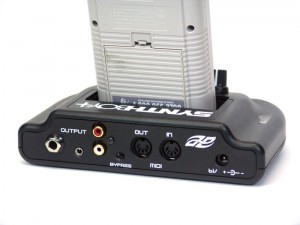
We have lots of audio connectors on the back of the synthboy+. Whether you are an experienced DJ or connecting it to your home stereo there are plenty of options. We have midi in and out of the synthboy+ so you can connect a midi compatible keyboard and be able to directly play the Gameboy as an instrument. If you don’t wish to ‘play’ the Gameboy as a instrument, there is a tracker style program that allows you to enter in note information and the program will cycle through these notes and sounds. The knobs do different things depending on what you are doing. If you are playing the Gameboy as a traditional instrument, the top three knobs allow you to quickly change parameters that will immediately effect the sound. If you are using the tracker style program the bottom two knobs will allow you to manipulate the flow and style of your song in real time.
Close encounters with MFB Dominion-X
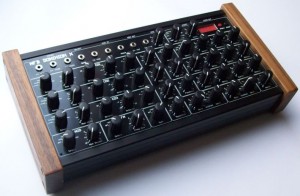
DOMINION X is MFB’s latest synthesizer. It combines analogue synthesis, programmability and modular patching. With advanced circuits, increased functionality and a new design, DOMINION X is the first of MFB’s next generation musical instruments.
DOMINION X offers three oscillators for maximum flexibility. Each waveform can be varied in symmetry. Besides altering the pulse width of a rectangle, you may also continuously turn a saw tooth into a triangle and a triangle into a sine. All oscillators also offer ring modulation. In addition, VCO 2 and VCO 3 can be synced to VCO1. Finally, VCO3 can modulate the frequency of VCO 1 and VCO 2. The analogue oscillator circuit is processor-controlled for stable tuning. To complete the available sound sources, noise or an external audio input can be added to the VCOs in DOMINION X’s mixer section.
The filter offers six operation modes. Available are three low pass variations with 12, 18 and 24 dB/oct. slopes. Also available are high pass-, band pass and a notch filter with slopes of 12 dB/oct. respectively 6 dB/oct. Variable filter modulations are possible via an invertible envelope, keyboard tracking, LFO, VCO, different MIDI controllers as well as by the use o the CV-input.
The two ADSR-type envelops are internally routed to the VCF- and VCA-sections. In addition, envelope 1 can also modulate the VCO section. LFOs 1 and 2 offer six waveform shapes including sample & hold. They may be switched to one-shot-modes to emulation simple envelopes. A third sine-LFO works in combination with a keyboard’s modulation wheel and can dynamically address the VCO, VCF and VCA sections.
Modulations are assigned by the use of selector switches, located at the destinations. This allows easily setting and re-routing internal modulation paths – ideally for your live-performance.
To integrate external modulators, control- and audio sources, DOMINION X offers nine inputs. Therefore, oscillators, filter, VCA, CV/Gate and mixer can be easily combined with other analogue synthesizers such as MFB’s MEGAZWERG, analogue sequencers such as MFB’s URZWERG PRO or modular synthesizer systems.
An additional selector switch allows assignment of velocity for up to eleven modulation destinations.
DOMINION X offers 128 programmable patches for your personal sound creations. To support sound programming without an attached keyboard, different demo sequences are available. To use DOMINION X as a filter box for external audio sources, the VCA can be opened permanently. Finally, there is an insert available to integrate an effect or distortion unit into the signal path.
A very very very short run on the patches memorized in the RAM-B bank of the small, but very effective, MFB Dominion-X Synthesizer
The small, but highly effective, MFB Dominion-X synth under CV/Gate control from Synthesizers.com 960 Step Sequencer. Out of sight, a plain MIDI keyboard for (occasional) key changes. Row 1 of seq goes on VCO 1, Row 2 goes on VCO 2&3, Row 3 goes on VCF.
Fiddling with control panel while playing the MFB Dominion-X synthesizer
The MFB Dominion-X synthesizer has some interesting capabilities of waveform shaping and its filter (developed by Carstein Schippmann) has some great modes
Basic beat creation, effect usage, G-Stomper Drum Machine for Android
G-Stomper demonstration video: Basic beat creation, effect usage.
(Device: Samsung Galaxy Tab 10.1)
G-Stomper is a highly optimized Drum Machine/Groovebox for doing electronic live performances on your Android device.
https://play.google.com/store/apps/details?id=com.planeth.gstomperdemo
https://play.google.com/store/apps/details?id=com.planeth.gstomper
Official Website:
http://www.planet-h.com/gstomper/
Custom scales in WerkBench! **Sneak preview!**
Get WerkBench here: http://bit.ly/L6jhd9
WerkBench is a live sampling step sequencer. There is nothing else like it! The next update (1.03) includes the ability to easily define custom tuning and scales.
Now you can use WerkBench to turn any sound into awesome melodies.
In this demo, I build a beat quickly and then play with this new feature with sounds from a Casio.
WerkBench features:
–“Fancy Controls” (pitch, lowpass filters, envelopes, and more!)
–Edit pitch and levels independently for each step!
–Funky lo-fi tape echo for spacey effects with a sweet real-time visualizer.
–The two sequencers can be chained to make a 32 step sequencer!
–Save and load loops.
–Export loops and recordings via Audio Copy, iTunes file sharing, and email.
–MIDI sync and MIDI trigger modes
–Custom scales (never play a wrong note!)
Pure Analog with the Oberheim OBXa + Roland SH-101
Background details:
I made this track in the mid 80’s with the Oberheim OBXa on a 4-track analog tape recorder Tascam 144.
Everything was played by hand, without a sequencer or MIDI.
The remastering is made with SONAR 8.0
This piece was also featured on our national radio called BRT-2 in 1987 in a special program “maneuvers in het donker” for home made electronic synthesizer music
Wired magazine goes all wired
Here’s Wired’s own words about the I Dream of Wires documentary:
I Dream of Wires, an upcoming documentary about modular synthesizers, celebrates analog hardware in all its wild, messy glory. More than 100 prominent musicians, including Trent Reznor, cEvin Key, Gary Numan, Carl Craig and Morton Subotnick are in the process of being interviewed for the ambitious feature-length film, which is set to be finished in the fall.
Colorful masses of patch cables, rows of knobs and faders, and electronic sounds abound in the exclusive clip above, shot this month at the legendary MUTEK Festival in Montreal. In addition to interviews with several musicians, including Keith Fullerton Whitman, Container and Clark, the 15-minute clip shows intriguing glimpses of the synths in action, in a massive multimedia dome housing 157 speakers called the Satosphere.
The “dedicated and obsessive subculture” of modular synth fanatics across the world formed the inspiration for I Dream of Wires, said director Robert Fantinatto in an email exchange with Wired. “Years ago, I made a small documentary film about the urban-exploration subculture called Echoes of Forgotten Places…. I felt that this whole world of modular synths could make an interesting little film.”
The project soon grew massively in size and ambition. Fantinatto joined forces with Jason Amm, better known as the electronic musician Solvent. With Amm as producer of the film, Fantinatto was able to reach a large number of well-known musicians.
“The trip to see Trent Reznor was probably the most nerve-wracking,” said Fantinatto. “He lives way up on the top of a mountain in Beverly Hills and it [was] quite intimidating leading up to the interview, but Trent was supercool and had us all at ease very quickly.”
But the most jaw-dropping array of modular synth gear that Fantinatto and Amm uncovered didn’t belong to Reznor or any of the other stars they profiled. The best collection, hands down, belonged to a clinical psychologist in Los Angeles.
“He had the most extensive collection of gear I’ve ever seen,” said Fantinatto. “A huge studio with every modular synth ever made, literally every single one ever!”
Fantinatto said he met many modular synth collectors who have “devoted a significant chunk of their lives [to] buying, building and collecting these machines that sometimes take over their homes and their lives.”
“The mystery behind what motivates this irrational obsession is at the heart of the film,” Fantinatto said. “In the end, it is a longing for something authentic — something that has been lost in a virtualized world.”
First patch with Make Noise Echophon
I’ll be putting together a more thorough Echophon demo shortly. In the meantime, here’s the first patch I set up after the Echophon arrived a couple of days ago.
Cyclebox –> LPG –> Echophon. Two Maths channels control everything.
At the 2012 NAMM Show, Make Noise introduced several new Eurorack modules, including the Dual Prismatic Oscillator and the Echophone – developed in conjunction with Tom Erbe of SoundHack
NIN goes 8-bit
Pretty Eight Machine is NIN’s Pretty Hate Machine album, re-invented in its entirety by Inverse Phase on eight different 8-bit systems.
Sound configurations include: SID/6581 (Commodore 64), POKEY (Atari 800), straight 2A03 (NES), AY/SCC+ (MSX+Metal Gear 2 or Snatcher cartridge), SN76489 (Sega Master System), 2A03+VRC6 (Famicom+Castlevania 3 cartridge), LR35902 (Game Boy), and OPLL (MSX-MUSIC or Japanese Sega Master System).
Pretty Eight Machine is available at the Inverse Phase Bandcamp page.
Trying, buying and installing Rack Extensions
This tutorial describes how you try, buy and install Rack Extensions with Reason 6.5 and Reason Essentials 1.5.
Read more and visit the Propellerhead Shop: http://shop.propellerheads.se
>> One very common comment I get, looking at the Rack Ext shop is that it is nice, well designed and lots of good products, but that it is way to expensive – and to be honest I tend to agree; 50 € for an effect plug-in…Quite sure we will soon see some discounts and Sales in the Prop shop 
DATAMASKIN

