
More information about Ableton Live 9 and Push
New information about Ableton live 9!
See Ableton Push in action. Push is a new instrument that solves an old problem: how to make a song from scratch. With hands-on control of melody and harmony, beats, sounds, and song structure, Push puts the fundamental elements of music making at your fingertips – and it fits in a backpack alongside your laptop.
Music toys: QUICKSHOT STUDIO 4 (1988)
Here’s a nice new toy demo from Analog Audio, details below:
Are you tired of cold, digital sounding recordings? The fully analogue QuickShot Studio 4 allows you to bring back the warmth of analogue in your recordings. The Studio 4 contains a great mixing console, a tape recorder, a microphone and very useful effects for the daily studio work…
QuickShot has also produced other high quality studio equipment like the “Sound Machine”. This is a similar machine, just instead of the effects it contains a synthesizer ;-).
It came with shoulder straps, microphone and headphones.
As a kid I always wanted it, but nobody wanted to buy it for me… my parents had no clue how important analog recording to me was 
Emmon & Mister Monell
Enjoy some cool electro!
Ableton announces Live 9 and Push – their first hardware product
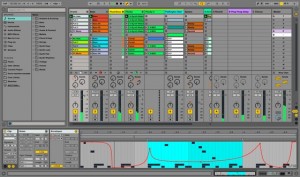
Ableton has announced two groundbreaking new music-making products: Live 9, the music creation software with inspiring new possibilities, and Push – Ableton’s first hardware instrument for Live.
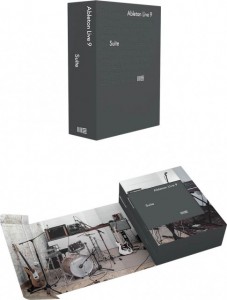
The upgrade to version 9 greatly expands the creative possibilities of Ableton’s popular Live software.
Changes in Live 9
- Session automation: In Session View, automation can now be recorded in real time directly within clips. Automation can move together with clips between Arrangement and Session View.
- Find sounds fast: Live’s new browser puts all instruments, effects, samples, and plug-ins in one easy-to-navigate view. Drag and drop folders from anywhere on your computer, search as you type and navigate from the keyboard to find everything quickly.
- Discover new sounds: Live comes with a large selection (3,500 in the Suite edition) of production-ready sounds, which were carefully crafted with the help of over 40 artists, sound designers and engineers. All sounds feature Macro controls for fast access to their most meaningful, musical parameters.
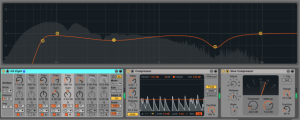
- Get your sound right: Live’s studio effects have all been reworked for even better sound and usability. The Glue Compressor is a new effect – an authentic model of a legendary 1980s console bus compressor. EQ Eight has an audition mode for isolating frequencies and an expandable spectrum display. The Gate and Compressor effects feature a Gain Reduction view which shows changes in signal level over time.
- Extract music from samples: Live’s new Harmony, Melody and Drums to MIDI tools extract natural-feeling MIDI directly from the favorite parts of your music collection. You can also sing, tap a rhythm, play any solo instrument, then use Melody or Drums to MIDI to turn your recordings into MIDI clips that you can edit and reuse with any sound.
- Edit the details: Transpose, reverse and stretch MIDI notes or warp clip automation and add curves to automation envelopes. New tools and an improved workflow allow fast and flexible editing of musical ideas.
- Max for Live – now in Suite: The Suite edition of Live 9 comes with Max for Live and its many unique instruments, effects and tools. Max for Live itself includes 24 new devices such as a convolution reverb, new drum synthesizer instruments, MIDI echo as well as reworked versions of classics such as Step Sequencer and Buffer Shuffler 2.
Ableton Live 9 will be available in the first quarter of 2013. Prices start at $99 USD/79 EUR (Live 9 Intro download version), $449 USD/349 EUR (Live 9 Standard download version) and $749 USD/599 EUR (Live 9 Suite download version). Upgrades to Live 9 Standard / Live 9 Suite vary in price depending on the Ableton products you already own.
With Push, Ableton presents a new hardware instrument designed to solve an old problem: how to make a song from scratch.
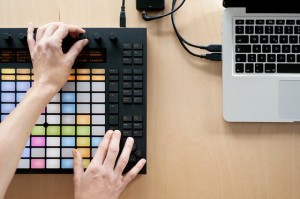
Push provides direct, hands-on control of melody and harmony, beats, sounds and structure, powered by Ableton Live running on your computer. High-quality, dynamic pads, buttons, encoders and display combined with an innovative workflow allow you to play and compose musical ideas without the need to look at or touch your computer, and more importantly, without interrupting the musical flow.
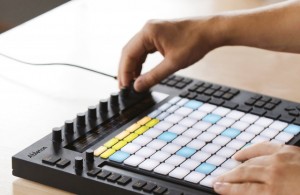
Push features
- Play and sequence beats: Push’s 64 velocity- and pressure-sensitive multi-color pads can be used to play, step sequence, and navigate within rhythm patterns – all at the same time. The 11 touch-sensitive endless encoders can control device parameters, adjust velocity, nudge timing and more.
- Play melodies and chords in a new way: Push “folds” a keyboard’s worth of notes into its 64 pads, with different pad colors showing the key center and other notes in the key. This allows you to play in every key using the same finger patterns, move between keys at the touch of a button, and explore new harmonies and phrases.
- Improvise with song structure: Push expands the scope of creation with its unique workflow. Using just a few buttons to trigger clips, overdub notes, move between song materials and variations lets Ableton Live itself become an intuitively playable instrument.
- Move smoothly from creation to arrangement: Push offers both the inspiring instrument to start creating music, and the full-featured software to finish off a track. Everything created with Push is laid out in Ableton Live on your computer – ready for fine-tuning, arrangement and export.
- Includes Ableton Live 9: Push includes Ableton Live 9 Intro and works with any edition of Ableton Live 9 (Intro, Standard, Suite). All the included instruments, effects and sounds, as well as your own libraries, are ready to be played, tweaked, and personalized.
- Designed by Ableton, built by Akai Professional: Utilizing Akai Pro’s long-standing expertise in the field of pad controllers, Push features 64 pressure and velocity-sensitive RGB (multi-colored) pads with an adaptive layout and a touch strip with 24 LEDs for pitch bending or navigating through a Drum Rack. The 11 touch-sensitive encoders and LCD display adapt dynamically to control and show active parameters.
- Fits inside a backpack alongside a laptop: Push is 370 mm / 14.57 inches wide, 293 mm / 11.54 inches deep and is 46 mm / 1.81 inches in height (including encoders) and weighs 2990g / 6.59 pounds. Backside connections are a USB port, power adaptor input and two assignable footswitch inputs. (Push is USB-powered, the brightness of the display and LEDs can be increased by using the included power supply).
- Push cover: An optional steel cover doubles as a sturdy, angled stand for performance.
Push will be available in the first quarter of 2013 for $599 USD/499 EUR. Push includes Ableton Live 9 Intro and works with any edition of Ableton Live 9 (Intro, Standard, Suite). Bundle upgrade discounts will be available for owners of previous versions of Live.
More info here >>
Logic Video Tutorial: Sidechaining the ES2 Synthesizer
More info: http://bit.ly/TAa0ze
“In this latest episode of Matt Shadetek’s Secret Knowledge series, our beloved Logic Pro course designer / instructor demonstrates how to use the side chain inputs in Apple’s Logic ES2 synthesizer to achieve creative modulation of a basic synth sound.”
KORG iKaossilator Unicorn for iPhone
Checking out some iPhone stuff from KORG, details below (in Googlish from Japanese):
If Korg teamed up with the rock band “Unicorn”! The customized to your specifications unicorn, iKaossilator Unicorn is the synthesizer application “(eye over oscillator) iKaossilator” can be played by anyone just scratched the screen of the coveted iPhone iPhone app fan. Recorded the sound loops and the single “WAO!”, Was selected from version “Feel So Moon” remix theme song of “The Brothers” Space anime, you can join the play as a sixth member, and Tamio Okuda and Yoshiharu Abe to control the performance of every one of the unicorn, we enjoy playing with feeling remix synth for beginners.
Korg MS-20 vs. Korg MS-20
Background description:
OK. This is not a song.
I had my friends MS-20 visiting mine for a brief moment. One of them is missing that legendary screw. You might have heard about this.
There’s two different filters in the MS-20. The Korg35 is in every unit which is lacking that screw in the VCA section, in the middle of the synth’s panel.
Rumours has it that the Korg35 filter makes the MS-20 sound more harsch.
You be the judge, but I for one can’t tell the difference.
Since I only had my friends MS-20 next to mine for a an hour or two, I wanted to take the opportunity to try them side by side.
I was only noodling and tweaking nothing but the filters or the parameters affecting the filters (envelope and LFO).
To make things more complicated, there’s MS-20 units with screws but still with the Korg35 filter inside.
I’ve had my MS-20 for about 18 years but never opened it up to see which filter it has.
Buchla & Eurorack
‘Eldancer’ has uploaded this nice video featuring Buchla and Eurorack. Its a nice ambient bitpop/electro pop tune with cool sci-fi ingredients
Roland Synth Story Tour
Roland has come a long way since its inception in 1972. Its synths, drum machines and effects have been used on some of the most famous records ever and have helped artists push sonic boundaries, creating new sounds and even radical new musical genres. Taking part over three dates in November, the Roland Synth Story tour will explore this rich history through a roster of artists and experts. Roland says that it’s an exciting opportunity for visitors to learn more about the company’s synths, speak to three musical icons and even get their hands on some classic Roland vintage gear.
The panel of experts, including Richard Barbieri (Porcupine Tree and Japan), Graham Massey (808 State) and Jody Wisternoff (Way Out West) will all talk about their experiences creating electronic music as well as discussing their favourite Roland synths. They’ll also be on hand to answer questions and chat to visitors after the event. All three guests are intrinsically linked to the history of the synthesizer. Richard Barbieri’s first ever synth was the Roland System 700, and he’s never looked back. His band, Japan, notched up numerous hits in the ’80s and they became a cornerstone of the influential synth-pop movement.
Graham Massey infamously named his band ‘808 State’ after the famous Roland TR-808 drum machine, which – along with the TB-303 – was an essential component to the way the band produced their music.
Jody Wisternoff uses a stable of Roland synths, including the Juno-106 and the legendary Jupiter-8, to make progressive house and breaks as one half of Way Out West. Their music didn’t just hit the charts, it also found its way into TV shows and video games.
Guests will also have the chance to get their hands on some rare and ultra-covetable Roland gear, including the following: Jupiter-8, Juno-60, Jupiter-6, Jupiter-4, Juno-106, JX-8P, D-50, JD-800, JV-1080, JP-8000 and XV-5080.
Dates and Venues
- 26 Nov. – The Roland Music Academy, Walsall College, Walsall
- 28 Nov. – The Roland Music Academy, Ealing, Hammersmith & West London College
- 29 Nov. – Huddersfield University, Huddersfield
Pricing and Availability:
Free but spaces are limited and demand is high (two tickets per person)
More information:
Experimental: Dyskograf – drawing a music sequence
DYSKOGRAF is a graphic disk reader. Each disc is created by visitors to the installation by way of felt tip pens provided for their use. The mechanism then reads the disk, translating the drawing into a musical sequence.
The dematerialisation of the props having led to an ignorance of the principles of recording and reading music, this installation leads to the rediscovery of a perceptible contact with recorded music and by this means, to the deduction of how it works.
The installation is above all a tool, which allows the creation of musical sequences in an intuitive way. The notion of a loop, closely linked to electronic music, is represented here by the cycle of the disk. The disk passes indefinitely in front of a camera fixed onto an arm. This substitution for the needle converts the drawing into sound by way of a specific application program (software). Through this system, the sequential ordering of music is learnt in a playful way, at the same time creating a unique object, souvenir of the musical composition.
The numeric world is a world of binary choice. The object of DYSKOGRAF is to give room again for accidents in numeric creation, accidents that often favour creativity.
——————————————————————
Venez essayer Dyskograf à Visionsonic et OFNI :
visionsonic.net (du 16 au 17 novembre à Mains d’Oeuvres / PARIS )
lieumultiple.org/6365/festival-ofni-10e-edition-ouverture-1411/ (du 14 au 15 au Lieu Multiple / POITIERS )
——————————————————————
Co-production : Cultures Electroni[k], Les Bouillants, Avoka
More info on the web :
dyskograf.com
avoka.fr
DATAMASKIN

