
Introducing Traktor DJ for iPhone
TRAKTOR DJ, the pro DJ app for iOS, is now available for iPhone and iPod Touch. More info and videos: http://www.native-instruments.com/tra…
Deliver devastating DJ sets using familiar iPhone gestures, with beautiful waveforms at your fingertips. Set up beat grids, cue points and BPM tags on your iPhone to sync with your TRAKTOR PRO setup. Perfectly adapted to the iPhone’s compact screen estate, TRAKTOR DJ for iPhone puts professional DJing in the palm of your hand.
TRAKTOR DJ for iPhone is available now at the iTunes App Store for only $4.99 / 4.49 €.
http://ow.ly/kzEzo
The iPad version is available for only $19.99 / 17.99 €.
http://ow.ly/kzEGz
Tracks by Modeselektor – Pretentious Friends (Instrumental version), Berlin (Instrumental version)
ImageLine – Harmor Minimal RnB Pads
Dan-D makes some free presets for everyone!
How to turn a Reel to Reel Tape Machine into a Tape Delay using a Modular Synthesizer
‘darshonaut’ wanted to turn a Reel to Reel Tape Machine (Revox A77 MK III) into a Tape Delay, but since he doesn’t use a traditional mixing desk with Aux In/Out , he had to come up with a patch for his Curetronic modular synthesizer.
Turnado Ipad Edition Trailer
Sugar Bytes awarded effects plugin TURNADO is now available for the iPad!
It features the full Turnado software with 24 effects which can be turned on and off
using big knobs.
For better iPad experience, we added a nice audio player, 4 XY pads and more!
Sugar Bytes Turnado, now on the App Store!
http://www.sugar-bytes.de/content/pro…
The Moog Ladder Filter
Moog Engineer Rick Shaich discusses the Ladder Filter, the first Voltage Controlled Filter, which is the heart and soul of the Moog modular synthesizers of the 60s, the Legendary Minimoog of the 70’s, and is still the same filter topology used in all Moog Synthesizers to this day. The Ladder Filter creates the massive, thick sound for which Moog instruments are renowned.
Novation Bass Station II – World Exclusive
Background video description from Sonic:
Novation were keen to give us another opportunity to see the new analog monosynth in the flesh in the altogether calmer and more forensic environment of our own studios. An extra bonus being we got time with Nick Bookman, a long time Novation guy who is also deep into the development of the instrument, and knows it intimately.
Bass Station II is an analogue mono-synth based on the classic original Bass Station but re-worked for the 21st century. It has two filters, two oscillators plus a third sub-oscillator, patch save and a fully analogue effects section. Add a step sequencer, arpeggiator, full sized keys and a powerful modulation section and you have the makings of a synth that is built for bass, but capable of so much more.
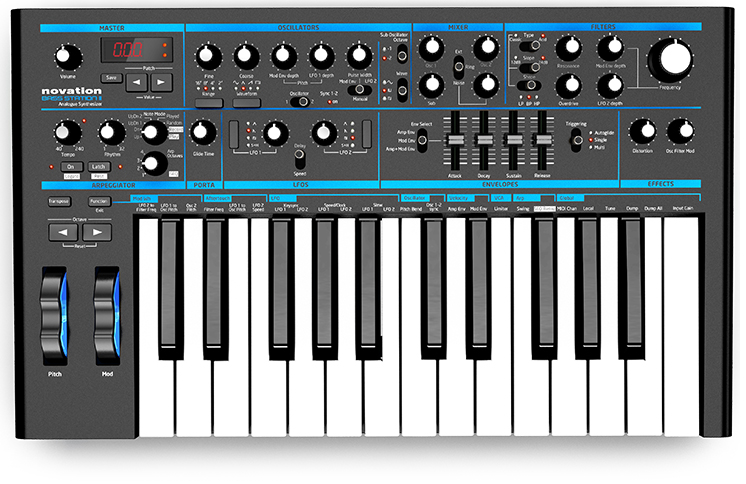
Bass Station II is an analogue mono-synth with a talent for bass, but a sound-engine that is versatile enough to kick out sharp leads and crisp arpeggios. It brings the best elements of the original Bass Station into a brand new design with re-worked modulation, effects, filters and more; like the Bass Station, but a much much bigger sound.
The signal path is pure analogue – including the effects section. The hardware has been laid out in modules with dedicated pots, switches, sliders and buttons for all major parameters. Critically, you can store and recall patches on Bass Station II. It comes with 64 killer factory presets, space for 64 of your own sounds on the hardware, and you can store more on your computer.
The key-mech consists of 25 full sized keys that are velocity sensitive with assignable aftertouch. It has been developed as a ‘synth-action’ keyboard, where each key is individually sprung so it is light to the touch and highly responsive to the synth engine. Bass Station II is a fully class compliant MIDI device with MIDI I/O on 5 pin din ports – for connecting to other MIDI outboard – and with your computer over USB. You can even connect an external instrument and run it through Bass Station II’s analogue filter and effects.
ALCHEMY MOBILE.The Big Sound Test for iPad
A look at the new upgrade for Alchemy Pro which now has Audiobus Compatabilty and lots of new features including a four track recorder, drum pads and lots of new sounds..This video concentrates on the sounds and playability via a midi keyboard.
Teaser from MacBeth – NEXUS TEST (3)
People have asked that MacBeth do a video of the NEXUS prototype again- more features now added include Octave Switch for all 4 Oscillators. For Oscillators 1 and 3- seperate Pulse Width Modulators have been added- separate mening independant of each other and of the on board LFO. Fatten your sound up with a full on 4 Oscillators! Also featured on this synthesizer are a Dual State Variable Filter, 4 Envelope Generators, Dual Noise Generators, Dual VCAs and Dual Tape Delay Simulator circuits! NEXUS is a true stereo analogue synthesizer with touch plate keyboard! In the hands of a real musician- this thing will work wonders!
Roland VR-09 Combo Keyboard First Hands-On
Keyboard magazines first hands-on time with Roland’s surprisingly affordable (under $999 street) new combo keyboard, which puts organ sounds first but also does great piano, EP, Clav, and synth sounds. It also offers lots of controls for realtime parameter tweaking (with the drawbars doubling as filter and envelope controls on synth sounds–cool!), and super-easy splitting and layering on the fly. Read the full review in our July 2013 issue.
Time machine: KORG 770 Analog Synthesizer 1976
The Korg 770 is a great little monophonic synth from 1976. It has 2 Oscillators, 2 Filters, Ringmod, White & Pink Noise, Scale Noise, 2 LFOs and external signal input. Small but very flexible!
“I played the Korg 770 along with a Lexicon MPX 500 for reverbs and a Roland DEP-5 for delays.”
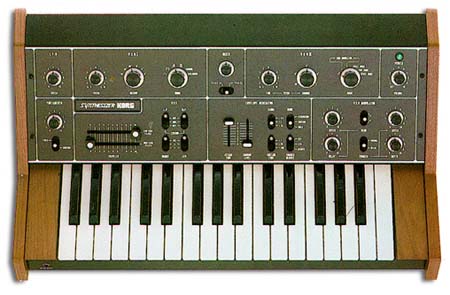
An ancient synthesizer from Korg. Aside from being very old, there isn’t much else to say about the 770. It was released in 1976, is monophonic, very limited in design, flexibility and sonic possibility. It can make some weird noises largely due to its retro-cool ring modulator. You can also run external sounds through it. Bass, string and lead sounds are ok. It’s got a fast envelope, auto bend, and LFO re-trigger too. An ole’ classic that’s fun to play with and useful if you’re in the mood for buzzy analog sounds.
DATAMASKIN

