
Experimental – Tessel, Kinetic Sound Installation
A kinetic sound installation investigating the perception of sound and space. Tessel is constituted of a suspended and articulated topography of 4 x 2 m, subdivided into forty triangles. Twelve of them are fitted with motors and eight are equipped with audio transducers, which transform the surface into a dynamic sonic space. A dialogue between space and sound is created through this sculptural “choreography”. Our perception is altered, as the surface slowly modifies its shape.
From Tinguely’s poetic machines to Alexander Calder’s mobiles or Buckminster Fuller’s synergetics, Tessel combines influences that question the link between geometry, movement and chaos, thus continuing the quest for beauty in the synesthetic perception of sound and spatial phenomenons. Its name is derived from “tessellation”, a term applied to the geometric subdivision of a surface into plane figures, also known as “tiling”. It also describes a software technique that allows calculation of renderings through the subdivision of surfaces into polygons. The term has its origin in the Latin word “tessella”, describing the square tiles used to make mosaics.
Tessel is a collaboration between French composer and artist David Letellier, and LAb[au], Belgian electronic arts studio. Tessel is a co-production of the galleries MediaRuimte (Brussels) and Roger Tator (Lyon), realised with the financial support of Arcadi, Dicream and the Commission des Arts Numériques de la Communauté Française de Belgique.
More info: http://www.davidletellier.net/works.html#tessel and
http://lab-au.com/
Prophanity – Free VST synth
Prophanity – http://www.vstplanet.com/News/2012/Prophanity
Developer: robersonaudio.tk
Chris Roberson (a.k.a. Blu Gruv) has released Prophanity, a freeware VST instrument which aims to clone the Prophet 5.
- Oscillator A: Frequency, Osc Waveform (Saw/Square), Pulse Width, Sync
- Oscillator B: Frequency, Fine, Osc Waveform (Saw/Triangle/Square), Pulse Width, Low Freq, Keyboard
- Mixer: Osc A, Osc B, Noise
- Poly-Mod: Sources – Filter envelope, Osc B; Desinations – Freq A, PW A, Filter
- Wheel-Mod: Source mix (LFO/Noise)
- LFO: Frequency, Waveform (Saw/Triangle/Square)
- Filter: Cutoff, Resonance, Envelope Amount, Keyboard, ADSR
- Amplifier: ADSR
- Volume, Velocity, Master Tune, A440, Glide
Download Prophanity here or here! 1.41 mb
Retro: Panasonic SG-123 Do-Re-Mi Portable Turntable & Mini Organ
“Cool vintage portable, ruining “Sleepwalk” by Santo & Johnny. Laughter/background vocals by the kids.”
This apparently emerged in 1977: Simply great! Listen to your own favourites and play to them. A masterpiece of a time where mothers were happy and children were creative!
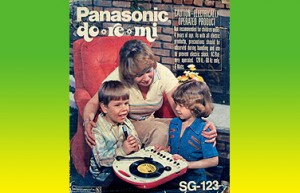
Via WTE
NAMM 2012 teaser – this time from Teenage Engineering
Seems the guys at Teenage Engineering are hard at work before Winter NAMM, whatever they are doing 
“Just a little teaser vid and some glimpses from our workshop/studio.”
http://www.teenageengineering.com
Nice demo featuring the Korg MS-20 and an Empress VM Superdelay
The superdelay is on the “tape” setting the entire time. No other effects are applied. The Vintage Modified superdelay is based on a superdelay with some modifications to the tape modes. The Vintage setting has some added modulation and the Old mode has had some high end rolled off a bit with the same modulation and some grit added to reproduce the sound of worn heads and dirty tape on your tape delay. The Vintage Modified Superdelay still has all the rest of the features and delays as the original.
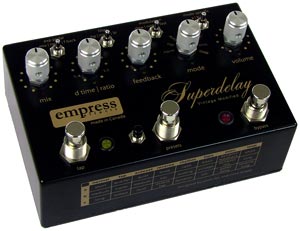
Hardware:
Korg MS-20
Empress Effects Vintage Modified Superdelay
Electronic moon chant
Equipment in action:
Arp Odyssey 2821
Kenton Pro 2000
Moog Voyager Bass
Moog MP 201 CF 251
Roland EF 303
Logic Ultrabeat Drum
NAMM teaser pic – Check out the Casio XW-P1 Performance Synthesizer
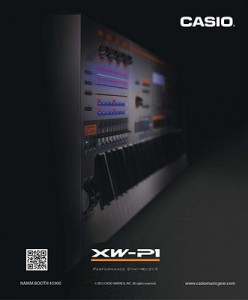
This is something we definitely need to check out at NAMM – don’t miss it
Acoustic NES! (Introducing: The Cartridge Kazoo)
This is pretty fascinating
DOWNLOAD THE FREE MP3: http://bit.ly/AcousticNES
MLR in Reaktor!
“The original MLR was written in Max/Msp by Brian Crabtree, inventor of the Monome. I have rebuilt his program in another language, Reaktor for many reasons: to best understand how a program works, bottom up; because I would like to see the program have more functionality, and I am more fond/capable of/with Reaktor over Max/Msp; and because Reaktor adds certain features that Max/Msp does not allow for. For one, the ability to use any program created in Reaktor as a VST, automatically in your favorite DAW.
After I am complete advancing the program the way I would like to in Reaktor, I will code it in C as a standalone program.”
opensource collaboration with no regard for national borders or trade agreements. this is grass roots interaction with the aid of the modern world.
mlrV is fundamentally based on brian crabtree’s mlr
it has been REFACTORED by trent gill with assistance from %
see: vimeo.com/2434050
GET IT > docs.monome.org/doku.php?id=mlr:mlrv
monome.org for the latest updates
Interview – John Foxx: Mr. Yes
Here’s a new interview with John Foxx that was published by Resident Advisor:
In conversation with the synth pop pioneer and his current collaborator, Benge.
The final track on John Foxx’s 1981 single, Burning Car, was called “Mr. No.” And you’d be forgiven for thinking that it was the man’s theme song. Whether it be leaving a band at the exact moment they were primed for stardom (Ultravox) in the late ’70s, going it alone on legendary synth albums like Metamatic and The Garden or withdrawing from music altogether in the ’90s to pursue graphic design, Foxx has been more than willing to play Bartleby time and time again. Turn it around, though, and you have a guy who has had the courage to walk away. A guy who can’t help but hate to do the same thing twice. A guy you can also call Mr. Yes.
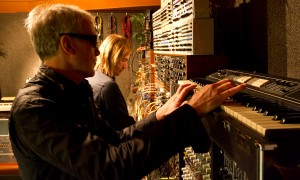
At this past year’s Unsound Festival, we talked to Foxx alongside his current collaborator Benge as part of RA’s Live Exchange series. The duo had recently put together an album, Interplay, that formed the basis for our conversation. Typically eloquent, Foxx was so engaging that we decided to edit and condense it for publication. Speaking with RA’s Todd L. Burns in front of a crowd, Foxx and Benge touched on their partnership, the creative process and the power of the bass drum.
The new record is a return to synth pop in a way for you. I am wondering why now? Why was this the right time to revisit this space?
John Foxx: It was an accident in many ways. Benge made a record called Twenty Systems, in which a lot of synthesizers sounded like themselves. What I mean by that is that they didn’t imitate any other instrument. I think it is a great sickness to try to imitate orchestras or bells or something specific. I think that this is a misuse of the instrument. What Benge was able to do was that he allowed them to make sounds that no other instruments could make, and therefore allow them to sound like themselves. When I heard that album, I wanted to work with him and to make some abstract music with him, but it didn’t quite work out.
At what point did you realize it was turning into a more “pop” project?
Benge: Halfway through the first track I think.
John Foxx: Once we had set up something on the Moog, we let it run by itself and produced a rhythmic loop, and we were able to produce a song immediately. You have the melody, you have rhythm and you have harmonic intervals that lend themselves to layering. So I instinctively started started to sing along with the machine, which is a lovely way to work: the machine leads. The machine takes precedence. All you do is listen to what the machine produces. Benge would set up things, and it was delightful to respond to it.
John, were there any lyrical themes that seemed to recur throughout the album?
John Foxx: Yeah, I always seem to write about the basic level; a man, a woman and a city. It’s because I am an urban creature most of the time. I think that’s increasingly relevant now because I think most people do live in cities and I think it is very interesting what happens in that environment. We alter ourselves constantly to live in it, to survive in it and that process has very poetic levels. I don’t want to sound pretentious, but it is very moving the way people accommodate each other and the city that they live in, and try to build this environment together. You almost have to dissolve yourself, re-incorporate yourself with the city in order to make it work on any level. All those tiny interactions and the major draws and minor draws that result from all that. I find it endlessly fascinating. I could sit in a cafe all day and some times I do. It’s like being part of a beautiful ocean that is constantly moving. A lot of what I sing about is trying to describe some of that process.
I’ve read you talking about the importance of acoustic space in your work. I was wondering how that came to play in this album if at all.
John Foxx: We weren’t so concerned with it because I think everything is artificial in some way.
DATAMASKIN

