
Synchonizing Electronic Musical Equipment and Acoustic Drums
“The ability to have sequences of different devices play in time together can be a challenge. In this video, I demonstrate how I synchronize various equipment. MIDI and DCB standards can also be easily synched, but are not shown in this video. I use primarily DIN Sync and analog clocks (including the Garfield MiniDoc) for this demonstration. The Casio and the DR110 have been modified to accept a clock input. The solenoid drum triggers were built by me and allow for dynamics (accents) – the roll in the drum pattern is programmed using a pulse LFO with an S/H modulation for random variation. There is more information on modifying clock signals at www.artoftravelogue.com.”
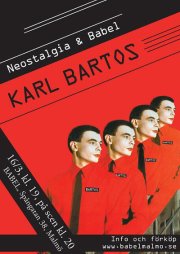
Tribute to Karl Bartos who is playing live in Sweden this week :-)
Radioactivity (KRAFTWERK)
by RUBYORLA PLAYS TENORI-ON
Bleep’ – new free synth plugin
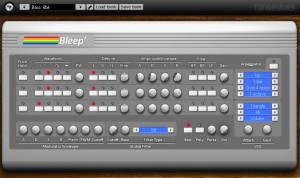
ToneBytes has announced Bleep’, a free synthesizer instrument for Windows.
Bleep’ — is a free VSTi synthesizer plug-in for Windows which inspired by the sound of MOS Technology SID. At the same time Bleep’ is not emulator of this chipset but only partially similar to its architecture.
Bleep’ features
- 3 oscillators with four waveforms: sawtooth, triangle, pulse (with PW) and noise.
- Each oscillator has own detuner, ADSR envelope and multimode LP/BP/HP filter.
- Multimode LFO synced with BPM.
- Modulator Envelope Generator.
- Pseudo arpeggiator.
- Overall multimode filter.
- Built-in preset manager with ability to patch name editing.
- VST automation and full MIDI Learning are supported.
Bleep’ is available to download as a freeware VST instrument plug-in for Windows PC.
Modcan Touch sequencer. “Four Voice Song” Quick demo.
Short edited demo of the integration of the Modcan Touch sequencer into a modular synthesizer system. 4 voices in 3 sequences that constitute a “song” in TS terms. Make Noise Rene controls wave shape and pitch of the low end pulse/4th voice of the Wiard Malekko Anti Osc.
Video shot with Apple Photo booth/MacBook Pro.
Tabletop Updates (HD)
A quick peek at auto-routing, and gesture tweaks
The heart of Tabletop is a modular environment where you can mix and match different devices. Select from over 20 devices including samplers, mixers, effects, sequencers and more. Buy only the gear you need from an expanding catalog.

Tabletop is the first musical environment designed from the ground up exclusively for the iPad. Each device has its own uses, characteristics, personality—ranging from classics like drum pad samplers to touchscreen effects.
- 27 unique devices
- Over 500 sounds (multisample instruments, loops, phrases)
- Record sequences, arrange into songs
- Adjustable quantization (pre- and post-record)
- Recordable parameter automation
- Overdub and replace record modes
- Trigger sequences and patterns live
- Multitouch instruments and devices
- Sampling (internal mic, line in)
- Adjustable tempo with optional swing
- Import your own sound library, save presets
- Support for imported .mid phrases
- Insert and send/return (master) effects
- Undo history
- 44Khz, studio-quality audio
- Share recordings directly to SoundCloud
- Sync 2 iPads running Tabletop or other apps with WIST
- Import sounds from dozens of apps with AudioPaste
- … and much more! See the full feature list
Live Dubstep Controllerism
More information below:
http://bandesnaci.com/
This is a live controllerism routine. No loops, no pre-recorded patterns, just buttons, samples and a little practice.
The track is called “Waking Up” and it’s the first of my productions to be sampled and chopped into little bits and one shots for the purpose of live performance.
Time machine: Roland JV-1080 “Early 90s”
all synth sounds and drums:
Roland JV-1080 Digital Synthesizer (1994)
recording: multi-track
more info: http://www.retrosound.de
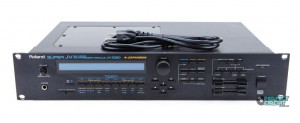
The Roland JV-1080 was one of the hottest and most popular digital synthesizers ever to come from Roland. Incredible sound quality capable of emulating any instrument imaginable plus totally fat analog synth type sounds and loads of percussion! It has 64 voices of polyphony and 16 part multitimbral, it’s no wonder this is part of almost every Film Score Composers set-up as well as many more artists and hobbyists!
It has 8MB of sounds and it also offers a lot of expandability with 4 expansion slots and 2 data card memory slots. You can get up to 42MB of sounds by adding any of the popular JV-80 expansion cards suited for Techno, World Instruments, Orchestral or Synthesizers. The 1080 has a large LCD screen, lots of effects and filters for creative flexibility, motion control and extensive MIDI implementation. Editing is intense but enhanced and simplified by external editors like MOTU’s Unisyn.
Synth Pylon
Nice and warm bleepy analog sounds coming your way
4ms Peg RCD VCAMatrix
Analogue Systems RS 100 RS 110 RS 360
Arp 2821 Pink Noise
Doepfer A 134 pan by Moog MP 201
Flame 2x Chord Machine
Make Noise Brains 2x PP Maths Moddenix QMMG Wogglebug
Malekko 4x Unkle 4x Anti
Oberheim Sem
Ringmodulator Anti& Unkle to 2x Moddemix
Roland System 104 Sequencer
Toppobrillo Sportmodulator
Master Clock Logic via Kenton Pro 2000II and 2x 4ms RCD
Drums Logic Ultrabeat
System 46 – pure vintage synth jam
Background details:
An epic, cinematic, melancholic electronic song based on my life experience and a few composers / bands who have influenced me in my youth years – Ennio Morricone, Joy Division, Propaganda / Trevor Horn (with a dash of Goldfrapp thrown in for good measure).
Instruments used:
Prophet-5 ver.3 through Electro-Harmonix Clone Theory (original ’70s model)
Jupiter-8 through Roland M-10DX reverb
Oberheim DMX drum machine
Korg Triton trumpet through Eventide H3000-D/SE reverb
Buchla Boys heavy beats live patching
Part of the first set of the last concert at the 2012 Sirén Festival. This is a festival arranged by the students at the composition and individual programs at the Academy of Music and Drama, University of Gothenburg, Sweden.
Buchla Boys are David Sabel and Niklas Sjösvärd, and they’re performing on a 1980’s 5-panel Serge and a 18-size Buchla 200e, both belonging to the Lindblad Studios at the Academy. The patching is improvised, and there’s a crowd dancing behind them (too dark to film). This is part of a longer set, and there’s more photage coming, of higher quality.
This was filmed with a mobile camera.
DATAMASKIN

