
Analog synthesizers – GRP A4 x8 24 Oscillators in unison
Paolo Groppioni plays eight Grp A4 Analog Synthesizers in unison. Twentyfour wild VCOs under the same MIDI master keyboard control.
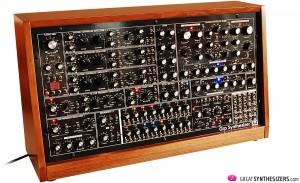
- Voltage Controlled Oscillator 1, 2, 3
- Wide audio range (64’-2’) w. Tune & Fine; six analog waveforms (sine, triangle, triangle & saw, saw, saw & variable pulse summed, variable pulse); manual pw & pwm (from VCLFO1, EG1, S&H, Aft); FM 1 Amt (lin/exp –from VCLFO1, LFO2, VCO1, 2, 3, Noise, S&H, EG1, EG2, Aft, ModW, KeyVel, EnvFoll) w. phase rev; FM 2 Amt (only exp – from VCLFO1, Env Foll); sub oscillator (on VCO 1, 2) -1/-2 oct; hard sync (VCO 1 master); kybd on/off (w. user’s selectable octave offset from MIDI Interface).
- Ring Modulator
- Ring Mod Sources: VCO 2 & VCO 3/Ext Input (user’s selectable).
- Noise Generator
- White & Pink Noise selectable.
- External Input
- Input gain from line to mic level; freely adjustable Gate Threshold (Gate to EG 1-2); enclosed envelope follower (goes into mod buss).
- Audio Mixer
- Separate level controls for VCO 1, 2, 3, Sub 1, 2, Ext Input, Ring Mod, Noise.
- Filter Section
- Dual analog filter section: 24 db/Oct Low Pass Transistor Ladder Filter w. pole selection & 12 dB/Oct State Variable Low, Band, High, Notch Filter.
- Each filter has a separate Distortion/Level control.
- Filter section can be configured in LP 24 Only, SV 12Only, Serial (LP into SV), Parallel, Direct Out (LP 24 goes on Left Audio Out, SV 12 goes on Right Audio Out).
- Low Pass Filter:
- Slope selection (6, 12, 18, 24 dB); Cutoff Frequency; Resonance; Overload LED; FM1 Amt (from VCLFO1, LFO2, VCO 1, 2, 3 Env Foll, Noise, S&H, EG2, Aft, ModW, KeyVel) w, phase rev.; FM 2 Amt (from VCLFO 1); FM 3 Amt (from Step Sequencer, Kybd Track 0-120%; Key Vel On/Off.
- State Variable Filter:
- Mode (12dB HP, 6 dB BP, 12 dB LP, 6 dB Notch); Cutoff Frequency; Resonance; Overload LED; FM1 Amt (from VCLFO1, LFO2, VCO 1, 2, 3 Env Foll, Noise, S&H, EG2, Aft, ModW, KeyVel) w, phase rev.; FM 2 Amt (from VCLFO 1); FM 3 Amt (from Step Sequencer, Kybd Track 0-120%; Key Vel On/Off.
- Voltage Controlled Amplifier
- Dedicaded Envelope Generator (see below); Control Selection (dedicated EG2, ON-hold, External CV); VCLFO1 Amt.
- AutoPan
- AutoPan Off/Internal Clock/VCLFO1; Pan Frequency Control; LED (red = internal clock; blue = VCLFO1).
- Stereo Main
- Master Volume.
- Envelope Generator 1
- Multi Stage Loopable Env (Attack, Hold, Decay, Sustain Lev, Sustain Time-Only in Loop On, Release); Gate Source Selection (Keyboard, S&H, ExtIn/ Step Seq); independent EG Amt for 24 dB LP Filter and 12 dB State Variable Filter, both w. user’s selectable EG polarity.
- EG time goes from 1msec to 60 sec.
- LED: red = EG under Gate sources; blue = EG under Step Sequencer control;
- Loop Envelope: loop from Attack to Release, w. Sustain Time selectable.
- Loop Mode Switch:
- Loop Off: EG as standard AHDSR, no Sustain Time.
- Gate: EG loops from A to S (w. Sustain Time max 60”) as long as Gate is On.
- Auto: EG full loop, from A to R; independent from Gate.
- Envelope Generator 2
- Same as EG 1, without Hold segment.
- Voltage Controlled Low Frequency 1
- Frequency (from very low to 2500 Hz); Waveform (sine, ramp, triangle, saw, square w. variable pulse); FM Amt (exp, w. phase normal/rev); FM Sources (Key, EG1, EG2, LFO2, Seq A, B, A+B, S&H, Aft, ModW, EnvFoll); Sync (Off, Gate, Seq, MIDI – dividing factor selectable from internal MIDI Interface); Shaping LFO out (from: Off, EG1, EG2, Lfo2, SeqA, B, A+B, S&H, Aft, ModW, EnvFoll).
- LFO act as modulation buss for auxiliary sources: EG1, EG2, S&H, Noise, VCO2, EnvFoll. The aux source can be amplitude modulated with the Shaping Select.
- Voltage Controlled Low Frequency 2
- Frequency; Freq Range (Low-Mid-High); Waveform (Triangle, Square); Shaping Select (Off, Aft, ModW).
- Independent Send Modulations for: VCO 1, 2, 3 freq; PWM 1, 2, 3; VCF 24/12 Cutoff; VCA Level.
- Sample & Hold
- Frequency; Frequency Source (Int, VCLFO1); LED (red = Internal, blue = VCLFO1); S&H Source (Pink Noise, White Noise, VCLFO 1, LFO 2, VCO 1, 2, 3); Glide.
- The S&H Clock can be routed to EG firing; there are three options: Off – no routing; Gate – the S&H clock is ANDed with keyb/ext/manual Gate; Auto – EGs always fired from S&H.
- Tuning/MIDI
- Master Tune; Portamento Time; Bend Amount; VCO 1 Portamento On/Off, VCO 1, Bend On/Off; Hold On/Off; A440 On/Off; Retrig On/Off; Manual Gate.
- MIDI Interface: MIDI Channel Select; Keyboard Off Octave Offset; External CV In Octave Offset; MIDI Clock Divider on LFO Reset.
- A4 receives: MIDI Note On/Off, Bend, Modulation, Aftertouch, Key Velocity, Expression Pedal, Damper.
- Step Sequencer
- User’s configurable Mode Select 8×2 or 16×1.
- Clock Source: Int, VCLFO1, Ext, MIDI.
- Clock Divider on all Clock Sources; dividing factor MIDI: 1/1, ¼, 1/4t, 1/8, 1/8t, 1/16; dividing factor TTL: 1/1, /2, /4, /16, /32.
- Sequencer Mode: FW, BW, FW/BW, PNDL, ALT, RND, TRG.
- CV Seq Clock: A, Off, B on internal Clock.
- VCO Seq Enable: VCO 1, 2, 3, Off/A/B/A+B
- VCF Seq Enable: 24dB Off/A/B/A+B; 12dB Off/A/B/A+B.
- Step Repeat: Off, x2, x3, x4.
- Permutations: n,n+1; n, n+1, n; n, n, n+1, n.
- Loop On/Off.
- Hold On/Off.
- Manual Controls: Reset/Step Advance, Run/Stop, Continue
- Pulse Width (legato/staccato) on Internal & MIDI Clock.
- Row A & B Parameters: Glide Amt; Range (x2, x4, x8); Quantizer On/Off.
- Step Parameters: LED; Step Value; Gate On/Off; Step Mode (End, Skip, Normal).
- Connections
- Audio: Mono Out; Phones Out; Left/24dB Out; Right/12 dB Out; Audio External In.
- Filter: CV In 24 dB; CV In 12 dB.
- Amplifer: CV In VCA.
- Synth Control: CV In; Gate In.
- External Modulation Buss: Ext 1/AftT; Ext 2/ModW.
- Sequencer Connections: Row A/B/A+B CV Out; Row A/B/A+B Gate Out; Run/Stop In; Continue In; Loop On/Off In; Clock Input; Clock Output; CV In Clock Modulation.v
Game of Thrones theme – Live on Eigenharp Alpha
This is Geert Bevin’s rearranged version of the theme song from ‘Game of Thrones’. It’s entirely played live on the Eigenharp Alpha, a new electronic instrument. Original song and soundtrack by Ramin Djawadi.
Check out Geert’s other Eigenharp music:
https://www.youtube.com/playlist?list=PLDFC8056082F8FC69
You can download this song from SoundCloud:
http://soundcloud.com/gbevin/game-of-thrones-theme
OP-1 Accessories Review – Unit Portables Bag
Presented here is DJ Thomas White’s review of the new Teenage Engineering OP-1 Accessories line including:
Brick Knobs
Antenna
Crank
Bender
Screen Protector
Accessory Bag
Unit Portables OP-1 Bag
Thomas provides a brief overview of each item with as much detail as he has at this time. His focus is on packaging, quality and basic application. In depth use and techniques may be presented in future videos.
“I love the bag! Get one now to protect your OP-1 from the elements. Thank you Teenage Engineers and also to you, the viewer for checking out another one of my videos. Happy music making!”
ISL – new inter-sample True-Peak limiter
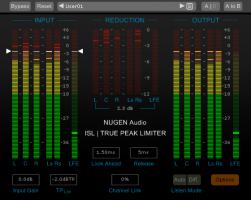
NUGEN Audio has launched ISL, an inter-sample True-Peak limiter that gives complete control over peak levels in audio signals from mono to 5.1. ISL diverges from traditional approaches to limiting by measuring inter-sample peaks and allowing the user to set the true-peak limit, rather than the traditional threshold at which limiting begins. By measuring and correcting for inter-sample levels, ISL protects against distortion that can be introduced when codecs such as mp3 and AAC are applied downstream. Like all NUGEN Audio tools, ISL is intuitive to use and lets audio professionals mix with their ears, leaving ISL to ensure compliance with loudness standards. Designed for the transparent limiting of relatively dynamic high-quality audio, ISL can also be used to hard-limit and reduce dynamic range where required.
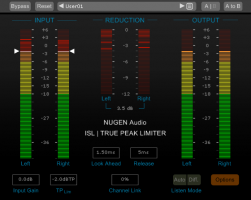
Using the standardized true-peak algorithms of ITU-R B.S. 1770 and related standards, ISL is suitable for post-production and broadcast applications. Features include comprehensive dBTP metering, adjustable channel linking, support for audio formats from mono to 5.1, adjustable ballistics, color splits, and peak indicators.
“I recently finished a “Between the Ears” program for BBC Radio 3 using ISL, and I found it completely transparent. I deliberately tried pushing it hard and it just works, even with much more gain reduction than I would normally consider using in this context. The NUGEN Audio ISL True Peak Limiter is now my limiter of choice for all my broadcast work,” said independent post production engineer Mike Thornton.
ISL is part of NUGEN Audio’s new range of innovative and easy-to-use loudness correction tools, which includes VisLM and LM-Correct.
ISL is RTAS, Audiosuite, AU and VST-compatible and available in 32-bit and 64-bit versions for OS X and Windows at $249.
More information about ISL and other NUGEN Audio products is available at www.nugenaudio.com.
Synth performance: amnésie – J’ai tué mon chat
Monday morning synth spotting, including Roland Juno 60, Roland SH101 & Moog Little Phatty, in this french video:
Extrait de l’album Le trou noir – Ego Twister – 2012 (sortie le 10-10-12)
Version originale : http://soundcloud.com/amnesie1/jai-tu-le-chat
Enregistré et filmé live dans les studios du CNDC au Quai à Angers.
Avec : Yan Hart-Lemonnier, Maxime Dobosz et Wilfried Thierry
Technique son : Loïc Lebris
Réalisation : Wilfried Thierry
Skube – A Last.fm & Spotify Radio
Rethinking home audio and understanding how and where people share music was the jumping point for creating Skube. We are moving more towards a digital and online music listening experience, current portable music players are not adapted for this environment. And sharing music in communal spaces is neither convenient nor easy, especially when we all have such different taste in music.
The result of our exploration is Skube, a music player that allows you to discover and share music and facilitates the decision process of picking tracks when in a communal setting.
It is a fully working prototype through the combination of using Arduino, Max/MSP and an XBee wireless network. We access the Last.fm API to populate the Skube with tracks and scrobble, and using their algorithms to find similar music when in Discover mode. Then using Applescript, we get Spotify to play the music. We use XBees for the wireless communication between the each Skubes and to the computer using custom software that manages all this.
For more information, please check out the blog post: soundplusdesign.com/?p=5516
Project by:
Andrew Nip – cargocollective.com/andrewnip
Andrew Spitz – andrew-spitz.com
Ruben van de Vleuten – rubenvandervleuten.com
Malthe Borch – ciid.dk/education/portfolio/idp12/students/malthe-martin-borch/
As part of the Tangible User Interface module at CIID ran by Vinay Venkatraman, David Cuartielles, Richard Shed, and Tomek Ness.
Music:
Artist – Kirsten & Marie
Track – My Dear
Album – Discover the Sound of Denmark
Knobcon 2012 Performances
Nice snaps from Knobcon via Raul, details below:
A little montage of some of the night’s performances by Caleb Condit, Low-Gain,Donald Crunk, and brownshoesonly(Nick Ciontea) on live video art. Before I get a million emails, brownshoesonly (Nick Ciontea) is using a custom LZX industries Visionary Modular. I didn’t get footage of Suit and Tie Guy because my camera doesn’t work when I go to bed early. Suit and Tie Guy did nourish my mind at his advanced sequencing workshop on Saturday though. Shot and Edited by Raul Pena.
Drum synthesis – TC-11 + Impaktor + Tabla
Impaktor is a drum modeller from Beep Street (www.beepstreet.com) that uses the mic input as an impulse to generate and trigger drum synthesis.
“I started playing it on my desk, then triggered by my tabla, and finally with TC-11 alongside.”
Magic Flute workshop – use your iPad as Sound Module
Background information on this tutorial below:
The iRig MIDI interface ( $ 60,00) connects the Magic Flute to an iPad to control not only the included SampleTank FREE but also a world of MIDI-compatible apps such as GarageBand.
In this clip reuben shows how it is been done
Both SampleTank, GarageBand and Thumbjam together will supply you with many great sounds. GarageBand has a limited set of sounds and even more limited on types of sounds, but what it does have are quite good. For just $5 it has a great sound bank.
Neither of these are very in-depth in the amount of sound editing capabilities but it is very user friendly!!
It is possible to assign breathcontoll in Sample tank but it is very limited and you need to use 2 extra apps to get the job done: MidiBridge and freewi. Maybe we get better control in the future , time will tell. So far I only could control the modulation wheel, any better results? let us know.
www.mybreathmymusic.com
Yamaha CS-5 and Roland TR-606 Demo
Here is a demo of the Yamaha CS-5 analog monosynth and the Roland TR-606 analog drum machine. The Yamaha is being triggered via one of the trigger outs on the 606. The CS-5 has an envelope follower of sorts on it’s audio in and that is what I ran the trigger into. Adjusting the gain on the audio-in allows for some odd timing on the pulses; it’s a neat effect.
The CS-5 is a single-oscillator monophonic analog synthesizer with classic filter, envelope and modulation controls. It features 37 full-sized keys, a multi-mode 12 dB/Oct resonant filter, an LFO with sample and hold, and an external audio input you can route through the VCF or VCA sections. The CS-5 is a very flexible and modulate-able analog synth that is quite capable of warm analog bass and bubbly synth effects! The absence of patch storage, MIDI and velocity are just reminders that the CS-5 is old
As you can hear in the video, the CS-5 excels at resonant sounds. The all-black CS synths are easily some of the cleanest sounding vintage synths; this sort of works against them in some ways as people seem to gravitate to the dirty or muffled (“organic”, bleh) synths of that era. It’s sound sits well next to a Roland synth of the same vintage
DATAMASKIN

