
“Next Hypnotic Live” (NightBirds Electronic – OFFICIAL VIDEO)
“Next Hypnotic Live” (NightBirds Electronic Music)
Recorded with the RSF Polykobol sequencer, ARP Odyssey & ROLAND System 100.
Video by R.V.
NightBirds P&C 2011
http://fr-fr.facebook.com/people/NightBirds-Electronique/100000038001995
http://soundcloud.com/nightbirds-electronic
Manx releases “Destiny” ARP Odyssey emulation
Manx has released Destiny, a new synth VSTi for Windows. Here are some sounds from the Manx Destiny, an Arp Odyssey clone from Manx Synthesizers which runs as a VST plugin on PC computers. “The emphasis here, as always with Manx products, is on authenticity; we’re fans of the original classic and we didn’t consider it to be in need of much updating other than full midi implementation and one or two minor tweeks.”
Destiny is the latest product from Manx Synthesizers, who specialize in the implementation of classic analog synthesizers in software; in this case, an Arp Odyssey clone. It is designed to emphasize sound authenticity so the Destiny feature set closely matches that of the original, although the user can select between monophonic and duophonic functionality.
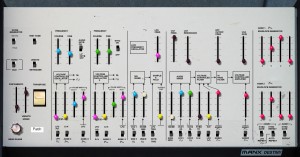
Features:
- Monophonic & duophonic modes.
- Oscillator sync, PWM, sample & hold.
- 2 LFOs.
- MIDI learn for all parameters.
Price: $59.
Underpass musicbox
Nice little tribute to John Foxx and the Maths according to the author, but also a nice feature of heavy synth gear, like the ARP and Roland
Steal that sound!
Hal Leonard Books has published Steal This Sound by Mitchell Sigman. Presented by Keyboard Magazine, the book is a collection of Sigman’s columns of the same name from Keyboard, detailing the greatest synth sounds from the greatest records, and how they can be achieved with modern gear.
Presented in chronological order as they appeared in the magazine from inception to the present, Steal This Sound includes more than sixty articles describing prominent synth sounds from Prince’s “When Doves Cry” and Nine Inch Nails “Closer” to MGMT’s “Time to Pretend” and Radiohead’s “Everything in It’s Right Place”.
Hal Leonard Books PR officer had this to say, “Steal This Sound is packed with invaluable tips and insights into re-creating these great synth sounds and provides a unique view into how synth technology has evolved over the years. Sigman explains how these sounds were created originally on synths by Moog, ARP, Sequential Circuits, Roland, and Korg, and gives step-by-step instructions to re-create the sounds using widely available modern plug-ins and software instruments from a host of manufacturers. Steal This Sound is a great read for music enthusiasts and an invaluable resource for keyboardists and programmers.”
About the Author:
Mitchell Sigman is a Los-Angeles based keyboardist, guitarist, and producer. His band Celebutante plays the LA area and has numerous TV track placements in shows such as The Jersey Shore, The Bold and the Beautiful, Burn Notice, Monk, and more. Sigman also won a BMI award in 2008 for his work on the Berlin track “Scream”, which is used as the theme song for the Lifetime drama Angela’s Eyes. Sigman has been a writer for Keyboard Magazine since 2004.
Pricing and Availability:
$19.99
More information:
Introducing ARP – advanced polyphonic arpeggiator and note sequencer
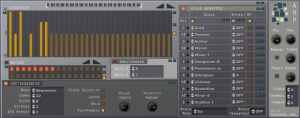
Homegrown Sounds has introduced ARP, an advanced polyphonic arpeggiator and note sequencer with scale remapping for powerful sequencing possibilities.
Here’s what they have to say about it:
With ARP, sequences can be re-mapped based on the played note – so, for example, a sequence can be forced to fit to the major scale. The idea behind this is to break away from the typical note sequencer where every key simply transposes the sequence, the ability to remap each note results in a much more creative sequence.
The Muter Section is a gate sequencer which decides which notes will play. ARP is also polyphonic and so can be used as a typical Gate Sequencer, or even more interesting as a polyphonic sequencer that syncopates. There is also the ability to offset the start note of each sequence so that when 2 notes are pressed together they automatically play syncopated. Finally there is OmniChorder which allows triggering up to another 2 notes when one note is pressed to create a chord, this becomes interesting when used with the Scale Remapper which can leave you with a selection of interesting one finger chords.
The demo version is fully featured, but times out after 10 minutes, it can downloaded here.
Full Feature List:
- Arpeggiator – Can be used as a classic ARP with the usual UP/Down/Alternate modes.
- Note/Sequence Repeats – This is used to play the note or sequence x amount of times before moving to the next note in sequence.
- 32 Note Sequencer Mode – This has a 2 octave range, centre value represents actual note pitch.
- 32 Note Muters – Basically a gate sequencer that decides if a note should play or not, can be used with the Sequencer or the Arpeggiator.
- 1-4 Octaves – Once the sequence is complete it will go up an octave as far as 4 Octaves.
- Fixed Velocity Mode – can use a fixed Velocity instead of played velocity, which is set via a knob.
- Latch Mode – Holds the note until the next one is played.
- Pulse Width – When Latch is off, this determines how long the pulse is, affecting how long the note trigger is held.
- Hold – This will hold any pressed keys until hold is depressed.
- OmniChorder – This can be used along with the Sequencer and also when the ARP is disabled. It allows setting 2 further notes to trigger to form a chord from pressing one key. Once this is enabled, the Scale Remapper can be used to manipulate the chord for each note in the octave, reminiscent of the classic Omnichord.
- Scale Remapper – Allows changing the Scale on each note (C – B) so that a sequence can be squashed to the scale:
- Over 70 scales to choose from.
- Sequence Offset – This allows offsetting the start note of each sequence when it is triggered. For example in Poly Mode pressing 2 keys together will start both sequences running, one could be set to start on step 2 so that it will syncopate. In Monophonic mode it allows building more complex sequence patterns as they iterate.
- Pitch Disable per note – This can prevent a sequence playing on the selected note, so that for example note C won’t play the sequence but just C notes. This is useful in Polyphonic mode so that one key can be consistent whilst another note can play a sequence alongside it.
- 7 Scale Mapping Modes – The mode decides how the scale is altered, when a note doesn’t match the scale, Up will select the next above, Down the next one down etc. There is also nearest, furthest and alternate. There is also a mode which holds the pitch of the octave, and simply uses the scale remapper to force the scale, useful for music without key changes.
- Works with the OmiChorder even when the ARP/Sequencer is switched off.
- Polyphonic – When used with a polyphonic instrument, notes can trigger individual sequences which is great for use with the Muters(Gate Sequencer) which can create complex rhythmic patterns.
- Midi Out – Can be used with any software or hardware midi instrument with host that support midi routing such as Reaper and Cantabile.
- Midi Volume and Pan – These can be used to set the volume and Pan of external gear (CC7 and CC10).
- Midi Channel – Use this to set which midi channel should be used.
- Manual Tempo – Normal Operation is based on the Host Tempo so that it remains in sync with the project, however manual mode can be used in the fashion of an old analog sequencer.
- Swing – Swing can be applied when the tempo is set to 32, speed can be reduced by changing the master clock tempo.
- Full VST Automation.
- Global / Local Randomizer/Default Buttons.
ARP for Windows (VST) is available now for US $20.
Crystal forest – by Bruno and his analogs
VELVET VOYAGE – “Kristallwald” (Crystal Forest) – Performed by Bruno Ender Lee, August 13. 2011
The Crystal-Sequence and some FX are pre-recorded, from the 2004-CD “Traummaschine”, with Arturia Modular Moog V. The Live-Part: Moog Little Phatty Stage II, Synthesizers.com Studio-88, ARP Odyssey, MacBeth M5N, Roland Juno-60, Roland JP-8000, Analogue Solutions Vostok, Korg MS-2000, Moog Etherwave Theremin
ARP Odyssey – new sample library for Kontakt 4
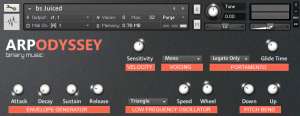
Binary Music has announced the release of ARP Odyssey, a new sample library for Kontakt 4.
Consisting of 101 patches made up of over 1,400 samples, this is a detailed representation of a classic analogue synthesizer. The patches cover a wide variety of sounds, including a selection from the original patch book and a set of multi-sampled patches where different filter settings are mapped to velocity.
There were three main versions of the Odyssey. The first white-faced models were manufactured from 1972, then the black and gold face from 1974.
The model that we’ve sampled is a black and orange faced 2821 from about 1979. This has the advantage of more stable oscillators – though nothing like the stability that we take for granted in modern gear. The Odyssey has attracted an eclectic mix of players: Herbie Hancock, Chick Corea, George Duke, Portishead, Pink Floyd, Kraftwerk, Ultravox, Gary Numan and Abba!
ARP Odyssey is available for download purchase now, priced at £12.00 (approx. $20 U.S.). There is also a free version with a small selection of patches.
The full version of Kontakt 4 is required to use this library.
Syntron 2011 – live performance
Hot from the Synthynopsis Youtube channel:
VELVET VOYAGE – “Syntron 2011” – Performed live by Bruno Ender Lee, July 28. 2011.
This is a remake of the track “Sphere Dance” from the first Velvet Voyage album “Syntron”…21 years ago…
Roland Juno-60 (arpeggio), Moog Little Phatty Stage II & Synthesizers.com Studio-88 (leads), ARP Odyssey (fx), Absynth 4 (pads)
All you can eat synths – live studio performance by Bruno Ender Lee
VELVET VOYAGE – “Music Of The Spheres” – Performed live by Bruno Ender Lee, July 10. 2011
ARP Odyssey (& Doepfer MAQ-Sequencer), MacBeth M5N (Bass), Synthesizers.com Studio-88 (Leads & FX), Moog Little Phatty & Absynth 4 (Leads), Roland Juno-60 (Wind-FX), Roland D-70 & Korg MS2000 (Pads), Moog Etherwave Theremin
Great live performance for all analog lovers!
Moog Minimoog Polymoog & ARP Odyssey performed by Tubeway Army. Tubeway Army (1976–1979) was a London-based punk rock and new wave band led by lead singer Gary Numan. Tubeway Army was the first band of the post-punk era to have a synthesiser-based hit, with the single “Are ‘Friends’ Electric?” and its parent album, Replicas, topping the UK Album Chart in mid 1979. Gary Numan was the driving force of the band, writing the material and producing the recordings. Subsequent albums were issued under his own name once the album Replicas became successful. Gardiner, Sharpley, and Payne continued as his backing band for some years. Gardiner died from a drug overdose in February 1984. Numan’s personal tribute to his former cohort was the song “A Child with the Ghost”, on the album Berserker (1984).
DATAMASKIN

