
Demo of the Roland VP-330 MKII Vocoder
Demo of working VP-330 features. No Processing FX or processing. Note that my gain staging to the video capture device was not perfect so there is some amplified whine during quiet passages. The whine originates in the video gear and is not present in the audio output of the VP-330.
Vintage synth exploration
This guy has released a whole bunch of demos, comparing classic synths:
This is a side by side comparison betweeen my Minimoog D from 1978 (featuring the new oscillator board introduced after SN 10175) and my Synthesizers.com modular, equipped with 3 VCO’s and the Moog 904-A filter clone produced by Mos-Lab in France. Of course this is just a rough demo, because it’s not that easy to set the 904-A and the Mini’s filter exactly the same in real time because of their different architecture. I used the Mos-Lab 904-A instead of Dotcom’s Q150 for no particular reason, they sound almost identical (see my demo about those filters). The VCO’s also are set with the same waveforms (equal wide square wave) and octave intervals. The Dotcom is on the left, the Mini on the right channel, some delay added (be sure your speakers or earphones are correctly connected…).
Another short demo of those great vintage and contemporary analogue synthesizers. The Minimoog is the one performing in the higher register. Direct board take, only delay added.
Roland SH-09 (1980) Demo
Various sounds and settings of my little vintage Roland SH-09 (vco with and without suboscillator, waveform and octave changes, various filter cutoff and resonance settings, s/h filter modulation). Sequenced by a MFB Step 64, delay added. 30 years ago, this was one of the cheapest monosynths on the market, just a low-cost Minimoog alternative. Anyway, even if it lacks a second vco for oscillator beatings, compared to actual digital and virtual analogue synths this little thing rocks! The SH-09 was one if not the last Roland monosynth entirely build with discrete electronic components so it is also easy to repair.
Eventide Space – Sneak Peak
Here’s a nice one for you. Sneak peak of the new Eventide “Space” Reverb stompbox. Running a Roland TR-808 and TB-303 through some of spatial effects including basic reverbs, delays and unique combination effects.
“Reverb” seems a bit too vanilla to describe a box from Eventide. Regarded as one of the best hardware effects processors ever, Eventide’s brilliant sounds have sadly been out of reach to most musicians. Eventide’s new stompboxes finally make those effects portable and affordable. The latest is Space.
- Room, plate, spring, hall.
- Special effects / combo effects: Shimmer, ModEchoVerb, DualVerb, Blackhole, MangledVerb, TremoloVerb, DynaVerb
- Mono and stereo operation.
- Tap tempo, MIDI clock sync. (Yes, that’s right – a tempo syncable reverb.)
- Instant program change, which makes this ideal for live performance use in a way many reverbs, hardware or software, aren’t.
- True analog bypass.
- Real-time controls – ten knobs, MIDI, expression pedal, metal footswitches, and a programmable “HotSwitch.”
- USB MIDI, USB2 software upgrades, and MIDI in, out/thru. Expression pedal, aux switch.
Ambient Analogue 001
This is a very nice video of a new audio experiment we came across
Ambient Analogue 001 is the first release of an audiovisual experiment with footage of Chicago cut to an ambient music track of classic vintage and modern analogue synthesizers.
Audio/Video produced by Logan Mannstrane
Music is available as a free download on SoundCloud:
soundcloud.com/loganmannstrane
Audio information:
Sequential Circuits Prophet VS: From 0:05 – 4:19
Roland Jupiter 8: @ 1:55, 2:21, 2:45, 2:51,
Sequential Circuits Pro One: From 4:20 – 4:48
Oberheim FVS (Four Voice): From 4:49 – 6:26 and 7:57 – 8:32
Roland TR-808: At 4:53-END
Moog Voyager: From 6:28 – 7:56 and 8:32 – 11:09
Sequencing done with Logic Pro and StepPolyArp for iPad. Mixed in Pro Tools 9. Filtering of drums and select synths with the Oberheim Four Voice stereo inputs.
TR-808 home project
During computer class some of the grade 3s decided to teach themselves how to program a 30-year-old Roland TR-808 drum machine.
Oxygene 2 Cover Jean Michel Jarre
Oxygene 2 – Cover
Composed by: Jean Michel Jarre
Played by: Piotr Nowak, Michał Bach
The gear that was used:
-Roland Juno-D,
-Roland D-50,
-Korg MicroKorg,
-Korg mini KP KAOSS PAD.
-Behringer Vintage Delay VD400
Roland JD-800 + Oberheim OB-Xa “Baltic Sea”
Retro synth jam via retrosound72
vintage synth track by RetroSound
“Baltic Sea” ambient track
lead sound and pads: Roland JD-800 (4 layer changing)
bass drone: Oberheim OB-Xa (hold mode)
MacBeth M5N (& Friends)_4
VELVET VOYAGE – “MacBeth M5N (& Friends)_4” – Performed live 5. Jan. 2011 by Bruno Ender Lee.
MacBeth M5N & Doepfer MAQ-Sequencer, Moog Little Phatty Stage II, ARP Odyssey, Roland Juno-60, Roland JP-8000, Analogue Solutions Vostok, Korg Delta, Korg DS-8, Prophet 2000, Technics KN 3000, Absynth
Shared by synthypnosis
Vince Clarke has released the 4th episode of Analogue Monologues
This time he is focusing on the Boss DR-55 and the Roland Jupiter-4
Boss DR-55
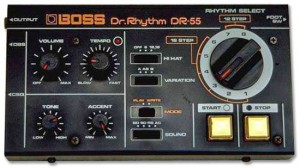
The DR-55 Dr. Rhythm was released in 1980 and was one of the first step-write-style drum machines, and it was the first rhythm machine in BOSS’ successful Dr. Rhythm Series. It was small, inexpensive and easy to use – perfect for musicians at any level. Incredibly basic controls and sounds made this drum machine an instant hit among guitarists and other musicians looking for drum accompaniment to practice along with and even record into their home recordings.
The DR-55 could store up to six 16-step drum patterns plus an additional two 12-step patterns. The 12-step patterns allowed for 3/4 and 6/8 rhythms. A variation switch allowed you to, on-the-fly, alter the pattern playing. There were only four sounds in the DR-55 which included Snare Drum, Kick Drum, Rim Shot and Hi-Hat. The sounds are comparable to Roland’s CR-series of rhythm machines as well as some of Roland’s cheaper TR-machines (like the TR-505, TR-606). You can globally adjust the Volume, Tempo, Tone and Accent for the drum sounds.
Roland Jupiter 4
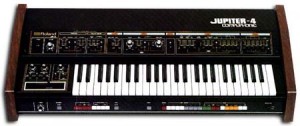
The first Jupiter synth. It was among one of the first poly synthesizers (4 individual voices which could be synced together for one fat monophonic lead), it had a pitch wheel that could be assigned to the VCA, VCF, VCO or all together, there are 8 memory locations and a cool arpeggiator – the arpeggiator can in the Duran Duran classic, “Rio”. It also has a very slow LFO for those ever-so-long filter sweeps. Pretty good for 1978!
Not so cool however, are the 10 preset sounds which sound nothing like the piano, brass or strings they claim to be. The placement of all the preset buttons below the keyboard can be inconvenient, especially while playing it. And as with most old analog synths, the Jupiter 4’s tuning can go out often. Still it is a nice analog synth for creating weird trippy analog sounds. It’s used by >Meat Beat Manifesto, Gary Numan, Thomas Dolby, Saint Etienne, the Cars, BT, Simple Minds, Moog Cookbook, Vangelis, The Human League, Duran Duran, Spandau Ballet, Heaven 17, and film-maker Satyajit Ray.
Emulated Roland SH-09 synth
SH-009 Monosynth is an unofficial emulated Roland SH-09 synth.
According to the developer:
It is is pretty close in functionality and sound to the hardware version. Highlights include a LFO modulator with random / sample-and-hold step voltage that can be used to modulate the oscillator, the filter, and the pulse width. It also includes an invert switch for the envelope, which can modulate the filter and pulse width, as well as the amplifier.
Two versions are included: a VST instrument and a VST effect. The effect version can be used as an insert or in a modular host to process external audio through the filter and to control the filter envelope.
Close only counts in horseshoes and hand grenades – but if “pretty close” does it for you, you can download SH-009 Monosynth at Postdawn Nurseries.
Demo via myVST.
DATAMASKIN

