
Closer look at Auria, Taychon and SpaceWiz for iPad
Featured Apps:
Tachyon – Simple morphing instrument $1.99 / £1.49
SpaceWiz – hypnotic generative music $9.99 /£6.99
Auria – multitrack DAW $49.99 / £34.99
Here’s a new episode from sonic TOUCH – the show dedicated to music creation on touchscreen devices.
This week we take a look at two more instruments from Jordan Rudess’s Wizdom Music – Tachyon and SpaceWiz. Then we take a look at the big new release from Wave Machine Labs – Auria. Is it the future of the DAW?
Auria Tutorial: AudioCopy/AudioPaste and Fabfilter Micro
This video tutorial features creating a simple synth part in a synth called Magellan and using AudioCopy/Paste to import the resulting audio into Auria. Then the optional In-App Purchase, Fabfilter Micro, is used to create some filter sweeps.
About Auria:
The mobile DAW you’ve been dreaming of has finally arrived. Auria is a 48-track digital recording system designed from the ground up for the iPad. With professional-level features like AAF import/export, and optional third-party plugin support from names like PSPaudioware, Overloud, Fab Filter and Drumagog (available via In-App purchase), Auria clearly sets a new standard for mobile recording.
FEATURES:
• 48 tracks of simultaneous playback of stereo or mono files. (24 tracks on iPad 1)
• Up to 24 tracks of simultaneous recording when used with compatible USB audio interfaces (Camera Connection Kit required)
• Supports sample rates of 44.1KHz, 48KHz and 96KHz, at 24 bits (iPad 1 supports only 44.1KHz and 48KHz)
• Vintage-inspired ChannelStrip on every channel by PSPAudioware includes Expander, Multiband EQ and Compressor
• MasterStrip on all subgroup and master channels featuring PSPAudioware BussPressor, EQ and Mastering Limiter
• 64 bit double-precision floating point mixing engine
• Third party VST effect plugin support available via in-app purchase (only iOS-version plugins are supported. All plugins must be purchased through the in-app store)
• AAF import and export allows transferring complete sessions between popular DAWs like Logic, Pro Tools, Nuendo, Samplitude and others
• Convolution reverb plugin with included IR library by MoReVoX
• ClassicVerb reverb plugin included
• StereoDelay and StereoChorus plugins included
• ReTune plugin included for auto pitch correction of vocals
• 8 Assignable subgroups and 2 aux sends
• Powerful waveform editor with features like cut/copy/paste, crossfade, duplicate, separate, gain, normalize, dc offset, reverse, and more
• Flexible snapping tools allow snapping to events, cursor, bars, beats and more
• DropBox, SoundCloud and Audio Copy/Paste support
• Track freeze for minimizing CPU usage
• Full automation support on all controls with graphical editing
• True 100mm faders when used in Portrait Mode
• Optional video import feature allows sample accurate sync of video to an Auria project with adjustable offset times and video export capability
• Timeline ruler options include minutes:seconds, bars:beats, samples and SMPTE time
• Auto-punch mode
• WIST support for wireless syncing of other compatible music apps
• AuriaLink allows two iPads running Auria to play and record in sync, allowing for 96 tracks of playback and 48 tracks of recording
• Full delay compensation on all tracks, subgroups, and aux sends
• Adjustable metering modes, including pre or post fader, RMS and peak
• Adjustable pan laws
• Sample accurate loop function
• Automatic sample rate conversion
• Built-in metronome
Teaser: First new track from I Satellite in 8 years
First song by I SATELLITE in over 8 years. This is a cover version of “This Heart’s Not Made of Stone” by Television Personalities. Preliminary demo vocal.
Instruments used: Minimoog (x2), Roland VP-330, Minikorg, Oberheim DX, Roland MC-4b MicroComposer, MPC-3000.
Buchla – Three Layers to Ponder
Buchla one take improv using 3x patch layers.
The 112 Touch Controlled Voltage Source is being used to both transpose the 5-note mini sequence, as well as the delay feedback amount. So you’ll notice differnt levels of synced delay feedback as I play different keys – many of which are tuned to unison pitches . . . and not in perfect tune – this allows for creepy, slight doppler shift note repeats.
Resonator – new free effect plug-in for Window
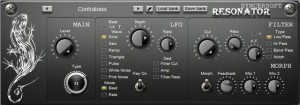
Syncersoft has announced the release of its Resonator free effect plug-in for Windows.
Resonator is resonance and morph effect designed to deliver the clear, penetrating sounds favoured by live musicians. It’s ideal for use in trance, dance, techno, dubstep, electronica, drum n bass, big beat, dub, reggae and all other styles.
LFO modulation sections was designed specialy for Dubstep genre but can be used in other styles too of course.
The plug-in is a free download for Windows (VST). Note that the installer of this plug-in includes optional toolbars. A personal licensed version without toolbars is available at a donation of $10 USD.
A little late-night jam on some old-school IDM stylee
A little late-night jam on some old-school IDM stylee by Chris Randall – Texteral
Gear used: Ableton Live, Audio Damage Phosphor, Replicant, Filterstation, and Automaton, Native Instruments Maschine, Eventide Space, Access Virus, and MeeBlip.
Electronic musician Mark Mosher picks his favorite virtual synths in 2012

My Boulder friend Mark Mosher has put together a nice interactive map that lay out his favorite synths in his virtual set up. The mindmap is interactive so go ahead and click it to find out more. Below is Marks’s commenst on the map, enjoy:
I own a lot of virtual synths :^) As part of a voluntary simplification exercise I started in January, I’ve been limiting myself to a smaller number of instruments over the last year so I could go deeper and create more expressive and unique signature sounds for compositions and live performance. The image above shows a mindmap of synths I’ve been most drawn to over the last year. In other words, these are the instruments that consistantly make into my tracks like “And What do the Trees Hear When the Wind Blows”, “Orbiting Miranda”, and “Now is Now Remix”.
When narrowing down to this list, I worked to find a very complimentary set of instruments with great workflow. The instruments range in character from pure synthesis instruments (Zebra and Predator), to sample-based instruments (Sampler, Iris), to hybrids (Alchemy, ElextraX) to virtual drum machines (utonic). The instruments with green dots in front are ones I’ve been spending 100s of hours with working to create signature “patches” from scratch that I’ll use in future compositions, productions, and live performances. I should also note that I’m also using many of these synths as effects processors allowing me to capitalize on the investment I made learning the synth workflows.
Rest of the post can be found here >>
Vermona Filter Lancet Fun with Drums
Filter Lancet is processing audio from MIAMI analog drum machine; first with static filtering, then with gate and enf foll extraction from audio
Acidlab Miami Drummachine
16 instruments, all analogue – fat and good, 3 trigger outs, ind. outs, 64 steps per pattern (A/B) max. , chase light principle, 4 fill ins, DIN sync – the 808 can be equipped with midi 2 ways: 1) a DIN sync interface is built in, there are lots of din sync to midi converters (doepfer,kenton..) 2)send it in and let kenton add a nice midi interface! (see the red button the the right side? it’s a midified TR-808 here!) Roland TR-808 and Jupiter 6 / 8 Buttons.. warning!achtung! the 303 buttons needed to be “slightly adjusted”.. most buttons on 808 and Jupiters do not work perfectly these days. here’s a replacement: —> omron B3F-4000 farnell nr.:176434 für 303 ( B3F-4050 ) F.nr.: 176435 and TR808 env/decay times Roland TR808 laufzeiten der hüllkurven – envelope running times: bd (decay =min) 242ms – (max) 1646ms. sd 199ms lconga 341ms mconga 234ms ltom 455ms mtom 309ms rim 15ms clave 41ms maracas 33ms clap 1964ms cow 1157ms cymbal min 276ms to max 3956ms OH min 144ms max 586ms CH 112ms 5 sounds must be switched and can not sound at the same time like d nicht gleichzeitig zu hören: conga or tom (3x). Maracas or claps and rimshot or claves.
built 2009 / 11x polyphonic
+ TR sequencer
this is basically a clone of the Roland TR808 but with MIDI, all analogue but really as simple about controlling the instrument parameters.
Mungo State Zero French Horn
John from Mungo Enterprises demonstrates a brass patch on the State Zero polyphonic modular. By coincidence someone was rehearsing on a french horn in another room which served as an ideal reference.
The Mungo State Zero modular synthesize is pure digital hardware, but uses a hands-on patch-cord interface. It offers 8-voice polyphony, full patch recall and knobs for everything. When you recall a patch, the knobs turn relative to the saved state, and the saved patch cord state is used until you make changes.
Because it’s a purely digital synth, you can’t patch analog gear into the front panel, but this is supported via rear connections.
Akai AX-60 Synthesizer Filter Resonance
A video discussing & demonstrating some design aspects of the Akai AX-60 analog synthesizer, in particular the filter resonance.
The AX-60 has been described as capable of some very ‘industrial’ timbres and one reason for this is the very strong filter resonance of the cem3394 voice chip. The design choice by Akai to use a full 5V CV for the resonance brought this out. Additionally, they used a linear taper slider for resonance, and a linear 5V response to the CV (they could have used a log taper, like I did here, or they could have processed the panel voltage and did a voltage taper conversion in firmware – cheaper! – to limit the resonance CV to the range in the cem3394 data sheet, but they didn’t).
These design choices meant many users probably ended up exploring a more ‘brash’ part of the AX-60’s sound palette than if Akai been more like Sequential Circuits in their limited internal programming of the cem3394.
DATAMASKIN

