
Yamaha SY20 Sounddemo – Rare Yamaha Monophonic Analog synthesizer of 1982
Yamaha SY20 Sounddemo (springreverb effect)
Copyrights Volker Hein – 2013
More information visit www.tastronauten.de
The SY20 was Yamaha’s last analog synthesizer model before committing to digital FM synthesis with products like the DX-series. It is an all-analog mono-synth that came out in 1982 but was never commercially sold outside of Japan, making it very rare. In fact, it was originally intended to be an “educational” synth to help students learn about synthesis. However, as most of the controls are labeled in Japanese characters, you will already need to be familiar with analog synthesizers (or Japanese) to grasp the SY20.
Despite being a rather simplistic looking mono-synth, the SY20 is a surprisingly refined and expressive synth. There are 20 preset sounds, arranged in two banks of ten. They include all the customary attempts at emulating the acoustic sounds of piano, woodwinds, stringed and brass instruments. The presets can be combined with the manual synthesizer control sections, which are very simply and logically laid out: VCO, VCF, and VCA, and each section can be individually switched on or off. There is an LFO to modulate each of these three sections for pitch, filter and tremolo effects. There is also Portamento and a one-octave Transpose knob that is notched in half-tone steps (it can be used to quickly transpose what you are playing to different keys).
The VCO section offers one oscillator with Square and Saw waveforms. A slider is used to mix between the two waveforms. The oscillator pitch can be set from 2′ to 32′. There is also Pulse-Width modulation and White Noise. The VCF offers three filter modes: low pass, and two band pass modes. The filter sounds really good, though it is not self-oscillating. The typical cutoff and resonance controls are accompanied by ADSR envelope controls for a nice contoured filter effect. The VCA section offers the standard ADSR controls as well.
While the main synthesis sections are all nicely laid out and straight forward, the real expressive potential comes from a few other simple but effective features. The 44-note keyboard supports after touch, which can be sent to the VCF, the VCA and the LFO for adding filter, volume and modulation effects using keyboard pressure. They can be combined in any way and with as much (or little) depth as needed for the desired effect. There are also three global effects: Portamento, Sustain and Brilliance.
The SY20 has a mono audio output, headphone jacks in the front and rear, and a built-in speaker! Unfortunately there is no CV/Gate and the MIDI specification was still a year away from being published, so it can not be hooked up to any sequencing equipment—you’re gonna have to play this one the old-fashioned way.
The SY20 has a lot to offer. It sounds really good—warm, pure, expressive and wholly analog. It is incredibly rare. It is the last analog synthesizer Yamaha designed before going digital. And it is covered mostly in Japanese characters. All these qualities combine to make it an historic and unique piece in any collection and it will definitely get used often, it may even become the “go-to” mono-synth for anybody lucky enough to own one!
Drum and Bass on iPad with Glitchbreaks, Magellan, DM1 and Cubasis
Just a quick video on how to crreate cool drum and bass beats with iOS apps. Drums: GlitchBreaks and DM1, Bass: Magellan (2 instances), FX – Animoog, DAW – Cubasis.
The Bleep Drum
Arduino based drum machine with adjustable samples and loop sequencing.
Available February 8th from bleeplabs.com and Sparkfun.com.
All audio direct from The Bleep Drum.
Transdimensional hand modeling provided by the HSS3jb (not hooked up to the Bleep Drum).
Specs:
- Four sounds, two with pitch control
- Four selectable sequences
- Record patterns just by playing them
- Tap tempo
- Reverse mode
- Hyper Noise 30XX mode
http://bleeplabs.com/store/the-bleep-drum/
OMD went to a Kraftwerk concert – “Incredible”
Kraftwerk’s opening show at the Tate; incredible, say OMD
This article is taken right of the BBC website, we own no rights to the content, enjoy 
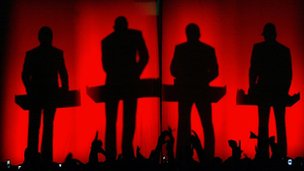
The first of eight shows by German electro pioneers Kraftwerk has taken place at London’s Tate Modern. Among the 1,250-strong crowd were Andy McCluskey and Paul Humphreys, whose music with Orchestral Manoeuvres In The Dark has been heavily influenced by Kraftwerk. What did they make of the performance?
McCluskey described it as “the best multimedia arts project on the planet”.
“It gets better and better. I saw them three-and-a-half-years ago at the Manchester Velodrome and now that the whole show is in 3D, with surround sound, it’s incredible.
“It’s amazing that 40 years into their career, they’re still relevant.
“The whole remit of Kraftwerk, when they moved away from that early jazz krautrock roots, was that they were trying to get away from Anglo-American cliches. When I saw them in 1975 they had their names in neon lights and they had some projections.
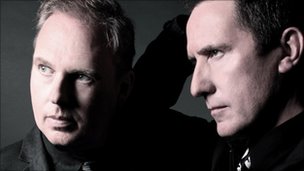
“They were already quite minimal but they were moving away from the cliches. This now, with the whole show in 3D, is taking it to the nth degree, 30 odd years later. It’s a wonderful extra string on their bow.
“I have to admit… some of the songs reflect the fact that they are so distilled that it’s hard to put [visuals] to them, but for two hours the whole show was incredible.”
Fellow OMD member Paul Humphreys added: ” To move from concert halls into museums is the perfect move for them, because even from the very beginning they were performance art, except they were playing in concert halls.”
“They have changed a couple of things,” noted McCluskey.
“It’s noticeable that Radioactivity has now become an anti-radioactivity song. And Ralf is now singing in Japanese. We thought they’d changed some of the words to Man Machine – made it slightly more sinister and negative.
“Because the music is so highly conceptual they are able to mutate and twist it. They’re not going to play the exact same song with the same riff and the same lyrics, they can vary it and it’s quite an interesting concept,” he said.
“For us it was incredible to hear both comet melodies live. This is what’s incredible about this series of concerts. They are going to play tracks that they have never played live before. The Autobahn album – trimmed down – is not very long, so the rest of it was essentially their highlights, their greatest hits.”
Humphreys added: “They are one of the most important bands for popular music.
“People say the Beatles were the most important band to change popular music but I think Kraftwerk were. Their DNA has permeated the blood of bands since then. There’s parts of Kraftwerk in all the popular music today.”
Original article can be found here >>
Filterbank study
Processing the modular (Echophon Clock output) through a Max patch, then processing the Max patch through the modular (Z-DSP (Stereo Ping Pong delay program)), all controlled with a Korg nanoKontrol.
The Max patch is a bank of “reson~” objects, divided into values taken from the Buchla 296e, Serge Resonant EQ, Moog 914a, ADDAC VC Fixed Filterbank, Moog/Bode Vocoder and EMS 3000 Vocoder units, with both manual and automated control over each band’s amplitude (displayed as sliders).
The patch is mono in/stereo out, with each band alternating between the left and right outputs.
Barbed Lines Suite – Studio Electronics Boomstar 4075 Basics
Single track twisting and turning of the Studio Electronics Boomstar 4075 – nothing too fancy as requested – for the sole purpose of getting to know the structural tonality and flexibility of this ARP-filtered SE synth.
Direct Boomstar audio out .wav file link: http://studioelectronics.com/assets/A…
Jomox Akasha synth prototype at NAMM
Juergen of Jomox demonstrates the Jomox Akasha at the Big City Music booth at NAMM 2013.
More coverage at http://www.catsynth.com
‘TELLY-SCOPE’ – Circuit Bent Television with Monotribe
An old portable television which has been modified to respond to audio signals with glorious effect.
Beware, this is a dangerous project! However, if you’re willing to accept the risk then you can find instructions here – http://electro-music.com/forum/topic-…
Ade Fenton (Gary Numan producer) loves the Analogue Solutions Vostok synthesiser
Ade Fenton (Gary Numan producer) loves the Analogue Solutions Vostok synthesiser.
Loves the true analogue sound.
This demo features a variety of sound types and sequences (traditional and non-traditional) demonstrating the Vostok’s sound palette and variety of timbres. All sounds, with exception of the obvious acoustic drums (used for context), are created on the Vostok using either traditional patching or the pin matrix — or a combination of both.
Sounds are being driven by either the on-board sequencer, MIDI sync (via GATE to CLOCK), or direct MIDI connection to a controller keyboard.
Emphasis for this video was more traditional synth sounds (basses, leads, sequences) as there are plenty of non-traditional (fx, ambient, noise) sound demonstrations on YouTube. The filter section at the heart of the Vostok was also a focal point of this video and is tweaked extensively for the various sound types.
Also, see the Telemetry (mini Vostok) in action at the following link:
http://www.youtube.com/watch?v=rvo5x5G4YJg
KEY FEATURES OF VOSTOK Pure analogue voice circuitry. Suitcase style design. 22×22 matrix pin panel. Rugged Steel construction. Quality chrome catches and cool steel spring handle. Stuffed full of electronics. No front panel space is wasted. Joystick, retro-VU meter, MIDI, jack socket patch points, more, more, more!
The DSP Prophet 12 in action
Background video description:
A synthy cover of the M83 x Big Black Delta remix of Daft Punk’s “Fall”….using just the Prophet 12 splits and Tempest (in playlist mode). More music at http://peterdyer.net/
Once again, the creative and talented Carson Day jammed on this w/ me at Namm ’13, tweaking the Tempest live, but since no video emerged of it, I wanted to share the sounds, as it was an absolute blast to play, and I’ve got to hand it back for now. I’ll try to abstain from anymore Tron OST or covers of remixes for a while.
DATAMASKIN

