
Noise Jam: Octatrack Meets Mixtape Alpha
Mark Mosher looks at the Mixtape Alpha – here’s what he has to say about it:
The goal of this jam for me was to experiment with using the Octatrack to 1) act as a mixer and process output from a variety of Rick’s collection of of noise and music making gadgets 2) To sample Rick’s performance on the fly into multiple tracks on the Ocatatrack then contribute to the jam by playing, effecting and doing live sequencing using only these samples are audio sources. I really love the Octatrack for this sort of thing, as it allows me to organically jam using the palette made from the jam itself.
While this video shows the Octatrack with the Mixtape Alpha, we used a lot of other fun stuff throughout the jam like Korg Monotrons, Korg Monotribe, Beep-It and more. You can see some of the gadgets in a bin at the 0:17 mark.
Modular: Sic Itur Ad Astra
Modular synth and Kontakt 5, details below:
Some ideas on the bass line sequence were to use the triple switch for ratchet timing. I used the Q960 for a pitch source, the Q963 Trigger Bus for note gate and switching in a double on beat 6. The faster 1/16th ratchet was randomly selected by a Yves Usson Random Gates module.
Two Q106’s were used with 32′ sawtooth and 16′ PWM. The filter was a Q150 Transistor Ladder Filter in -24dB. I routed a split line output from the filter through a VCA controlled by a slow LFO and back into the filter for boosted body which came and went. The output from the Q150 then went to a Q107 State Variable Filter. The Q107 had two slow LFO’s slightly modifying the resonance and frequency center. There was a third tap off the Q106’s sine wave through another VCA into the Q107 filter.This sine wave was slowly coming and going with an LFO which brought up the deep bass tone.
The midrange piano-like sound was a combination of two Q106’s controlled by an STG VMS and a Q119 row. The filter was an Oakley SVF in LP mode.
The percussive sound was noise through an Oakley Diode Ladder Filter with it’s center frequency modified by a quantized random voltage from a Sputnik WCRS. The trigger to the Oakley envelope generator was from an STG TMS. output skip timing was a Cynthia LPG under gate control from a row of the Moon 563 Trigger Bus.
A fast arpeggiation line was from the Future Retro Mobius into a Double-Dekka Ultrasonic VCO then through an EG, VCA and delay pedal.
The played chord parts are using Kontakt5 with three instances of Hollow Sun’s Vintage Strings VP330 choir, Polymoog Vox Humana and Arp Solina brass. Recorded in Cubase and edited in Final Cut Pro. All in one track.
Such Is the Path to the Stars!
MIDImorphosis – an audio-to-MIDI app for iOS
Audio MIDI Connect has transformed into MIDImorphosis – an audio-to-MIDI app for iOS.
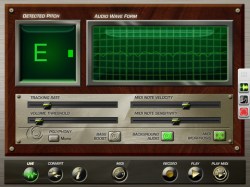
Here’s what’s new in MIDImorphosis:
- In this version, the speed and accuracy of pitch detection has been greatly improved.
- MIDI output now supports multiple destinations, both CoreMIDI and Virtual MIDI, as well as DSMIDI Wifi.
- Audiobus support has been added, for both input and output slots.
- Audio can be imported or exported using audio copy and paste. The app supports off-line conversion of audio to MIDI, with MIDI files being available using the “open in” method, or through iTunes file sharing.
- Pitch detection now supports polyphonic playing. A toggle button selected between monophonic, small intervals, and chords.
https://itunes.apple.com/us/app/audio…
Introductory pricing — ends July 28th
MIDImorphosis captures the pitch of incoming audio, and converts it into MIDI notes that can be used to control iOS synthesizers or external equipment. With support for CoreMIDI, Virtual MIDI, DSMIDI Wifi, Audiobus, and background audio, connecting MIDImorphosis is a snap. Connections to laptop and desktop computers can be made using WiFi or with MIDI adapter cables.
The app performs both monophonic and polyphonic pitch conversion, and is designed to work best with a guitar or bass. We recommend dock-based instrument adapters; connections through the headphone jack frequently have crosstalk and poor frequency response. We also recommend running MIDImorphosis on an iPhone4s or better, or an iPad2 or better (this is especially true when using Audiobus).
Complex sounds can be created by combining a typical guitar effects app along with MIDImorphosis and a synthesizer app. The guitar effects app can provide tone control and immediate response, while the synthesizer can augment this with a deep, evolving sound.
With any conversion system, there is latency between a note played on an instrument, and when the note can be correctly identified; the slight delay motivates the combination of guitar effects and synthesizers. MIDImorphosis should be fast enough to work well for playing at moderate speeds. For guitarists in need of a system that can handle “shredding,” we would recommend hardware converters by companies such as Roland or Fishman.
A number of videos are available on the app web page, to illustrate typical performance, and playing techniques to get the most out of the app. For guitarists, a light palm mute should be used to prevent unwanted notes from ringing. Pitch detection is typically best with the bridge pickup, and with a clean tone.
In addition to live conversion, MIDImorphosis can also convert recordings into MIDI (avoiding latency issues). The app can record audio; audio can also be imported using either Audio Copy or iTunes File sharing. Audio can be exported with Audio Paste. MIDI can be exported to other apps using the “open in” feature, or through iTunes. The app also allows scanning through audio files, to see the detected pitch at any given moment; this feature should be particularly useful to musicians interested in transcribing a recording. Recorded audio and converted MIDI can be played back through the app. The app is compatible with the Audiobus input and output slots.
For polyphonic pitch detection, the app supports both intervals and chords. Many guitarists play small intervals on adjacent strings; pitch detection has been optimized for this case. When set to chord detection, the app can find additional notes, but is less accurate.
Yamaha FB-01 Bundle – vintage synthesizer sounds for Native Instruments Kontakt
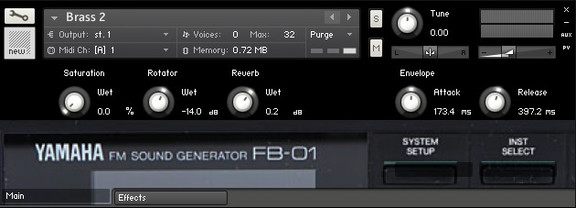
TW-Sounds has announced the Yamaha FB-01 Bundle, a collection of vintage synthesizer sounds for Native Instruments Kontakt.
The samples are recorded from the old vintage FB-01 FM Synthesizer from Yamaha. The Bundle include 46 Instruments mapped in Kontakt 5 with a GUI for manipulation of the sounds.
The bundle is currently available to purchase from Sampleism for £7 GBP.
TW-Sounds is also offering all Sampleism users a free copy of the SampleWiz Sound Library as part of Sampleism’s Summer Sale.
New free soundbank for the microKORG

Korg has released a new free soundbank for the microKorg synthesizer.
Here’s what they have to say about it:
These 128 custom sounds from Korg USA are truly a micro makeover, pushing the powerful microKORG analog modeling engine to deliver a fresh and wild collection of leads, basses, atmospheric textures, arpeggiations, motions synths, rhythmic grooves and much, much more to explore. Take your microKORG and your music to new levels with this exciting new sound set!
Download the new sound library right here >>
Delexia by AnalogResistance ( System-100m & SH-101 )
Self evolving drone. Was recorded in just 1 shot. Containing a 2 191J system and a SH-101. Effects used during recording are: Eventide H949, Roland RE-201, Fostex 3180, Ibanez AD-202 and a UE-405
Roland MKS 80 Super Jupiter – Overview
The MKS-80 is basically a refined Jupiter 8 in a module. It is called the Super Jupiter and it is very fat and very analog!
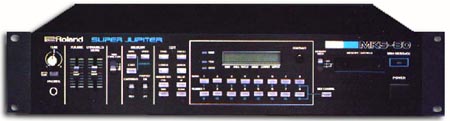
Its great sound is due in part to the classic analog Roland technology in its filters, modulation capabilities and a thick cluster of 16 analog oscillators at 2 per voice. It comes in a 2 space rack-module – no keyboard here. Tons of editing capabilities, although editing is tedious. It’s got all the classic sounds of the Jupiter synths and so much more. An excellent choice for ambient drones, pads, blips, buzzes and leads.!
The Jupiter-8 is an 8-voice polyphonic analog synthesizer. Each voice features two VCOs with cross-modulation and sync, pulse-width modulation, a non-resonant high-pass filter, a resonant Low-pass filter with 2-pole (12 dB/octave) and 4-pole (24 dB/octave) settings, an LFO with variable waveforms and routings, and two envelope generators (one invertible).
Features include adjustable polyphonic portamento and a Hold function for infinite sustain of notes and arpeggios. A versatile arpeggiator can be synchronized with external equipment by using the proprietary Roland DCB interface, clock input via CV jacks on the rear panel, or one of the aftermarket MIDI kits from Encore or Kenton. An assignable bender can be used to control pitch or filter frequency.
From the factory, the JP-8 could store 64 patches. Patches could be stored to, or loaded from, a standard analog tape/cassette. The Encore JP8MK MIDI kit doubles the patch memory to 128 and enables the JP-8 to store and recall patches over a MIDI connection, using a computer with sysex utility software.
DJ Controller: Numark Orbit Overview and Demo
Going over the features and demonstrates the controls of the Numark Orbit wireless DJ controller.
The Numark Orbit has the standard DJ controls you can come to expect from other popular DJ controllers. There are some obvious differences but you have everything you need to get mixing and performing, right out of the box. While many DJ controllers tout the “plug and play” functionality but require a few extra steps to get going, the Numark Orbit and it’s companion Orbit DJ software synched as soon as I got connected. So if you are someone who is just starting out with audio and DJ software, you can rest assured that the Numark Orbit will not put up a fight when it comes to getting started right out of the box.
The pads, the bank buttons, the bumpers, and the endless rotary, all have a great feel and the controller itself is built very well. Using the rotary wheel in the middle is certainly a different way to DJ. It can be used to control volume, EQ levels, and act as a crossfader depending on what function you have it assigned to control. The wheel itself responds well to the touch and has a nice LED indicator for your level control.
Next to the wireless capabilities, the built in accelerometer is sort of what the Numark Orbit is all about. You can control all the parameters of your effects by tapping the bumpers and manipulating the controller in the proper fashion. Each bumper can control a parameter of a selected effect on its own, or you can hold down both bumpers and open the full function of the accelerometer control. You can lock the Numark Orbit’s accelerometer by double tapping the bumper, which eliminates the need to hold the bumper down when controlling effects.
WaveRunner | Official Trailer UVI©
All sounds & instruments are from WaveRunner, which will be released on August 1st. Additional drums from PlugSound Pro.
A multitude of synths, drum machines and rare prototypes of esteemed German heritage come together in this massive and unparalleled retrospective. WaveRunner presents you with a wondrous collection of authentic and fascinating sounds from over 30 years of wavetable synthesis. Everything from the raw and strident origins to the wild evolving tones of more modern, full-featured machines. Each system addressed was serviced, meticulously multi-sampled and artfully designed into 7 unique hybrid instruments driven by over 30,000 samples. Both a historical archive of sound and a collection of new and unique instruments with hundreds of presets and limitless sound design potential, WaveRunner is a suite not to be missed.
WaveRunner includes 7 instruments:
WaveRunner 360
Based on a very old and quite rare machine, WaveRunner 360 delivers a raw and lo-fi sound. Explore the origins of wavetable synthesis and let loose with ripping vintage timbres.
WaveRunner Terminal D
Including sounds from vintage prototype drum modules, synths and modern rack drum synths, Terminal D is an uncompromising drum machine with an impressive range of sounds and easy to use interface.
WaveRunner Terminal U
Built on a generous collection of sounds from the entire range, Terminal U is a powerful and dynamic multitrack phrase sequencer capable of generating everything from tight rhythmic chains to wild and evolving passages.
WaveRunner 2.0
Based on the original German blue, WaveRunner 2.0 delivers an uncommonly warm and vintage tone from an often overlooked classic known for its amazing analog filter.
WaveRunner 2.3
Similar to the 2.0 but with a distinctly different flavor, WaveRunner 2.3 is built on the upgraded German classic and its loquacious programming pal.
WaveRunner Orange
Based on the modern flagship wavetable synthesizers famed in the ’90’s and ’00s, WaveRunner Orange delivers the modern sound of wavetable synthesis covering the gamut from lush bells to violent and evolving tones.
WaveRunner X
An extraordinary collection of raw waves harvested from the entire range of machines come together in this fresh and powerful dual-layer subtractive synth; capable of deep, modulating ambiances, brutal basses and uncanny leads.
*PPG and Waldorf are trademarks of their respective owners and are not affiliated, endorsed, connected or sponsored in any way to this website or any of our affiliate sites ; therefore do not be confused between UVI and PPG or Waldorf.
“Rakéta” (MV-8800, Waldorf Rocket track)
A short track made with the MV-8800 and Waldorf Rocket. This is rather fun than serious. Rocket test coming soon 😉
Vocals recorded by Piotr Kardas.
Enjoy,
Hunart©
DATAMASKIN

