
MidiPads (MidiPadz) with Traktor Pro
MidiPads is the full version of MidiPadz Lite and it’s got several new features. It’s not just a drumpad controller, here its usage with Traktor Pro.
Learn about the user interface in the first part. For details in conjunction with Traktor skip to the last third.
Get MidiPads on the App Store: http://itunes.apple.com/us/app/midipads/id418216060?mt=8
Once connected, MidiPads sets itself apart with flexible control on each of those pads. Just tapping rectangles isn’t much fun on the iPad, of course – you lack tactile feedback and pressure sensitivity found on a physical pad. So, instead, MidiPads provides other modulation to exploit the touchable surface for continuous control. In fact, thinking of it as a “drum pad” is almost a bit unfair. New in this release:
- Presets, which you can share with other users – which could in turn make a nice little community of users here
- “Bouncing mode” for touch pads and sliders
- Send multiple messages with each axis and knob
- Individual up/down messages for each touch pad and slider, if you so wish
- Enhanced views, settings reset, and MIDI connection settings
- Resize pads and pad area (essential for either fat fingers or getting more controls!)
MidiPads (MidiPadz) with HALion Sonic
mNodes: Patchable Modular Controller
mNodes|nod| : Patchable Modular Controller
2011 STEIM(Amsterdam)
AVR C++ supercollider
created by jinKu
This patchable modular controller is called mNodes
It is an intuitive and tactile controller for performances and compositions.
Unlike other controllers, mNodes is using patch cables to route signals.
It is a modular system and one can simply expand its capacity.
mNodes use softwares such as MaxMsp/Jitter, Ableton Live,cSound,Processing etc through USB make it an extremely flexible and powerful controller.
Introducing the Chomp: the bite-sized, affordable MIDI box for creative music projects
Max Justicz has announced a new DIY MIDI controller ‘brain’, the CHOMP, that looks awesome.
Basically, the CHOMP (Configurable Hardware Open-source MIDI Platform) is a cheap board you plug switches and pots into to create custom MIDI controllers.
Features:
- Completely open-source.
- Affordable ($50).
- Compatible with ANY MIDI configuration.
- 48 Inputs/Outputs!
- Made and assembled in the USA.
- Programmable
- Tiny, only 100mm x 60mm x 25mm
Here’s what Max Justicz has to say about the CHOMP:
It has come to my attention that the world needs an inexpensive (but extraordinarily solid) MIDI controller. That’s where the Chomp comes in. With zero technical skills, you can hook up dozens of buttons, knobs, switches, and sensors to control endless parameters of digital software.
The Chomp is the first open-source MIDI controller that’s been designed right. Other MIDI controllers on the market are proprietary, difficult to use, non configurable, and most of all: expensive. The only other commercial option available ships exclusively from Europe and costs the US equivalent of $240.
But because it’s Arduino powered and completely user programmable, the Chomp is more than an awesome MIDI controller. With new code, Chomp can do just about anything: play Bach on a digital keyboard, or help you along in a live musical performance.
Checking out the Serge iPAD Control
Serge modular controlled from an iPAD running TouchOSC.
Wholetone scale with 4 x sliders controlling FM pitch / FM amount / filter cutoff / envelope scaling.
www.ianboddy.com
About Serge:
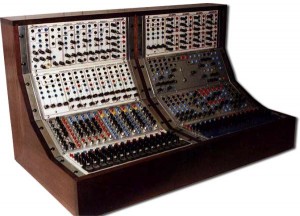
The Serge synthesizers are the creation of French electronic/synth designer Serge Tcherepnin. They are analog modular systems that began production in 1974, and continue to be produced to this day. The Serge concept was that a powerful, musical and great sounding analog modular system could, unlike the Buchlas, Moogs and ARPs of the time, be smaller, more compact and most importantly: cost less, making them far more accessible to musicians looking to jump into the bold new world of electronic music and sound design.
Although Serge was French, the modular systems that bore his name were orignally designed and produced in Los Angeles, CA. Initially designed in 1974 (in Serge’s home), mass production of the systems began in 1975 and continued until 1986. There was a rough period between 1986 to 1993 where modules were still produced to special order (slowly), but full production resumed again in 1993 after Serge’s circuit designs were sold to Rex Probe (an early collaborator) who went on to found Sound Transform Systems, who continue to produce many of the original Serge modules, plus a few new one’s of their own design.
Influences of the Buchla can be seen in Serge systems, such as touch sensitive keyboards & sequencers, random voltage generators, function generators, and matrix mixers. Yet the Serge has many unique designs of its own such as the Wave Multiplier module and the use of banana plugs in lieu of traditional patch cords. Its filters are unqiue sounding but it may be the Wave Multiplier module that truly sets a Serge apart as it is a totally unique synthesizer section that sits between the Oscillator and Filter sections and allowed for external audio or control voltage signals to be used to modulate the timbre of the oscillator’s tones.
Originally, Serge systems were custom built to order. Like any modular system a buyer would pick and choose individual modules they want and assemble them into a cabinet. However, to reduce the price tag and make them more accessible to musicians not interested in building a modular synth from scratch, Sound Transform Systems sells Serge systems in pre-configured systems: Shop Panels and the M-Class.
NAMM 2012: Electrix Tweaker introduction
The Tweaker is a performance controller for Abelton users, Traktor users, and music producers and performers of all genres.
At the heart of Tweaker lies a grid of 32 rubber pads backlit by RGB LEDs, and 8 velocity sensitive drum pads. There is a channel strip on each side of the grid, and a crossfader centered underneath. Each channel trips is comprised of a fader, three backlit rubber pads, an analog knob, and three push encoders with red LED rings. The navigation section at the top of the unit has a large browsing encoder and a four-way selection push grid (left, right, up, down).
Tweaker is fully USB bus powered and also has MIDI In and Out ports.
Latest updates will be announced here >>
NAMM 2012: Livid CNTRL-R
Designed with Richie Hawtin, this step sequencer and controller is an Abletonators dream!
CNTRL:R is a contemporary MIDI performance instrument for creative music production. Housed in a lightweight aluminum body, this controller is ideal for live performance and studio production. Create rhythms, sequence and perform drums, launch clips, mix tracks, and have complete control over your performance with CNTRL:R’s advanced set of features. High quality faders, push button encoders, rotary knobs, expression pedal inputs, and keypads backed with RGB lights give you all the controls you need for an interactive performance. With scripts available for Ableton Live and NI Traktor, the CNTRL:R meets the needs of anyone looking to perform electronic music.
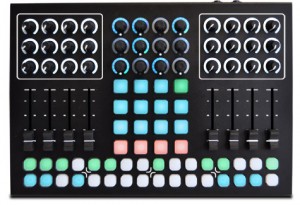
CNTRL:R was designed over a one and a half year period with electronic music pioneer Richie Hawtin and the artists on m_nus records. The controller is designed to provide a high quality controller sized small enough to fit into a backpack, but large enough for extensive hands-on control. The instrument has all of the essential controls for music creation and can be adapted to many different software and styles. The “sequencer” section of the controller can be set to create sequences and grooves, or control cue points and triggers. The central 4×4 keypad can launch clips, play drums, and control functions. The fader and knobs are ideal for channel strip controls, device control, EQ, and effects. The CNTRL:R is totally programmable and adaptable to any software that supports MIDI.
NAMM: Taking a closer look at AKAI Max 49, Nord Drum and Casio WX-P1
The Akai Max 49 is unique in the way it combines traditional keyboard controller functions with MPC pads, control voltage support and LED faders.
The Nord Drum is not sample-based, but uses a virtual analog synth engine that’s designed specifically from drum synthesis.
A lot of buzz around the WX-P1 – the first Casio synth release for 20 years.
More hot videos from NAMM featuring the OP-1, Minitaur, MiniBrute and Livid controllers
Teenage Engineering @ NAMM 2012 – OP-1 OS update
Cyril from MOOG shows off their new MINITAUR @ NAMM 2012
Arturia @ NAMM 2012 – MINIBRUTE
Livid @ NAMM 2012 – What’s New
Uploaded by DontEatWhatTheyFeed
Akai @ NAMM 2012 – MAX 49
No clue why this video is upside down, but at least you get some good views of AKA’s MAX 49
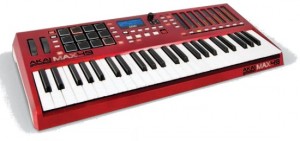
The new Akai MAX 49 Keyboard Controller may look like a typical controller keyboard (albeit well equipped), but it has a number of features that set it apart as one of the most versatile controllers available. Aside from the familiar trigger pads featured on the MPK range of controllers, and the same semi-weighted keyboard, the MAX 49 has features which make it capable of controlling just about synthesiser, past or present.
The Akai MAX 49 is similar in appearance to the MPK range of keyboards, though this model is finished in red. To the left of the unit, 12 velocity sensitive, and backlit trigger pads provide an intuitive way of programming percussion parts, or triggering live samples. These features the swing and note repeat feature made famous on the MPC range of samplers. To the right, 8 touch faders add additional control over the synthesiser or software package currently being used. In terms of controlling synthesisers, the Akai MAX 49 is better equipped than any other controller available. Aside from the more familiar connections, such as a USB socket for connection to a host computer, an a MIDI socket for connecting to other keyboards, sound modules or MIDI equipment, the MAX 49 has a CV & Gate Output, making it capable of controlling vintage (or modern) analogue synthesisers. With the recent increase in popularity of genuine analogue synthesisers, this feature may make it the first choice of controller for those looking to ‘go analogue’ in a live setting.
The Akai MAX 49 ‘s CV connectivity goes hand-in-hand with another of its features: an on-board step sequencer. This allows patterns to be created on the unit itself and sent to whichever synthesiser is being controlled. An arpeggiator also features. For those who are more rooted in the modern studio, the MAX 49 comes complete with a software package called AkaiConnect. This neat utility automatically maps the keyboards controls to VST plug-ins. To further increase compatibility with software packages, the device can operate in Mackie Control and HUI modes.
The Akai MAX 49 is a great controller in its own right, but the addition the step sequencer, arpeggiator and CV and gate outputs provide a means of adding additional features to an analogue synthesiser, as well as providing a central device for controlling both modern and vintage synthesisers. Is this the beginning of an analogue renaissance?
New 3 oscillator synth from StudioLogic – Sledge
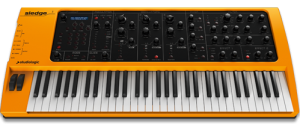
Studiologic, mainly known for their controller keyboards previously, have released their first synthesizer, the Sledge. The Sledge is a 3 oscillator virtual analog synth that includes not only the standard analog waveforms, but a full set of wavetables from the PPG Wave. Also includes a Waldorf-modelled multimode filter, selectable white and pink noise, hard sync, an arpeggiator, fast envelopes, and a basic selection of effects. For many synthesizer enthusiasts, it is the particular interaction of the sound engine and user interface that makes a great instrument. A quick look at Sledge shows you the generous set of controls available to interact directly with the sound engine. When you touch the knobs and switches of the front panel, you will instantly be aware of the meticulous attention to detail our engineers have refined, during many decades building the best electronic keyboards.
You will experience the logical set-up of the synthesizer modules, mirroring the signal flow of a classic analogue synthesizer. But what really distinguishes any synthesizer is its sound. Fortunately, our friends at Waldorf Music have happily shared their experience and know-how on this crucial part of the Sledge Synthesizer.
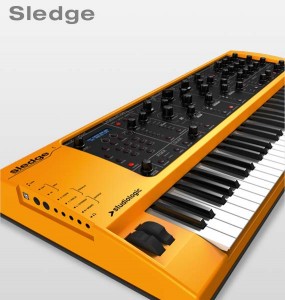
Specifications:
• 32 Pots
• 3 chicken head rotary switches (7 positions)
• 1 rotary encoder with push function
• 2 x 16 digits backlit LCD
• High Quality Pitch and Mod Wheel
• up to 256 Sounds
• fast and efficient sound selection via numeric keypad
• 2 fast LFOs per voice, each with adjustable Speed and Depth
• 1 extra modulation routing for Mod Wheel, with adjustable Speed and Depth
– Shape: Sawtooth, Rectangular, Triangle, Sine, Sample & Hold, Ramp
– Destination: Osc 1, Osc2, Ocs3, PWM / Wave / FM, Volume, Filter Cutoff
• Monophonic mode with single or multiple trigger
• 3 Oscillators per voice
– Range from 64′ to 1′ each
– Shapes: Sawtooth, Square, Triangle, Sine, Pulse (with Pulse Width Modulation)
– Oscillator 1 with 66 Original PPG Wavetables
• Frequency Modulation of sine and triangle
• Oscillator Hardsync (Osc 2 to Osc 3)
• Noise Generator with selectable white and pink noise
• Mixer with Volume and On/Off switch for each Oscillator and Noise
• 1 Multi Mode Filter per voice
– 24 / 12dB
– Lowpass
– Highpass
– Bandpass
– Resonance up to Self-Oscillation and beyond
– Adjustable Keytrack and Drive
• 2 fast Envelopes per voice (filter / amplifier)
• Powerful Arpeggiator
– Latch mode
– syncable to MIDI Clock
– Direction Up, Down, Alternate
– Range up to 10 Octaves
• 2 simultaneuous Effects
– Effect 1: Chorus / Phaser / Flanger
– Effect 2: Reverb / Delay
• sturdy, lightweight enclosure (less than 10 KG)
• high quality, 5 octaves Fatar TP 9 keyboard
• Master Volume Control • Power Switch
• Stereo line output
• Headphone output
• Expression pedal input
• MIDI in and out
• USB connector for MIDI in / out
– uses standard USB MIDI driver provided by host computer OS
– Windows ME minimum, Windows XP or newer recommended
– Mac OS X 10.2 minimum, Mac OS X 10.3 or newer recommended
• Built in power supply
DATAMASKIN

