
Tom Artrocker interviews Gary Numan
Check out this exclusive footage of electro legend and serial Artrocker cover star Gary Numan talking to Tom Artrocker…
“And it is interesting to note that Numan has now unequivocally the king of This Kind Of Thing. Nine Inch Nails have retired (notably Numan was a star guest at a handful of the farewell shows, coming on stage to perform Cars and Metal with Trent Reznor). Marilyn Manson has slumped into cocaine bleached self parody. Al Jourgensen of Ministry and Revolting Cocks stumbles from one ill-conceived schlocky album to the next. The Young Gods have sadly lost the spark that once made them true innovators. This leaves Numan, who is significantly older than all of them bar Jourgensen, weirdly as one of the only credible practitioners of industrial metal at this scale.”

New video interview with John Foxx, Tara Busch and Benge
Background data:
We recently posted an excellent stage tour from the John Foxx and the Maths gig at London’s XOYO Club. Benge took us around selected highlights of the live rig used to reproduce the latest (and brilliant) release from Foxx titled Interplay. Its a lesson in how to produce minimal, dark electronica but with a healthy dose pop – recommended.
Also shot on the day of the gig was a three way chat between Tara Busch – who was supporting for the UK section of the tour, Benge – musical collaborator for John’s recent works and live drummer for the show and of course John Foxx himself.
Many thanks to Tara Busch for the interview
Via SS
Tim Blake – Interview and Passage sur la Cité … 1979
Tim Blake interviewed and playing for French TV in 1979 ..
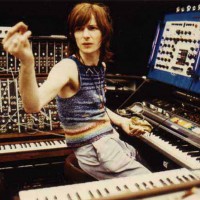
Composer, Performer – Sound & Light Artist since 1970 Tim has been based in France since 1971. One of Europe’s first synthesiser players, working as Crystal Machine, as well as collaborating with cult Space Rock bands
GONG & HAWKWIND
Tim’s attitude to electronics has profoundly marked the sound of electronic et rock music from the late ’70’s to this day, resulting in a discography of more than 25 titles, including 5 solo albums . Tim has greatly influenced the musiciens he has collaborated with, in particular
STEVE HILLAGE & JEAN-PHILIPPE RYKIEL
Light work with long-time partener PATRICE WARRENER, Has totally changed the world of Light Shows & Illumination, with the Introduction in the the very early ’70’s of LASER light in Crystal Machine performances, as well as the introduction of Giant Image projection, with the HOLD-UP Team as early as 1976. Tim continues to collaborate with Patrice on projects using his CHROMOLITHE POLYCHROMIC ILLUMINATION SYSTEM as well as on some Crystal Machine performances.
Despite beeing very seriously injured in a car accident in 2004, Tim, totally fit at last, is currently touring with HAWKWIND, (with whom he performs on Theremin and ‘Virtual Lead Guitar’) performing also as Crystal Machine, in particular with Jean-Philippe Rykiel, as well as participating in some of Europe’s major Light events , with Patrice.
Tycho shows off vintage synths
Wired Magazine has an article out featuring synth virtuous Tycho and a set of pictures of his most precious jems, here are two of them:
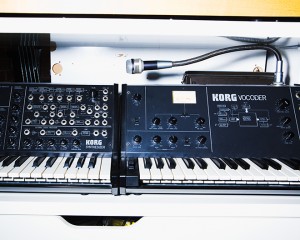
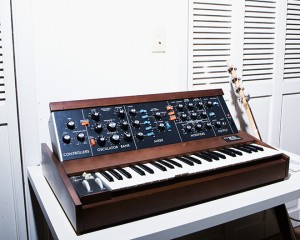
I guess these two are of no surprise to anyone 
Excerpt from the article:
Scott Hansen owns a lot of synthesizers. Moogs. Korgs. Obscure Italian synths from companies that don’t exist anymore. He loves them and protects them, because they make the music that makes him famous.
But whatever you do, don’t call Hansen, who performs under the name Tycho, a “synthesizer collector.”
Leading Wired.com through the basement studio here that houses his wares, Hansen lovingly showed off each item, but stressed that having so many synths isn’t about amassing fetish items — it’s about trying lots of machines in order to find particular sounds.
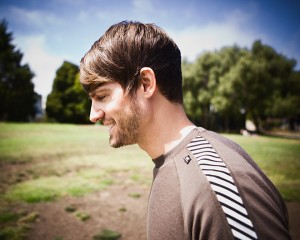
“I know it looks bad right now, but that’s why I have to get rid of some of them because there is some redundancy and waste here,” Hansen said. “I’d rather sell all of them than refer to myself as a collector. It seems sacrilegious. It’s wasteful if it’s not getting used because there are only so many of these in the world. Somebody else could put it to good use.”
That doesn’t mean there aren’t a few prized items Hansen, who is also a graphic designer under the name ISO50 (see his blog of the same name here), simply couldn’t live without. When making his latest album, Dive, which came out last week on Ghostly International, Hansen fell in love with the Minimoog and ended up using it to create many of the sounds on the record. He also used string synths to get the ambient, atmospheric vibes he was looking for.
Interview with Vince Clarke by MusicRadar
On line magazine MusicRadar has released an short interview with Vince Clarke, read it below:
Everyone reading this will know the name Vince Clarke, be it through his Depeche days, Yazoo years, The Assembly age or the ever ongoing Erasure era.
He is almost entirely responsible for a web of genres, still very much alive and well in 2011. Erasure havesold over 25 million records, and continue to be a household name 26 years after their formation.For the latest album, Clarke was working out of a synth paradise in Maine, New England and alongside Frankmusik in LA. Future Music spoke to Vince about changes in studio technology and the Erasure live show.
We love your Analogue Monologues at vinceclarkemusic.com. Was there ever a time you thought of taking all your kit on the road?
“Well, we used to but it was a nightmare. About six or seven years ago, I decided I would digitise the multi-tracks and record them into Logic to use live. We recorded individual tracks and I’d make my own stems from Logic.”
Is that what you’re using today?
“Yeah, Logic is running everything in real-time, all at the right tempos. For some stuff I’ve re-recorded the parts, just because I didn’t really like the original and there was timing discrepancies because it was the early days of sequencing. So I’ve corrected all that too. For Yazoo, because it was so early, I cut up every single sixteenth of a bar, of every sound, of every track and moved it back into time.”
Do you use Logic in the studio too?
“Yeah I use it in the studio – we’re making a new album at the moment and we demo everything in soft synths and then I convert all of the sounds to analogue with my synths.”
So what’s on the record will be 100% analogue?
“Well 50%. I’m working with Frankmusik at the moment, he’s a digital guy. Most of the drums are his samples and whether they’re digital or analogue I’ve no idea, but they sound great. I’m more interested in the music. I was using soft synths for a long time and was thinking they sounded pretty good but now that I’ve got my studio and can do an A-B comparison, it’s an incredible difference.”
Which soft synths are you into?
“I like all the soft synths that emulate old stuff, the Moogs, modular synths, [u-he] ACE is great but it’s still not as good. It’s the classic argument with CDs versus vinyl and I have a very good record player and if I listen to Dark Side of the Moon on vinyl and listen to it on CD, the vinyl is another level. It’s the same with analogue versus digital. Having said that, digital is so useful for writing and remixing. It’s immediate and it stays in tune. I use some of the Logic synths too, the ones that come built in. But at the end, for the fi nal recording, I’ll use my analogue synths and it’s the same on the new album.”
How did you end up working with Frankmusik on the new record?
“Well we were talking to a lot of people really, but he was just really enthusiastic and is a bit of a fan. We got on quite well, and I’m a fan of his work too. He’s so fast. It’s really nice to work with someone who’s young and that enthusiastic. Those are the best types of producers to work with – not the people that know everything, but the people that really love it. That’s an inspiration for me.”
Artist Interview: DJ Lucky Date
When Jordan Atkins-Loria (DJ Lucky Date) was introduced to Reason, he instantly recognized the potential of it’s synths and set about to master them. Originally following tutorials he found online, Lucky Date began making his own tutorials which showcased his penchant for modern electro dance synths in Reason. As his tutorials grew in popularity, so did his career as a DJ and Producer.
In just a couple short years, DJ Lucky Date has gone from making his first video tutorial to completing 4 dirty electro dance ReFill sound libraries, charting on Beatport, and massive club and festival gigs as a headlininer.
We met up with Jordan one night in LA where he had a few thousand Angelinos jumping and screaming at Avalon in Hollywood, CA. Before the show he walked us through some of the secrets to his massive sounds and even gave us the patches so we can share them with you all.
More about Propellerhead and Reason:
http://www.propellerheads.se
http://www.propellerheads.se/reason/
Download the patches from this video:
http://www.propellerheads.se/stuff/luckydate.zip
DJ Lucky Date’s Electro ReFills:
http://store.payloadz.com/results/results.asp?m=96514
Interview with Ladytron

Here’s a short interview with the electronic act Ladytron by EM: It makes absolute sense that Daniel Hunt’s “favorite record ever” is My Bloody Valentine’s 1991 album Loveless. Aside from the obvious fact that Hunt’s band is also a quartet comprised of two men and two women, Ladytron is like MBV for the electronic set: dense layers of synths rather than a shoegaze-y wall of guitars.
“I grew up listening to music that I could not fully understand,” Hunt says. “I like this kind of swell where you hear certain things and you’re not sure what they are, and you’re not sure what is connected to what.”
That isn’t to say that Ladytron is creating an amorphous sonic mess in the studio. Ten years after releasing their debut album, 604, Ladytron has learned a thing or two about maximizing space in the mix. With the band’s fifth full-length record, Gravity the Seducer, Hunt says they’re more cognizant of when to say when.
“I think we’re instinctively preempting those problems in the mix by not throwing too many bass-y mono synths and layers down there,” he says. “We’re just a bit more aware of what’s required than we used to be. With the first and second records, the mix engineer would be like, ‘You know, you put seven basses on here.’ And we’d go, ‘Okay, well it’s your job. You just make it work!’ We’re a bit more considerate now.”
While Ladytron dove into recording their previous two albums immediately after months on the road—thus creating an album that would easily translate to the stage—the band took a different approach to Gravity the Seducer. “We probably had about a year off from the road in which to write and prepare and had a clearer idea of what we wanted,” Hunt says. “It was refreshing to make a record without thinking about the accompanying tour. We didn’t care about it, so I think the record sounds freer and more coherent as a result.”
Alan Wilder interviewed at ElektroStat (Oslo) – Live DVD and Talk Talk cover album
Here’s a brand new interview with Alan Wilder at ElektroStat in Norway. You can also ready our interview with Wilder here that we made a couple of weeks ago, enjoy.
In a video interview with Side-Line Magazine in Oslo backstage during the ElektroStat festival, Alan Wilder has announced plans for a live film of the recent “Strange Hour” tour. The material was shot in Budapest at the end of last year in super HD and if all goes as planned the material should hit the stores in early 2012.
Alan Wilder also recorded two covers (and not just one: read also Talk talk tribute album featuring Alan Wilder (Recoil)) of Talk talk for an upcoming Talk Talk tribute album which should come out in Spring 2012. The covers are “Dum Dum Girl” (1984) and “Inheritance” (1988), the latter was recorded together with the UK-based dub poet Linton Kwesi Johnson. More details on these two covers can be heard in the interview video here or below.
And the revelations didn’t just stop there. During the interview Wilder also announced that he’s also doing a remix for Alessandro Cortini, an Italian musician best known for touring and recording with Nine Inch Nails from 2004 to 2008. Currently, Cortini is also the frontman for the Los Angeles based electronic-alternative band Sonoio and that’s the project Wilder made a remix for.
There is one more gig to come for Recoil at Sinner’s Day in Belgium at the end of October.
More ElektroStat reporting will be published in the next few days with pictures, audio, interviews and so on. As a teaser, here’s an impression of the Recoil set (or check below) and the excellent ambiance inside the venue, a lovely renovated factory in the center of Oslo.
Talk Talk’s “It’s my life”
A Portrait of Rhythm Droid
Mini-documentary about Rhythm Droid. Directed and produced by Devin Curry of Grand Atrium. Explore what makes Rhythm Droid tick as he works in the studio and offers some of his perspectives on electronic music production.
Photography by: www.chroniquesautomatiques.com
Worlds in a small room – interview with Steve Jansen (former member of Japan)
Steelberry Clones had the great opportunity to talk to Steve Jansen during his recent visit to Sweden. Steve Jansen was former percussionist in the legendary 1980’s new romantic act Japan (also featuring David Sylvian, Richard Barbieri and Mick Karn). After the band decided to quit in 1982 Steve has embarked on a long and successful journey, some times in collaboration with his brother David Sylvian on his solo albums, sometimes in more unknown appearances together with Japanese artists like Yukohiro Takahashi (YMO), but also driving more pop orientated endeavors with the Dolphin Brothers, which he started together with Richard Barbieri. Steve Jansen has at many occasions been dubbed as one of the most important percussionist of his time, and the characteristic sound that gave way for their all time selling album Tin Drum, has provided him with the opportunity to play with most of the leading artists since then. I wanted to know more on what has happened since then, his views on today’s music scene and the evolution of electronic music, as well as discovering his more recent works in the border lands between pop, ambient, arts and experimental music.
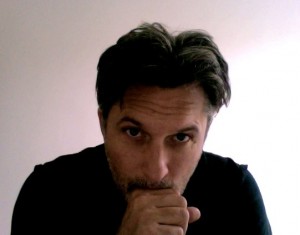
Today’s music scene
Steve Jansen is a highly productive musician, if it is not something on his own doing you will certainly find Steve in collaborations with David Sylvian, John Foxx, or as part of the band on tour with Ryuichi Sakamoto in Japan. So I asked Steve to give me an update on what he is up to right now and his collaboration with Sugizo.
Most recently Steve has been involved in finalizing Mick Karn’s new Dalis Car album, partly to keep his spirit alive, but also as a fund raising initiative for his relatives. Steve has therefore been active both as a mixer and performer of the new album and engaged in the process of reworking some of the new tracks. The yet untitled album is due out in the October – November time frame. As most of you know Mick Karn died recently and one of things that Mick Karn was doing at the time was to produce a new Dalis Car album. Dalis Car’s first album “The Walking Hour” released in 1984 was an interesting album where the borders between various musical styles were mixed to create a very unique album at the time. With Sugizo Steve recently contributed a rhythm track to a new recording, a track also featuring Mick Karn on bass.
With some thirty years as a musician, working across most prominent genres – as a new romantic pop star as part of Japan, to exploring the fields of ambient electronics and jazz fusion, to bridging the gap between modern art visuals and experimental music, it is highly relevant to ask Steve’s view on today’s music scene. Steve says that today’s scene is of course in many ways very different from back when he started his career. The power of the record companies put a lot of constraints and pressure on the bands to deliver on time, but also to make music in line with what they and the fans were requesting – “pleasing the record label almost became a means to an end”, Steve says. Today you have much more freedom to explore and the artists does not work under the same pressure. So although it is harder to make a living you are the one in control. With modern music technology you almost have endless possibilities to manipulate sounds and craft your own ideas – inside your head.
Back to Japan
You really cannot write about Steve without touching on the subject of Japan, both as a band and as the country where both David and Steve over the years has continued to find inspiration, collaborations and a solid fan base. When Japan ended as a band in 1982, (doing their last tour in Japan, followed by a live album), the band members ended up doing several projects on their own or in collaborations with each other.
I wanted to know how this fascination with Japan as a country came to shape their music going forward. Steve tells me that it has probably been more that they have all individually made their own subjective interpretations of the music. And although it was a strong influence on the Tin Drum album, Steve says that more recently it has been more important for him to embrace modern rhythms and electronic sounds, although that he has in his collaboration with Sugizo been working to incorporate the sounds of traditional Japanese Taiko drums.
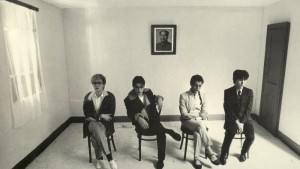
Steve and David Sylvian have over the years done several highly acclaimed albums where they have been exploring the boundaries of ambient, electronic and jazz. As a listener you can easily picture late night improvisations where Steve and David together with other musicians like Harold Budd and Robert Fripp, would jam together beautiful ambient landscapes. I wanted to know if this was an accurate image of the music production process and how the songs took their shape.
DATAMASKIN

