
Circuit bending – Coco Electrik Build
Circuit bent with 24 modifications + a new wooden framework and control interface. See the build here… http://www.cocoelectrik.co.uk/2011/12/s-cat-casio-mt40-build/
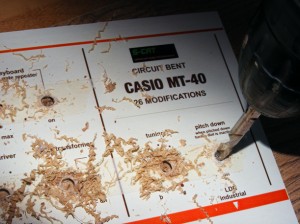
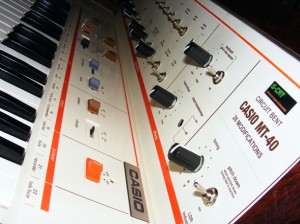
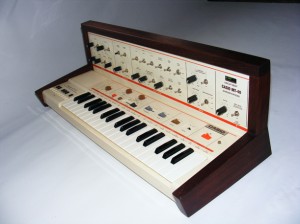
The Casio Casiotone MT-40 is a musical keyboard, formerly produced by Casio and originally developed for the consumer market. It is 9 voice polyphonic, with 37 main keys and 14 smaller bass keys. Eight notes may be played on the main keys, and one note on the bass. The bass section has one timbre, and the main section has 22, assignable to one of four presets. Like most small Casio keyboards, it also has a drum section with 6 different beats, a tempo knob, and a “fill” button. The fill button plays sixteenth note pulses of either the “snare” or “kick” as long as it is held down. Production started in the early 1980s and ceased shortly thereafter. The successor of the MT-40 came with a gray case, and was sold as the MT-41.
The keyboard is a prime candidate for modification through circuit bending, owing to simple circuits and a series of smaller potentiometers inside for factory adjustments, there are two examples of circuit bent units on Youtube, which have been built by S-CAT. The relative scarcity of these makes bending relatively risky, and most are left as stock.
The MT-40 had a built-in pattern based on the Eddie Cochran song “Somethin’ Else”. Because of this, a synthesizer version of the song’s bassline ended up as the basis of one of the most popular dancehall music riddims of Jamaican music – the Sleng Teng riddim which started the “Digital Reggae” revolution in 1985.
It has also secured a niche in indie music. It occurs occasionally in songs by The Magnetic Fields, and is featured prominently on most of Emperor X’s album Tectonic Membrane/Thin Strip on an Edgeless Platform. Its thin fuzz can be heard on lesser known Australian indie band Turnstyle’s top 20 single Spray Water On The Stereo. In the UK, The Farmer’s Boys, who were signed to EMI and beloved of John Peel, used it on a number of singles and album tracks – with an ironing board as a keyboard stand.
MiniMogue Demo (free Analog VST Synth using Savihost)
http://youtu.be/2cWN9Pl02ww
Alright, got a quick demo of the Minimogue free vst synth, one of the best as far as emulating the original Moog synthesizer.
“Let me know if you have any questions or would like to see more demos, thanks and enjoy!!”
Based on the most popular analog monosynth of all time! This amazing softsynth sounds very close to the original Minimoog, yet has tons of additional features not present on the original Mini (as well as the Minimoog Voyager!), including 5-note polyphony, an Arpeggiator and 16-note Step Sequencer, dedicated Release knobs for the two Contour Generators (envelopes), Tuning of Osc 1, Fine Tuning sliders for Osc2 and Osc3, Aftertouch control, adjustable filter Velocity curve, 3 independent Overdrive sliders (one per oscillator), Global Overdrive with hi and lowpass cutoff, Oscillator Sync, Chorus, an independent LFO that includes oscillator drift and stereo panning, and a fully programmable Digital Delay! Like the original Mini, you can turn Osc3 into an LFO with dedicated modulation for the Osc Pitch and the Filter. There is no dedicated Noise Generator as on the original Mini, but pink and white noise are selectable on Osc 3. All controls are mapped to MIDI CC#’s, and you can override the default settings by using the MIDI Learn feature. Use as a simple stand-alone synth (.exe file included), or copy the DLL into your favorite DAW or sequencer’s plugin folder.
By the way you can also find an emulation of the ARP 2600 on the same page:
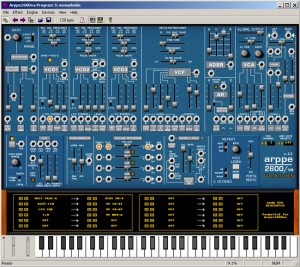
Based on ARP’s legendary semi-modular analog monosynth! This amazing softsynth sounds very close to the original ARP 2600. Like the original, it’s a monosynth (no polyphony). But, also like the original, it has a multitude of Frequency Modulation options which enable it to create some truly awesome sound effects. PWM, Sample & Hold, virtual Spring Reverb, Ring Modulation, and a dedicated Noise Generator are all there! Also, there are some things even the original Arp 2600 didn’t have, like Oscillator Sync and Filter Color (to adjust between LowPass and HiPass filter types). Most important of all, beginning with version 2.0 the Arppe2600va is now completely patchable via a cleverly designed Mod Matrix! You can have up to 12 patch routings with a very user-friendly (and visible!) drop-down menu interface, instead of messy virtual patch cables cluttering up the screen. All controls are mapped to MIDI CC#’s, and you can override the default settings by using the MIDI Learn feature. Use as a simple stand-alone synth (.exe file included), or copy the DLL into your favorite DAW or sequencer’s plugin folder.
Ableton releases Puremagnetik Retro Synths 1980s

Ableton has released Retro Synths 1980s, a new Partner Instrument by Puremagnetik.
In the 1980s, analog synthesis entered a new stage, with the debut of classics like the polyphonic Roland Jupiter series and the revolutionary frequency modulating Yamaha DX7. Puremagnetik has meticulously multisampled these synths to create a brand new Partner Instrument: Retro Synths 1980s. Packed with 39 Instrument Racks made up of nearly 2,000 samples, this is an essential collection.
The originals from the 1980s don’t come cheap (or, in many cases, easy to program), but Puremagnetik has captured the fire in these classics, and made it available in Retro Synths 1980s. Featuring the cream of the crop of Puremagnetik’s library, Retro Synths 1980s boasts meticulously multisampled synthesizers that behave like the originals. With 38 Instrument Racks and one Drum Rack, made up of nearly 2,000 samples total, this is an essential collection indeed.
Retro Synths 1980s features
- Juniper — a rich collection of expertly crafted instruments based on Roland’s legendary Jupiter series of analog synthesizers.
- SixVoice — classic pure analog patches from the Korg PolySix synthesizer.
- Vespine — finely tailored instruments that fully capture the charm of the EDP Wasp synthesizer.
- DeeEx — instant 80s FM synthesis based on the famous Yamaha DX7.
- Phazeform Vol. 2 — the captivating sounds of the Casio CZ-1 and its unique phase distortion synthesis.
Retro Synths 1980s for Ableton is available to purchase for 29 EUR until January 15, 2012 (25% off regular price of 39 EUR).
RP Predator Introduction
Rob Papen Predator introduction.
Showing the power of Predator its user interface. Also a good starting point for working with Predator.
Predator is a “phat sounding” killer synthesizer that combines inspiring presets and first-class features to make this your ‘go-to’ synth for contemporary music production.
The user interface has been designed so that almost all controls are visible on screen, making it fun and incredibly easy-to-use. And if you’re unsure about a particular synth function, simply right click your mouse to access the help screen.
Predator is packed with powerful features such as Preset Quick Browser, Preset bank mananger, Preset Morphing, Intelligent Preset Variation, MIDI and Synth Controllable FX, Unison Detune, Chord Memory and an extremely versatile Arpeggiator.
Included preset banks: HipHop (NY, Club, DirtySouth and Gfunk) banks. Jump, hardcore, breakbeat, various Trance styles, DnB banks. Hardcore dance, House, SFX banks and much more…
Last but not least …Predator also includes PredatorFX, allowing you to use the incredible filters, modulations, effects and vocoder as an FX plug-in within your music host.
Predator 1.6 is out now with even more presets included klangMedium “Ambient bank/Downbeat bank” and JoMal bank.
Time machine – ROLAND SH-5 Analog Synthesizer 1976
Time for a new vintage synth to enter the stage, this time it is the classic Roland SH-5
The Roland SH-5 from the year 1976 is a excellent, serious analog synth from Roland. It has the beautiful early Roland sound. The SH-5 is equipped with almost everything what you could wish from a analog monophonic synth:
2 VCOs, 1 resonant multimode filter (highpass/bandpass/lowpass), 1 resonant bandpass filter, 2 LFOs, Sample & Hold, ring modulator, oscillator synchronisation, noise generator (white and pink noise), ADSR and AR envelopes. Also there is a nice signal mixer with routing capabilities.

More details below:
The SH-5 is a classic yet very advanced monophonic synthesizer rivalled mainly by its successor, the SH-7. The SH-5 has just about two of everything. There are two analog VCOs with triangle, ramp, square and pulse waveforms, two LFO’s, two filters, two VCA’s, white and pink noise generators, and more.
The oscillators can be modulated by the LFOs or the ADSR envelope generator. The two LFOs include controls for rate and waveshape: ramp, reverse ramp, triangle, sine, square, delay; and there is also a Sample + Hold feature. The two multi-mode filters include hi-pass, low-pass, and band-pass filtering with cutoff, resonance, keyboard tracking, envelope sensitivity (AR, ADSR or preset) and modulation (ramp, sine, square, s+h) controls plus an additional band-pass-only filter. The two VCAs offer Attack/Release and ADSR envelopes which can be triggered by the Sample + Hold, LFO #2 or an external audio trigger input.
Extra features include the standard SH-type Mixer section with 5 sliders to adjust noise, VCO1, VCO2, ring mod and an external signal levels. Each of these 5 signals can be individually sent through the VCA, the multi-mode filter, the band-pass filter or both. The SH-5 even has stereo output with panning controls in the VCA section and portamento! The Ring Modulator alone is enough to wet your appetite for this synth. A serious analog mono-synth with lots of flexibility for creating serious electronic and dance music.
Free Ableton Live Device – Christmas Tree Synth
AfroDJMac is gearing up for Xmas  so here’s a little treat from him
This week I created an Ableton Live synth especially for Christmas. My Christmas tree has lights that play little Christmas songs, so I sampled the sounds coming out of its tiny little speaker and created this instrument for Ableton Live. I hope you enjoy it!
Download the Live Instrument: http://bit.ly/freesynth39

I just put up my Christmas tree and put on some lights that play Christmas songs. The songs are comprised of very simple monophonic melodies, coming out of a tiny little speaker, but as soon as I heard it I was transported back to my youth sitting around the tree late at night. Naturally I had to sample it. So I put my AKG C3000 right up to the speaker and let it play. I selected four different notes to use in the instrument. The lights only play notes ranging just over an octave, so there’s not a lot of choice. From there I placed it into an Ableton Live Device Rack and went to town. I put some reverb and delay in a separate rack, inside the main instrument, to allow you to mix in some space without drowning out the original note. There’s an arpeggiator hooked up to the macro knobs, as well as Sampler’s Shaper control for some added grit. The different samples can be played all at the same time, three at the same time, two at the same time or just one, if you are a purist like me. I’ve also looped one of the samples so that you can play the instrument with some sustain; the original notes are just short bleeps and bloops. The result is a very lo-fi quaint little synth, but at least for me, it has a lot of charm.
Pulsate for Android
Out now in the Android Market: https://market.android.com/details?id=de.despudelskern.application.pulsate
Pulsate allows you to use geometry to create melodies straight from your Android device. Pulsate’s simple, organic functionality lets you explore a world where sounds and shapes are inextricably linked. Pulsate will keep you hypnotised for hours, you will never make the same melody twice!
Interview with Necro Facility at ElectriXmas 2011
We start of the live reporting from the Swedish electronic music fest ElectriXmas, that took place this weekend, with an exclusive interview with Necro Facility.

Necro Facility consists of Oscar Holter, who writes the music and plays all the instruments, the vocalist Henrik Bäckström, who also writes all the lyrics and finally Cristopher Hedström a session player. The band started in 2001 when both Oscar and Henrik were in the Swedish “Högstadie”, 14 and 15 years old. They released their first demo in february 2001. They released 2 more demos before getting signed to Progress productions. They released their debut “The black paintings” in 2005.

Make sure to follow our coming reports from ElectriXmas over the course of the next few days, including acts like Tyske Ludder and Hocico
We do apologies for the bad sound on the live on stage performance parts in this video
Find out more about ElectriXmas by clicking the logo below:
Vangelis CS80 sound from a moog little phatty …finally!
“Working on the moog for a while, didn’t like it at first, vary raw and growly..:) trying to tame it”
Originally created on a Yamaha CS-80, it’s been mimicked on just about every synth released.
Here, mik300z, who’s a master at ‘reverse-engineering’ iconic synth sounds, improvises with his take on the iconic sound, recreated on a Moog Little Phatty, with the help of the ‘Hall’ reverb preset on a Behringer mixer.
Yet another app gets the “i” – iOrgan
Let’s perform a lead organ!
While pushing the keyboard, sound continues sounding eternally.
Ten kinds of tones can be chosen.
Moreover, two or more sound is sounded simultaneously and an effect like a pipe organ can perform easily.
The tone of a lead organ can be created.
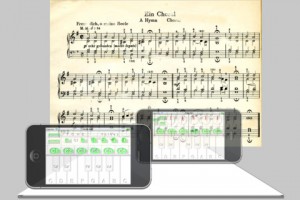
Operation
tone
– Ten kinds of sound can be chosen with plus and a minus button.
voices
– Sound two or more sound simultaneously.
C1~C6
– Specify the range of the pitch of a keyboard.
scale
– Choose the display of a pitch, and un-displaying.
manual(Auto)
– Create the tone of an organ by a pitch and volume.
It returns to the original screen by Auto.
DATAMASKIN

