
Audiobus Demo at the London Mobile Music Makers meet
A brief video of part of the demo from tonight’s demo of audiobus.
What’s the difference between Audiobus and Virtual MIDI?
Virtual MIDI is a local communications channel for passing around MIDI messages like “C# 1, Velocity 127“, or “Modulation, 50” – simple messages that control how a synthesizer should generate audio. Audiobus is a communications channel for sending live audio, like the audible output of a synthesizer app, or the output of a guitar amp effects app, for example.
Time machine: ROLAND JUNO-6 Analog Synthesizer 1982
“This is the Roland Juno-6 (or: who stole the programmer on my Juno-60?). The sound and the sound architecture is identical to the Juno-60. But the highpass filter of the Juno-6 is infinitely variable, whereas on the Juno-60 you can choose from 4 settings.
I played the Juno-6 dry without any additional effects.”
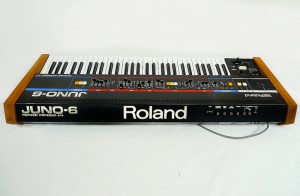
The first in a series of amazingly affordable quality synthesizers from Roland’s amazing Juno family! The Juno-6 is a six voice polyphonic analog synthesizer! It’s a very stable synth thanks to its digitally controlled analog oscillators. The Juno-6 sounds great, however it lacks basic necessities like MIDI control and patch memory storage.
The next generation Juno-60 version added 56 patches of memory storage. Both of these synths sound virtually the same and are considered by many to sound better (punchier) than the popular follow up, the Juno-106. The Juno-6 and 60 are very rich sounding synthesizers and are great analog machines as long as you can overlook the absence of MIDI control. Of course nobody can deny that the wooden side panel look is a true sign of Vintage status!
Time machine: PPG wave 2.2 synthesizer – “Dark Voices”
all sounds self-programmed: PPG wave 2.2 Wavetable Synthesizer from the year 1982
recording: multi-track without midi
fx: a little bit delay and reverb
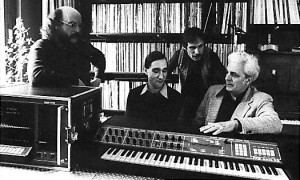
The German made PPG (Palm Products GmbH) Wave 2 series of synthesizers are incredibly great sounding analog/digital hybrid vintage synths. They use digital samples of wavetables and feature analog VCA envelope and VCF (filter) sections for a classic and warm sound. The Wave 2.2 has oscillators that can generate over 2,000 different single-cycle 8-bit digital waveforms! Covered by knobs, the Wave still looks analog and this comprises the “Analog Control Panel”. More complex and new-wave editing of the wavetables and samples is covered by the “Digital Control Panel” where there are several key-pad buttons and an LCD screen. Another familiar treat to analog junkies is the inclusion of an 8-track sequencer which features automation of pitch, loudness, filter cutoff, waveforms and more. A cool feature – its onboard sequencer will also record any filtering and wave changes, in real-time!!
The more commonly encountered Wave 2.3 followed the 2.2 and had enhanced sample-playback capabilities. The sampler was pretty full-featured for its time and included upgraded 12-bit digital waveforms, Fourier analysis and linear playback of samples. The 2.3 model also featured 8-parts multitimbrality and MIDI implementation. The PPG Waves are know to create excellent pads, brass and bass sounds.
In fact it was Tangerine Dream who helped the company and the Wave develop. 1978 saw the development of the PPG Wave Computer 360. But the Wave Computer sounded harsh and tinny. In 1981, the PPG Wave 2 was released which added analog VCF and VCA filter and envelopes to warm the digital sound. The original Wave 2 had 8-voice polyphony, like the 2.2 and 2.3, but it had only one oscillator per voice. The 2.2 offered two oscillators per voice which opened up a whole new realm of sonic possibilities because two separate wavetable sounds could now be combined.
more info: http://www.retrosound.de
Ladytron member Helen Marnie to release Marnie solo album
Helen Marnie, main vocalist of the electronic band Ladytron, has made a solo album. Recorded in Reykjavik, Iceland the album is untitled so far. Expect an electronic album with more of a pop element and ‘pristine’ vocals.
The release will be out via Pledge Music.

Note that it seems that Marnie has taken the occasion to hold a real boot sale as the packages hold several things which you wouldn’t really expect when buying an album. Or what did you think of getting a designer dress or a bikini she wore, or … a Rover Mini Cooper from 1998. The latter is yours for 5000 UK Pound.
FL Studio Mobile 2 | What’s New?
More info here – http://www.image-line.com/documents/news.php?entry_id=1348098765&title=fl…
Features include:
Audio tracks – Import WAV/MP3/AAC/AudioPaste & iPod library.
Wave editor – Cut, trim, normalize, reverse, fade in/out
Multi-tracking – Up to 8 track simultaneous recording
FL Studio Mobile HD – Now a Universal App
iPad retina display – Supported
Dropbox – Export to Dropbox. Import from Dropbox App.
Library – Amped Guitar & Bass pack in the shop
ZIP – Export improved to include all custom instruments, audio recordings and the project
NOTE: To load an FL Mobile 2 projects in FL Studio for Windows you will need FL Studio 10.8 or higher. In addition to use the Amped expansion you will need to delete the existing FL Mobile Samples folder, from the Shared Data folder (C:\Program Files\Image-Line\Shared\Data\FL Mobile Samples) then re-download it from the content library.
Where’s ANDROID will it EVER happen?! Yes. see here…
http://www.youtube.com/watch?v=6kPX5xTPRKU&feature=plcp
Mode Machines SID Preview Video + xoxbox MK2
Background details for this video below:
Hello ladies and gentlemen,
we received many messages because of the first preview video for the new “SID”.
Here we want to present the new product preview video in combination with the top seller “xoxbox MK2”.
We work real hard to present the new SID as soon as possible.
The product video is coming real soon..
If there are any questions, please send us an e-mail: info@modemachines.com
More informations @:
www.modemachines.com
Using Absynth to Morph Sound Waves
In this video tutorial sound design course designer/instructor Evan Sutton, explores the sonic capabilities of “morphing waves” in Native Instruments’ Absynth software.
“Evan Sutton is one of Dubspot’s esteemed instructors by day and a sonic alchemist by night with his Astrolith (Space is the Place) music project which employs wobbling, funky bass lines under pitch-modulated vocals and synths. In this new video, Sutton shares his creative process of “adding a counterpoint” to his signature wobble using Native Instruments’ Absynth instrument. “At the core of this sound is the morphing wave. This is a really cool feature that Absynth has, and one of the only places where additive synthesis is used in Native Instruments’ Komplete (aside from Reaktor library instruments),” explains Sutton. In this tutorial he uses Logic as a DAW, but also explains that the process for using Absynth is exactly the same if you use Ableton or another DAW.”
Modular synths: Don and Rob
Buchla 223e as keyboard/controler for a Rob Hordijk System.
I tuned the 223e output voltage to use it as 1/V Oct keyboard.
Works great!
Percussion from Buchla and Hordijk. Lead is a HRM into Filter into the Phaser.
M83 ‘Steve McQueen’ Official video
Official video for ‘Steve McQueen’ by M83, taken from the album ‘Hurry Up, We’re Dreaming’. The video is the winner from the competition run in partnership with Genero TV. The now released video is a companion piece to the music video created for the previous single “Midnight City”. The video continues the story of a group of children with various psychic abilites as they are pursued by their shadowy handlers in an attempt to recover them. As with the previous music video, the artists have cited Akira as a major source for their inspiration.

The ‘Steve McQueen’ single is now available to pre-order on iTunes with a full release on on 25th November, featuring remixes by Maps, SALM, BeatauCue and Alluxe: http://smarturl.it/m83stevemc
Directed by Balthazar Auxietre & Sylvain Derosne
Editor – Balthazar Auxietre
Animation – Sylvain Derosne
The child – Augustin Clerc
Produced with the support of Manuel Cam Studio
Luftrum 9 – Soundbank for DIVA
Luftrum 9 is a soundbank for DIVA set to release in start November. The soundbank contains cinematic pads, gentle arpeggios and synth emulations inspired by Tangerine Dream, Vangelis, Royksopp, Kraftwerk, Jean Michel Jarre, William Orbit etc. but also a few soundscapes, sound effects and strings found their way to the soundbank. 2/3 of the soundbank are pads and arpeggios – so it’s pad arp haven. Since DIVA doesn’t contain an arpeggiator yet, all arpeggios in the YouTube audio demo were made with the Kirnu Arpeggiator – which is free to download.
DATAMASKIN

