
Time machine: Synth solo with the analog vintage Roland SH 2000
Solo with the analog, one VCO mono synth, Roland SH-2000.
Pad: Oberheim OBXa
EFX: Roland DEP-5
Reverb: Sonar
Live played and recorded by magevers 04-11-2012
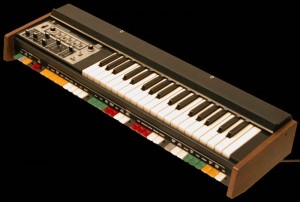
The SH-2000, introduced in 1973, is Roland’s second synthesizer and is essentially a limited version of the SH-1000. Like the 1000, it is a single-oscillator monophonic analog Preset synthesizer designed to sit atop a home organ. It’s got a great old analog sound but its lack of edit-ability and connectivity compared to the SH-1000 is what ultimately holds it back from being really great. (Perhaps Roland wanted to simplify it for the target demographic at the time – churches and casual home organists.)
Below its 37-note keyboard are several colorful tab switches which are used to select any one of its 30 Preset sounds. They range from the usual to the unusual: Tuba, Trombone, French Horn, Trumpet, Saxophone, Bassoon, Oboe, Flute, Clarinet, Cello, Violin, Bass Guitar, Hawaiian Guitar, Banjo, Fuzz Guitar I, Fuzz Guitar II; Piano, Harpsichord, Accordion, Vibraphone, Xylophone; Singing Voice, Song Whistle, Popcorn, Space Reed, Planet, Frog Man, Funny Cat, Growl Wow and Wind.
Left of the keyboard are the only editable controllers available on the SH-2000. They include the filter’s cutoff, resonance and modulation sliders, LFO modulation rate, portamento, vibrato, pitch bend, volume and master tuning. The filter and LFO are severely limited and there are no ADSR envelope controls. However, the cool ‘Growl’ and ‘Wow’ effects and the Random Note Generator from the SH-1000 are here, which is nice. Amazingly, this 1973 synth has aftertouch, called the ‘Touch Effect’ which can be assigned to modulate the volume, Vibrato, pitch, ‘Wow’ and ‘Growl’ effects. A few other drawbacks to the SH-2000 is the total lack of CV/Gate for external communication and no user memory.
The SH-2000 is great for squeaky effects and growling bass notes. However the SH-1000 offers much more flexibility and a better sounding filter.
Roland MC-505 / MC-303 Promo Video revitalized
Here is a video Jordan Passmore created using segments of a Roland promo video they released sometime in the late 90’s.
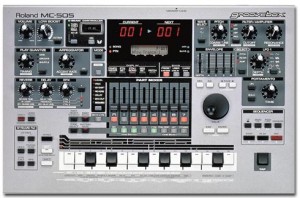
An all in one techno music production studio, this machine has it all. A massive collection of professional and coveted electronic synth and drum sounds, effects, built-in real-time VCF and envelope knobs for tweaking, a sequencer/arranger, and many other great additions. This is the successor to the MC-303 and is now much more advanced. Its sounds will be familiar to any techno-head.
The LFO and resonant filters allow quick and easy sound manipulation. The new D-Beam allows you to randomly tweak your sounds by passing your hand over an infrared beam! It has a great sequencer for building your songs (with groove quantizing and part level faders for mixing) as well as many idea catchers like the phrase sampler and arpeggiator.
This is an all-in-one music machine that’s great for DJ’s or anybody else who wants to create slamming dance tracks. Designed as a stand alone machine, they do not work quite as well when incorporated into a multi-synth keyboard rig. It’s perfect for beginners and advanced users, but offers the most possibility to those who will use it exclusively. By the way, in comparison to the MC-303, this is far better especially in the quality and quantity of sounds!
Time machine: Exploring the Moog Source, Minimoog and Roland JD-800
A voyage into the heart of the Moog Source from the year 1981.
Exploration by Marko Ettlich
monophonic analog synthesis 2 VCO I Saw, Square, PWM,
Filter – 24dB lowpass
sample/hold
step sequencer, arpeggiator
and more
A voyage into the heart of the Moog Minimoog from the year 1970.
Exploration by Marko Ettlich
monophonic analog synthesis 3 VCO I Saw, Square, Spaced Saw, Pulse,
Filter – 24dB lowpass
44 keys, single-trigger, low-note priority
A voyage into the heart of the Roland JD-800 from the year 1991.
Exploration by Marko Ettlich
rom sample based digital synth
24 voices
6 part multitimbral
multimode filter, lfo
61 keys with velocity and aftertouch
Time machine: ROLAND JUNO-6 Analog Synthesizer 1982
“This is the Roland Juno-6 (or: who stole the programmer on my Juno-60?). The sound and the sound architecture is identical to the Juno-60. But the highpass filter of the Juno-6 is infinitely variable, whereas on the Juno-60 you can choose from 4 settings.
I played the Juno-6 dry without any additional effects.”
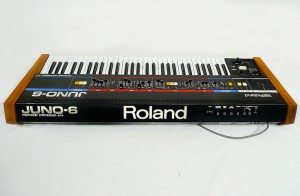
The first in a series of amazingly affordable quality synthesizers from Roland’s amazing Juno family! The Juno-6 is a six voice polyphonic analog synthesizer! It’s a very stable synth thanks to its digitally controlled analog oscillators. The Juno-6 sounds great, however it lacks basic necessities like MIDI control and patch memory storage.
The next generation Juno-60 version added 56 patches of memory storage. Both of these synths sound virtually the same and are considered by many to sound better (punchier) than the popular follow up, the Juno-106. The Juno-6 and 60 are very rich sounding synthesizers and are great analog machines as long as you can overlook the absence of MIDI control. Of course nobody can deny that the wooden side panel look is a true sign of Vintage status!
Jordan Passmore Demo of the Roland JX-10, Roland SH-2, Akai MPC-60
This is a demonstration of two Roland analog synths, a JX-10 and a SH-2, combined with the sequencer/sampler the MPC-60. The MPC-60 is loaded with Linn LM-1 samples (courtesy of ToneBldr, http://www.drivenmachinedrums.com ) and is also sequencing the JX-10 and SH-2. The SH-2 is doing the bass while the JX-10 is doing the melody; Jordan is playing lines over the melody on the JX-10 occasionally. All sounds are mixed on a StudioMaster mixer and there is an analog delay (Washburn Accellerator) on one send and a EH HolyStain on another.
“The MPC-60 is sort of out of shot so near the end I bring the camera around to show what I’m doing with that.”
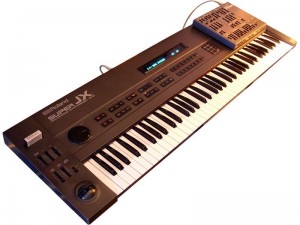
Released in 1985 the JX-10 (Super JX) combines two individual JX-8P’s for an outstandingly warm, rich and analog sound which is still used in many modern studios all over the world. This synth was the first Roland Synth to be fitted with a quality 76 note keyboard with velocity and aftertouch. Two DCO’s per voice, two ADSR envelope generators per voice, and a resonant lowpass & non-resonant highpass filters are only the beginning. It has a 12 voice polyphony for a total of 24 oscillators and it is by far one of the most programmable synths of its time! However, as on the JX-8P, knobs and sliders have been replaced by low-profile buttons and a nice LCD display. Although this may look sleek and elegant, it makes editing a chore. Assign parameters to the alpha dial for tweaking, one at a time, or get the optional PG-800 Programmer to provide traditional, hands-on, dedicated sliders for editing the JX-10’s parameters.
The JX10 has a Chorus effect and a chase-play Delay function. The chase-play function allows programmable delayed repeats of voices by alternating patches of the upper and lower modules. The simple chorus effect is either off, slow or fast. It has two programmable sliders (if you don’t use the PG-800) for some real-time control which can be recorded along with other effects and keyboard modes into one of the 64 Program Patches. This is in addition to its standard 50 preset and 50 user patch memory. A simple sketch-pad 1-track real-time sequencer is also on-board. It stores sequence data directly to an M16C card, or an M64C card for Patch/Tone OR sequence data. The M16C has a capacity of 400 notes, the M64C 1440, according to the manual.
The JX-10 also comes in a rack-mount version known as the MKS-70. It’s worth noting that the JX-10 can not be edited via SysEx, however the MKS-70 can which is one reason many have chosen the rack version of the keyboard. The JX-10 can make bulk dumps of its sounds over sysex, but only with (discontinued) Roland M64C RAM cartridges.
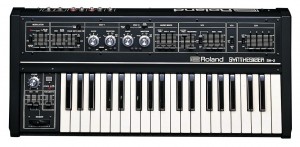
The SH-2 is one of Rolands’ early synthesizers. It is very simple in design, look and function. It sounds much like the SH-101 synth, including the typical SH-style sub-oscillator. But the SH-2 employed 2 oscillators for a much fatter sound. It has the typical Roland SH sound – it’s a monophonic bass synth that’s flexible enough to provoke punchy analog basses, leads and squelchy sounds. The oscillators can be de-tuned as well, another feature the popular SH-101 lacks. But it isn’t very pretty to look at as it shares the same design and layout as the SH09. Still it makes a simple and easily programmable mono-synth that can be used in place of the more common SH-101. However the SH-2 is harder to find and so it usually has a higher price than other SH-type synthesizers from Roland.
Roland Synth Story Tour
Roland has come a long way since its inception in 1972. Its synths, drum machines and effects have been used on some of the most famous records ever and have helped artists push sonic boundaries, creating new sounds and even radical new musical genres. Taking part over three dates in November, the Roland Synth Story tour will explore this rich history through a roster of artists and experts. Roland says that it’s an exciting opportunity for visitors to learn more about the company’s synths, speak to three musical icons and even get their hands on some classic Roland vintage gear.
The panel of experts, including Richard Barbieri (Porcupine Tree and Japan), Graham Massey (808 State) and Jody Wisternoff (Way Out West) will all talk about their experiences creating electronic music as well as discussing their favourite Roland synths. They’ll also be on hand to answer questions and chat to visitors after the event. All three guests are intrinsically linked to the history of the synthesizer. Richard Barbieri’s first ever synth was the Roland System 700, and he’s never looked back. His band, Japan, notched up numerous hits in the ’80s and they became a cornerstone of the influential synth-pop movement.
Graham Massey infamously named his band ‘808 State’ after the famous Roland TR-808 drum machine, which – along with the TB-303 – was an essential component to the way the band produced their music.
Jody Wisternoff uses a stable of Roland synths, including the Juno-106 and the legendary Jupiter-8, to make progressive house and breaks as one half of Way Out West. Their music didn’t just hit the charts, it also found its way into TV shows and video games.
Guests will also have the chance to get their hands on some rare and ultra-covetable Roland gear, including the following: Jupiter-8, Juno-60, Jupiter-6, Jupiter-4, Juno-106, JX-8P, D-50, JD-800, JV-1080, JP-8000 and XV-5080.
Dates and Venues
- 26 Nov. – The Roland Music Academy, Walsall College, Walsall
- 28 Nov. – The Roland Music Academy, Ealing, Hammersmith & West London College
- 29 Nov. – Huddersfield University, Huddersfield
Pricing and Availability:
Free but spaces are limited and demand is high (two tickets per person)
More information:
Eurythmics – Sweet Dreams (Are Made Of This) – Get That Sound
The title track from 1983’s Sweet Dreams (Are Made Of This) album has one of the most instantly recognisable synth riffs around. There have been many different theories about the synths used on it, but the consensus seems to be that either an Oberheim OB-X was used for both the left and right riffs, or perhaps a Juno-6 and Roland SH-09 for the left and right channel riffs, probably sequenced using a Roland CSQ-100.
I guess asking Eurythmics themselves wasn’t an option 😀
Introducing the powerful LuSH-101 multilayer synthesizer
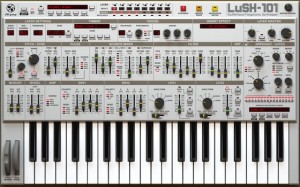
D16 Group has announced the availability of LuSH-101 (formerly known as SHIOITOR), the long awaited authentic sounding virtual synthesizer for Windows and Mac.
LuSH-101 is a synthesizer created from modules that can be found in many modern virtual synthesizers, all combined into a single compact and logically intuitive design. This basic simplicity combined with its multilayer architecture turns it into an easy-to-use but extremely powerful instrument that can be programmed and tweaked quickly.
The multilayer architecture guarantees that both the sound design possibilities and number of unique situations in which LuSH-101 can be used are virtually limitless. Any combination of keyboard splits, layers, and multitimbrality is possible with just a single instance of LuSH-101. Each layer working as an independent synthesizer with its own polyphony, parameters, enhanced arpeggiator, and a palette of eight insert effects.
LuSH-101 comes complete with a powerful built in mixer, complete with layer-independent parametric equalizers, compressors and three send effects: reverb, delay and chorus.
Innovative oscillator algorithms developed by D16 Group make LuSH-101 sound exactly like a sampled hardware analog synth. Filters with constant resonance across the entire frequency domain has natural warmth and character.
A generous factory library contains more than 1600 presets of every type, while intuitively designed preset browser keeps everything organized and easy to locate.
LuSH-101 for Windows and Mac (32 & 64bit VST/AU) is available to purchase for 149 EUR/$199 USD/£119 GBP incl. taxes (if applicable). LuSH-101 is now also included in the Total Bundle. Discounts are available to registered product owners from their User Area at the D16 Group website.
Vocoder exploration: Alesis, Clavia, Digitech and Roland
1.Alesis MetaVox
2.Clavia Micro Modular
3.Digitech Talker
4.Roland SVC 350
carrier Flame Talking Synth Modul
input Moog Freqbox quartet
CP251
Buchla System #1
Doepfer 2x A132-3
4ms Peg RCD VCAMatrix
Make Noise Format Jumper Wogglebug
Roland System 104 Sequencer
Kenton Pro 2000 II
Kick Logic Ultrabeat
FX Boss VF 1 Line6 Echopro Lexicon PCM 80 TC M3000
Bruno Ender Lee: Return to the Pleiades
BRUNO ENDER LEE – “Return to the Pleiades” – performed live, October 14. 2012
MacBeth M5N & Doepfer MAQ-sequencer, Synthesizers.com Studio-88, ARP Odyssey, MiniMoog Voyager OS, Moog Little Phatty, Analogue Solutions Vostok, Korg Polysix, Korg DS-8, Korg MS2000, Roland Juno-60
2012 Velvet Voyage Productions, all rights reserved
DATAMASKIN

