
Exploring Crumar Toccata
Founded in the late ’60s/early ’70s by Mario Crucianelli, Crumar was an Italian company that became very famous in its time mainly by their synths, keyboards and organs (both in compact or not so compact models). Mario was brother from Pierro Crucianelli, president of Elka – another very well known Italian company. Crumar existed until 1987 and the company’s golden age was in the second half of the ’70s, when they put on the market their “Pianoman” and “Stringman” models (1974) and later the model that combined the two machines in one, the “Multiman” model (1977). Even with this machines achieving a great reputation on the market, for me Crumar’s coolest instruments are the “Hammond organ clones” made from 1974 on which had a great sound, very close to Hammond organs, but much more compact and easier to carry than the originals.
The Crumar Toccata organ was released in 1981 as a more compact version of all previous models of these “Hammond clones”, more specifically the model T1/C (whose main difference was having one extra octave – higher than the Toccata’s four octaves – and drawbars, like that ones from Hammond organs). The Crumar Toccata organ was manufactured until 1986.
SONAR X2 Overview
Curious about the new version of Sonar, then check this video out for a quick intro:
From getting great tone to releasing a final mix, today’s musicians must master every element of the music production process. SONAR X2 Producer is there every step of the way, and the revolutionary Skylight interface lets you move seamlessly among the elements, instantly going from recording to editing to mixing and back again.
Dial up the perfect synth sound with Rapture or a searing guitar tone with TH2 Producer. Record it, tighten it, chop it, and drop it in the Matrix for realtime triggering. Shape it with the ProChannel. Warm it with the Console Emulator. And do it all with a single Smart Tool.
New experimental EP: Celebrates the BBC’s Experimental Stereo FM Broadcasts

Absolutely fabulous 
It was 50 years ago this week when the BBC began broadcasting regular experimental stereo FM broadcasts. While the musical climate and how we get our music has changed considerably since then, there’s no doubt the BBC’s influence on all subsequent media, and recording artists, has been tremendous, especially the far-out sounds that came from its Radiophonic Workshop. To commemorate this anniversary, our very own Tim “Love” Lee (Two For Tennis, Tuesdays at 4pm ET) pays tribute to the BBC’s wild side with Test Signals—a limited-edition EP of electronic strangeness on Lee’s Tummy Touch imprint featuring the help of Tara Busch, Jack Dangers and Si Begg. Stream the EP below, then head here to pick up one of the 150 copies of the 7”, which includes a download featuring bonus remixes from the likes of Sonic Boom, Depth Charge, Kirk De Giorgio and others.
Listen here:
Space music: S.P.O.C.K – First ever promotional video from 1996
If you are into glittering and bleepy synth pop, here’s a nice treat for you all.
This was the first promotional video made for Swedish spacepop group S.P.O.C.K. It contains footage from some of the TV-shows the band appeared in 1996:
1) “All ETs Aren’t Nice (A.R.M. Mix)” – Fritt Fall, SVT2, Sweden
2) News At Night, MTV Europe
3) “Astrogirl” – MC, SVT2, Sweden
4) News At Night (with excerpts from “Astrogirl” and “Strange Dimensions”, MTV Europe
5) Sydnytt, SVT, Sweden
Enjoy
Beatmaking with iMaschine and Ableton Live
Video details below:
http://www.pointblankonline.net/ In the next 3 episodes in our ‘Making Music with Apps’ series Danny J Lewis shows you how you can put together professional sounding tracks on the move. In this tutorial he starts off with the beatmaking using Native Instrument’s iMaschine.
This approach is all about making the most of the unique qualities of each app and recording the results into Ableton as audio clips. The advantage is that you are committing the sound that you have made to audio so there is no temptation to endlessly fiddle with the synth parameters or the intricacies of the midi patterns and you can get on with the task of arranging the parts to make that banging tune that your 8 bar loop had promised!
Go to: http://www.pointblankonline.net/courses/ableton-live-courses.php to find out how you can learn more about using Ableton Live as a recording tool. Please get in touch with our course advisors at advice@pointblankonline.net if you want to find out more.
New iPad Controller For Reason
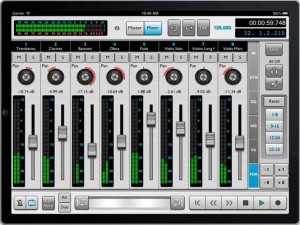
Harmony Systems, Inc. has announced the worldwide availability of Delora rsTouch, an iPad application that offers control surface functionality for the Propellerhead Reason music application on a Mac or PC. rsTouch emulates Reason’s Mixer and transport functions, allowing nearly complete operation of Reason’s transport controls and Main Mixer from the iPad.
rsTouch works with Reason 6.5 or higher, Reason Essentials 1.5, or Record 1.5 installed on a Mac or Windows PC. It supports either “wired” MIDI connections using an iPad compatible USB MIDI interface, or “wireless” MIDI connections using iOS compatible network MIDI. Reason control surface support files are required and are available free from the Delora website.
rsTouch expands the Delora Software line of music controller apps for iOS devices, including lpTouch for Logic, gbTouch and gbRemote for GarageBand, and vKiP and vKi for Kyma.
Record and mix songs, mute or solo any channel during playback. Channel fader meters, master volume meter, and “Big Meter” provide visual feedback to monitor audio levels. Set start and ending loop points and navigate through the song with the jog strip. Know where you’re at with the timecode and bar-beat display, and channel name and number identification.
Sound setting and level adjustments are made easily with large, multi-touch, color-coded rotaries and faders. rsTouch’s seven screens offer the ability to edit send effects, insert parameters, and EQ settings, as well as adjust channel, pan and dynamics levels. A dedicated Master screen allows full adjustments of Reason’s Main Mixer master section.
rsTouch is available for $9.99 (USD) on the iTunes App Store.
More information:
Quick Roland TR-808/Juno-60 Demo
New video from Jordan featuring the TR808 and a JUNO 60, description below:
Here is a quick demo of my Roland TR-808 and Roland Juno-60. No effects were used. They were both mixed on my mixing board and sent straight to my soundcard (Native Instruments Kore). The 808 is doing it’s thing and sending a pulse to the Juno’s Arp In jack. This video was done mostly to demo the Juno-60’s sound while in this mode (Youtube has a suspicious lack of videos demonstrating this). I consider this to be one of the best features of the Juno. It’s incredibly fast to build basslines and song structures this way. From start to about 3:40 I am kind of tweaking the 808 to get a drum pattern that feels right. From 3:40 on it is mostly improv lines on the Juno while the 808 rolls along.
Test run of the Tinytenori
A test run for the iConnect midi interface using Tenori-On and TouchOSC on the iPhone to control Tinysizer.
One layer of the Tenori-On controls a bass sequence using one of Tinysizer oscillators. TouchOSC provides a virtual joystick controlling Tinysizer’s second oscillator. The joystick needs more work (rescaling) because its really too sensitive at present.
Drum sounds are a custom set I made from the DrumDokta module by Din Sync. No other sound sources involved.
Best on good headphones or speakers.
Magellan and Cassini – iPad Show
This week Sonic State takes a look at the new update to Animoog and hooking up class compliant devices for MIDI and audio connectivity. Then they check out two new synth releases
Yonac – Magellan and Icegear’s Cassini
Featured Apps:
Animoog – innovative Moog synth at a price $29.99/ £20.99
Magellan- complex analog modelled synth $4.99 / £2.99
Cassini – clean, tabbed synth $4.99 /£2.99
Hosts
Gaz Williams – Songsurgeon.co.uk
Nick Batt – editor sonicstate.com
Real mobile music studio :: test jam!
Background information:
welcome to my house/mobile studio! just giving her a test jam out! hope you enjoy! Everything played live and fully improvised, no sequencing or loops were used.
http://www.noisyvagabond.com
DATAMASKIN

